Women Helping Women is deeply concerned by the Ohio Supreme Court decision that may allow individuals with certain domestic violence-related convictions to seek restoration of firearm rights.
Every day, we work alongside survivors whose lives have been forever changed by violence, coercion, threats, and intimidation.
We know from decades of experience and extensive research that access to a firearm in a domestic violence situation increases the risk of homicide by 500%.
While the Court’s decision addresses a legal question regarding the interaction of state and federal law, we must not lose sight of the human impact. Survivors deserve to know that their safety remains the highest priority in our communities and justice system.
Domestic violence is not a private matter. It is a public safety issue. Firearms can turn moments of fear into moments of irreversible tragedy.
Women Helping Women remains committed to advocating for policies and practices that prioritize survivor safety, hold offenders accountable, and reduce the risk of future violence. We encourage policymakers, law enforcement leaders, victim advocates, and community stakeholders to carefully consider the implications of this decision and its potential impact on survivors and families across Ohio.
Our message to survivors is simple: We see you. We believe you. We stand with you.
Anyone experiencing relationship abuse, stalking, sexual assault, or domestic violence can contact Women Helping Women’s 24-hour crisis line for confidential support and resources.
The Women Helping Women help line is staffed 24/7. If you are currently experiencing abuse, please call or text 513-381-5610.
Women Helping Women is heartbroken by the mass shooting in Shreveport and the lives impacted by this tragic act of violence. Our thoughts are with the victims, their families and the entire community.
While the details continue to unfold, the broader reality is that violence often intersects with patterns of domestic violence. Addressing that violence requires not only response, but prevention – through coordinated, community-based approaches that identify risk early and intervene before situations escalate.
Programs like the Domestic Violence Enhanced Response Team (DVERT), developed in Cincinnati and now expanded across 39 jurisdictions in Hamilton County, brings together domestic violence advocates and law enforcement as advocates rapidly respond 24/7 on-scene after 911 DV calls. This model is designed to disrupt cycles of domestic violence and create paths to safety before tragedy occurs. Since its launch in 2018, DVERT has responded to more than 11,000 survivors and their 10,000+ children with zero domestic violence homicides.
Violence does not delay. Nor can response.
Women Helping Women remains committed to expanding access to lifesaving resources and working toward a future where communities are equipped to recognize and respond to violence before it turns deadly.
If you or someone you know needs support, we are here to help 24/7 at (513) 381-5610.
BRAVE Peer Educators are part of a preventative program that educates Xavier’s campus on bystander intervention, healthy relationships and everything that falls under the umbrella of gender- and power-based violence. Although BRAVE effectively cultivates a safer campus that does not tolerate violence in any capacity, Xavier and every other university cannot promise that gender- and power-based violence will not happen, as it is most prevalent on college campuses. It will be a long and treacherous road to end the cycle of sexual violence on college campuses, so it is vital to know the resources that Xavier offers to survivors in case you or someone you know is affected by gender or power-based violence.
One of the first steps a survivor of gender or power-based violence can take is to contact the Campus Advocacy Coordinator (CAC), Susan Pelle. The CAC’s role is to provide confidential support, and they will not share any personal information with the university without the student’s consent.
The CAC provides immediate support, which can include just listening, providing options for the survivor to take so that they can make an informed decision that is best for themselves, and also ongoing support. Immediate relocation to a safe place and permanent housing relocation is also a support option.
The CAC also lets students know their rights, other campus resources, academic outreach to professors, medical and counseling referrals and legal referrals if the student decides to take legal action.
Medical support can include referrals, accompanying survivors to medical exams, testing and treatment and as accompaniment to the ER for a sexual assault exam. Safety planning is also included and can entail all of the steps needed to recreate a safe environment.
If a student is looking for more confidential on-campus resources, the Peer Support Volunteers are another great option. Xavier’s Peer Support Volunteers are a group of trained peers that provide confidential, trauma-informed support services for survivors. They also host survivor support groups and workshops centered around how to support a friend who is affected by gender-and power-based violence.
Other confidential resources on campus include the Center for Faith and Justice’s Abby King-Kaiser, Counseling Services and Psychological Services. After-hours support is also available through texting or calling Women Helping Women’s 24-Hour Crisis Line at 513-381-5610. A confidential advocate will be available to speak with, and for 24-hour confidential online chat support, visit womenhelpingwomen.org and select “Live Chat.” This resource serves all gender identities and sexual orientations.
Although non-confidential resources on campus may seem daunting to a survivor, these resources are also private, and the information stays between university officials and the survivor.
Kate Lawson and Talia Mason are a part of the Title IX & Interpersonal Violence Response office and can be contacted if a survivor wants to report the instance of violence they experienced. Title IX’s office oversees ensuring that student’s rights are protected and that sex discrimination does not have a place at Xavier. BRAVE Peer Educators can also provide non-confidential, immediate support to those who disclose to them, and will also direct them in making informed decisions about what comes next.
These resources are here at Xavier to let students know that they are not alone and that the university will do everything it can to make sure survivors feel supported. These resources are also here for friends and family of survivors and those who receive disclosures as well. Support for the community around survivors is equally as important. Most importantly, Xavier’s resources set the standard that the cycle of sexual violence on college campuses will not be perpetuated by ignorance. We hear you, we see you and we believe you.
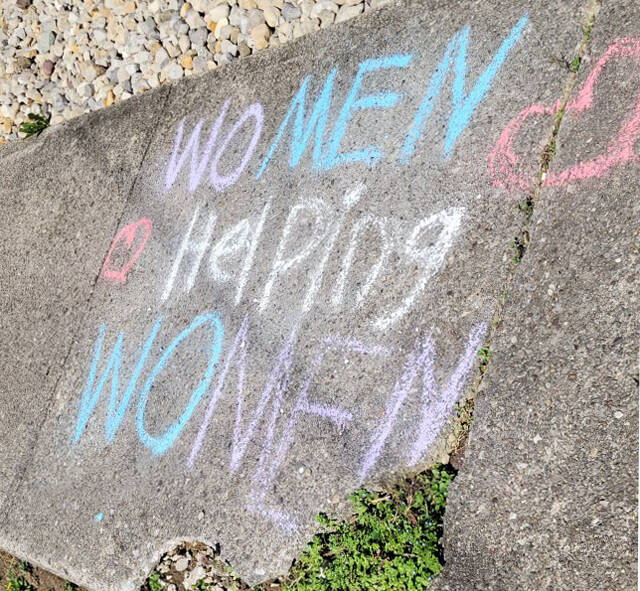
Once again this year for Sexual Assault Awareness Month (April), Women Helping Women asked local businesses and agencies to participate in the “Chalk the Walk” Event. The task was simple: April 13 and 14 chalk the sidewalk at your establishment with a note of encouragement to survivors of sexual assault.
This has been a very successful campaign in Adams and Brown Counties the last few years, led by Davina Cooper, the Rural Program Manager for Women Helping Women. Women Helping Women provides local court and hospital accompaniment, one-on-one crisis counseling, operates a 24-hour hotline and currently offers virtual support groups. They expanded their sexual assault services to both Adams and Brown Counties in January of 2017. All services are free and confidential. Davina Cooper can be reached at (513) 262-1788.
Weather made it challenging, but was nothing compared to the challenges survivors face. If you or someone you know are in need of services please do not hesitate to reach out on our 24/7 hotline which also now features a text to chat option. (513) 381-5610
Over 20 local agencies and businesses participated in “Chalk the Walk” including: Adams County Board of DD, Adams County Homeless Shelter, West Union High School, Mosier’s Furniture, Blake Pharmacy, Shelton Law Office, Ohio Country Properties: Huff Realty, Venture Productions Inc., Raven Perch Tattoo Studio, DC Engineering & Consulting, West Union Electric & Plumbing, FRS, Tan & Tone and Creative Spark Studio.
Whether you’re searching for woman-to-woman mentorship or looking for an outfit to help ace your next job interview, these five local organizations have your back.
IMAGE COURTESY STOKKETE VIA ADOBESTOCK
Women Helping Women
Serving women in Hamilton and Butler counties, WHW works to prevent gender-based violence and empower survivors through crisis intervention and support services ranging from a 24-hour hotline and hospital accompaniment to legal advocacy and professional training. The organization serves more than 15,000 clients each year and provides sexual violence crisis services to women in Brown and Adams counties.
This mental health collective offers individual, women-focused therapy delivered by licensed clinical psychologists and behavioral health experts in a positive, comprehensive environment. Join one of the collaborative’s “Thrive Circles,” small groups that gather regularly for eight-week sessions to work through a variety of topics, from burnout and body peace to postpartum life and coping with chronic illness.
Through individualized, one-on-one mentorship and programming, this Mason-based organization aims to lift single, low-income mothers out of poverty. More than 90 percent of the 100-plus moms who have graduated from the multi-year program remain financially self-sufficient.
Dignity and respect—that’s the promise made to each woman at Dress for Success, the local nonprofit that has provided workwear to tens of thousands of job-seeking Cincinnati women since its founding in 1999. The interview outfitting StyleHER program remains a hallmark of DFS, but the organization has broadened its services to include career development programming for unemployed and underemployed women.
Our chapter of the world’s oldest and largest multicultural women’s organization provides a wide variety of programming and assistance programs to help women thrive. More than 900 professionals have been honored as part of the YWCA’s Rising Star Leadership Program, a five-month program shaping the city’s future leaders in gender and racial equity.
Sheila Ruf had filed a protection order in Campbell County Court in mid-January, alleging Eric Lightfoot would hit and kick her, often coming in drunk and saying he was “going to kill her.”
NEWPORT, Ky. — Court documents show one of the women killed in a double homicide in Newport had previously filed a protection order against the man accused of murdering her and her friend.
Eric Lightfoot, 59, was charged with two counts of murder after police found 59-year-old Sheila Ruf and 61-year-old Diana Eddy dead inside a home on Ann Street March 16. A prosecutor said the two women were beaten to death, found after a property manager let officers in for a wellness check.
Ruf had filed a protection order in Campbell County Court in mid-January, alleging Lightfoot would hit and kick her, often coming in drunk and saying he was “going to kill her.” One week later, police said Lightfoot violated the order by showing up at her home.
Court documents show Ruf dismissed the protection order one month later.
About one month after Ruf dismissed the order, Eddy texted her daughter, telling her she was with Ruf and a man was there. Eddy said the man “might do something crazy.” Her daughter called police the next day, but officers could not get into the home. Three days later, they found Eddy and Ruf dead.
Kristin Shrimplin, president of Women Helping Women, said she believes the case highlights a disturbing trend of domestic violence.
“Domestic violence is a public health epidemic, that’s the bad news,” Shrimplin said. “One out of three women are experiencing this type of violence in their lifetime.”
Women Helping Women helped 7,500 survivors in Hamilton, Butler, Adams and Brown County in 2021. Shrimplin said that number is just the “tip of the iceberg.”
“That’s the message for all of us to hear loud and clear,” Shrimplin said. “If anyone ever discloses violence to you, please tell them immediately you’re not alone. It’s not your fault. I believe you. If you want it, there’s help available.”
Ruf’s niece said her aunt loved life and everyone she was around, her family remembering her by her caring smile.
If you are a victim of domestic abuse, you can call your local police department or contact Women Helping Women’s 24/7 hotline at 513-381-5610.
In working to continually find better ways to prevent and respond to cases of sexual harassment, assault and misconduct, the University of Cincinnati is adding to the range of options it already offers in the form of advocacy, training, prevention and resources related to
In an agreement between UCs Division of Student Affairs and Women Helping Women (WHW), the community organization is providing two full-time, on-campus, confidential advocates to provide comprehensive support to those who have or are experiencing (or have witnessed) gender-based violence, such as sexual assault, domestic violence or stalking.
Starting in this new role on Oct. 20 is Courtney Harchaoui. She can be reached by stopping by 559 Steger Student Life Center, at 513-556-4418, or via e-mail at [email protected]
Starting as a second confidential advocate on Nov. 1 as part of the same agreement is Susan Pelle. She can be reached by stopping by 559 Steger Student Life Center, at 513-556-4418, or via e-mail at [email protected]
These advocates will provide confidential services that are focused on the survivor and include individual crisis intervention, hospital accompaniment, campus reporting assistance, accompaniment through Title IX and law enforcement or legal processes, assistance with campus-based accommodations, referrals for health and wellness services, and assistance with interim measures. While primarily focused on serving all students, the advocate will also be available to campus faculty and staff as well.
In addition to these full-time, on-campus advocates, the Women Helping Women hotline is available 24/7 at
513-381-5610
the WHW hotline.
Our new advocates, to be dedicated to serving the campus community, will provide confidential support for students. We believe survivors, and we support survivors. The advocate’s role is to listen to the survivor, outline options, link survivors to services that they want and to focus on empowerment,” said Kristin Smith Shrimplin, president and CEO of WHW.
According to Debra Merchant, vice president of UCs Division of Student Affairs, students need a variety of support options, and this new partnership with WHW provides another confidential support on campus, in the same way that there are counselors in UCs Counseling and Psychological Services who specifically provide assistance to survivors of sexual assault or harassment.
She stated, this adds to what we can provide to students. Some of the support is what we call confidential (like that offered by a counselor or this advocate). Some of it is what we call non-confidential or of public record, like going to UCPD. In order to provide the best service, its important to provide these confidential options as well.
Other Title IX News:
With the start of the new school year, UC expanded prevention options with new bystander training.
With the start of the new school year, UC has developed a Support Services Coordination Team to bring together all those addressing gender-based violence and sexual assault.
UC has added two Title IX investigators and recently hosted (on Aug. 15-16) a level one Title IX investigator training session, led by the Association of Title IX Administrators.
Annually, incoming UC students take ‘Think About It’ online training highlighting the role alcohol often plays in terms of sexual assault. That training also focuses on accountability and consequences, laws and policies governing sexual assault.
The new offerings add to those already available to students, including confidential medical services, UCPDs victim services coordinator, and UCs Counseling and Psychological Services Center 24/7 service to students in crisis due to sexual harassment, misconduct and assault. For a complete list of resources, visit UCs Title IX site.
Kristin Smith Shrimplin is the president and CEO of Women Helping Women, an agency that serves all survivors of sexual assault, stalking and domestic violence in Hamilton and Butler counties.
The story about a Stanford University student who committed sexual assault caught national and local attention. But this is not a new narrative. This is a story that is very worn out. As the leader of Women Helping Women, I am unapologetically angry at the repetitive nature of this story. It’s 2016, and our nation, our communities and our campuses remain besieged by rape culture. This is an epidemic, and it is time for radical change.
Let’s start by changing the narrative. Media: Please tell us the stories of all of the actions and the words of the male friends of Brock Turner who went to the party with him. Tell us about how they stepped in at every point that he and any other individual targeted a woman for domination and control. Tell us about what Stanford University taught Brock Turner and all of its students about consent culture during first-year orientation. Tell us what Brock Turner’s father told him as a young man going off to college about how to respect women’s autonomy. Tell us what the teachers taught Brock Turner in middle and high school on prevention of sexual violence. Tell us what Brock Turner’s swim coach taught him when he was 8 years old about character, integrity and being a true champion.
Brock Turner (right) makes his way into the Santa Clara Superior Courthouse in Palo Alto, California, on June 2. He received a six-month jail sentence for raping a young woman.
Tell us. We will listen. But no one can tell us those stories because no one can find those headlines. The headlines can’t be reported because that’s not what happened that night or at all the points in time before that night. This is what is happening:
98 percent of rapists never see a day in jail or prison.
1 out of 3 women are sexually assaulted or physically abused in their lifetime.
1 out of 4 girls experience sexual assault before the age of 18.
A rapist’s father complains about his son’s sentence of 6 months of prison for “20 minutes of action,” and the woman raped must live with the impact of the trauma for the rest of her life.
In 2015, WHW responded over 15,000 times to the hospitals, to the courts, to the hotline, to support groups, and to one-on-one crisis intervention to serve survivors in Hamilton and Butler counties alone.
In the first quarter of 2016, WHW hit a record of responding over 4,000 times to survivors.
Let’s change the narrative by changing what we tell women and girls. Men: Be brave and talk to your sons, grandsons, nephews and friends about sexual assault, rape and consent culture. Promote prevention. Listen to the women and girls in your life. When women and girls tell you their stories, stand beside them with full support and model the Stanford survivor’s powerful words:
“… to girls everywhere, I am with you. On nights when you feel alone, I am with you. When people doubt you or dismiss you, I am with you… you are important, unquestionably, you are untouchable, you are beautiful, you are to be valued, respected, undeniably, every minute of every day, you are powerful, and nobody can take that away from you. To girls everywhere, I am with you…”
Let’s change the narrative and unite as a community to combat this violence. This public health epidemic demands attention as if it were toxic, lead-laden water in our public pipelines. Policymakers, institutions, universities, and community members: Let’s work together to dismantle immaterial language that describes a rapist. Individuals who commit sexual violence make a decision to commit a crime to victimize and violate another individual. It is immaterial that a rapist is an athlete with a promising swimming career who can no longer enjoy a steak because of the crime he committed. These irrelevant words serve as a manufactured smokescreen that takes us away from the real story.
The real story is that the rape culture violates our community’s ability to thrive. WHW trustees, advocates, prevention educators, volunteers and survivors call for a “forever cure” to this public health crisis. All leaders, supporters and major institutions must intensely use their influence and resources to shine a light on a crime that hides in the dark behind dumpsters. Humans are not trash.
We can no longer dismiss this issue as merely a “women’s issue.” This is a human rights issue in which humans are stripped of their autonomy and self-agency of their very own bodies. Sexual assault is a crime – a debilitating, soul-stripping crime. And now is the time to change it all: Change the media’s framing of the narrative. Change the judicial institutions’ response. Change patriarchy. Change oppression. Change apathy. Change the system.
WHW believes in the radical notion that all of our community members deserve to thrive in a culture of accountability, prevention and consent. Let’s all be “upstanders” and build that community together to support survivors and promote prevention.
This mode enables people with epilepsy to use the website safely by eliminating the risk of seizures that result from flashing or blinking animations and risky color combinations.
Visually Impaired Mode
Improves website's visuals
This mode adjusts the website for the convenience of users with visual impairments such as Degrading Eyesight, Tunnel Vision, Cataract, Glaucoma, and others.
Cognitive Disability Mode
Helps to focus on specific content
This mode provides different assistive options to help users with cognitive impairments such as Dyslexia, Autism, CVA, and others, to focus on the essential elements of the website more easily.
ADHD Friendly Mode
Reduces distractions and improve focus
This mode helps users with ADHD and Neurodevelopmental disorders to read, browse, and focus on the main website elements more easily while significantly reducing distractions.
Blindness Mode
Allows using the site with your screen-reader
This mode configures the website to be compatible with screen-readers such as JAWS, NVDA, VoiceOver, and TalkBack. A screen-reader is software for blind users that is installed on a computer and smartphone, and websites must be compatible with it.
Online Dictionary
Readable Experience
Content Scaling
Default
Text Magnifier
Readable Font
Dyslexia Friendly
Highlight Titles
Highlight Links
Font Sizing
Default
Line Height
Default
Letter Spacing
Default
Left Aligned
Center Aligned
Right Aligned
Visually Pleasing Experience
Dark Contrast
Light Contrast
Monochrome
High Contrast
High Saturation
Low Saturation
Adjust Text Colors
Adjust Title Colors
Adjust Background Colors
Easy Orientation
Mute Sounds
Hide Images
Hide Emoji
Reading Guide
Stop Animations
Reading Mask
Highlight Hover
Highlight Focus
Big Dark Cursor
Big Light Cursor
Cognitive Reading
Virtual Keyboard
Navigation Keys
Voice Navigation
Accessibility Statement
womenhelpingwomen.org
October 17, 2026
Compliance status
We firmly believe that the internet should be available and accessible to anyone, and are committed to providing a website that is accessible to the widest possible audience,
regardless of circumstance and ability.
To fulfill this, we aim to adhere as strictly as possible to the World Wide Web Consortium’s (W3C) Web Content Accessibility Guidelines 2.1 (WCAG 2.1) at the AA level.
These guidelines explain how to make web content accessible to people with a wide array of disabilities. Complying with those guidelines helps us ensure that the website is accessible
to all people: blind people, people with motor impairments, visual impairment, cognitive disabilities, and more.
This website utilizes various technologies that are meant to make it as accessible as possible at all times. We utilize an accessibility interface that allows persons with specific
disabilities to adjust the website’s UI (user interface) and design it to their personal needs.
Additionally, the website utilizes an AI-based application that runs in the background and optimizes its accessibility level constantly. This application remediates the website’s HTML,
adapts Its functionality and behavior for screen-readers used by the blind users, and for keyboard functions used by individuals with motor impairments.
If you’ve found a malfunction or have ideas for improvement, we’ll be happy to hear from you. You can reach out to the website’s operators by using the following email
Screen-reader and keyboard navigation
Our website implements the ARIA attributes (Accessible Rich Internet Applications) technique, alongside various different behavioral changes, to ensure blind users visiting with
screen-readers are able to read, comprehend, and enjoy the website’s functions. As soon as a user with a screen-reader enters your site, they immediately receive
a prompt to enter the Screen-Reader Profile so they can browse and operate your site effectively. Here’s how our website covers some of the most important screen-reader requirements,
alongside console screenshots of code examples:
Screen-reader optimization: we run a background process that learns the website’s components from top to bottom, to ensure ongoing compliance even when updating the website.
In this process, we provide screen-readers with meaningful data using the ARIA set of attributes. For example, we provide accurate form labels;
descriptions for actionable icons (social media icons, search icons, cart icons, etc.); validation guidance for form inputs; element roles such as buttons, menus, modal dialogues (popups),
and others. Additionally, the background process scans all the website’s images and provides an accurate and meaningful image-object-recognition-based description as an ALT (alternate text) tag
for images that are not described. It will also extract texts that are embedded within the image, using an OCR (optical character recognition) technology.
To turn on screen-reader adjustments at any time, users need only to press the Alt+1 keyboard combination. Screen-reader users also get automatic announcements to turn the Screen-reader mode on
as soon as they enter the website.
These adjustments are compatible with all popular screen readers, including JAWS and NVDA.
Keyboard navigation optimization: The background process also adjusts the website’s HTML, and adds various behaviors using JavaScript code to make the website operable by the keyboard. This includes the ability to navigate the website using the Tab and Shift+Tab keys, operate dropdowns with the arrow keys, close them with Esc, trigger buttons and links using the Enter key, navigate between radio and checkbox elements using the arrow keys, and fill them in with the Spacebar or Enter key.Additionally, keyboard users will find quick-navigation and content-skip menus, available at any time by clicking Alt+1, or as the first elements of the site while navigating with the keyboard. The background process also handles triggered popups by moving the keyboard focus towards them as soon as they appear, and not allow the focus drift outside it.
Users can also use shortcuts such as “M” (menus), “H” (headings), “F” (forms), “B” (buttons), and “G” (graphics) to jump to specific elements.
Disability profiles supported in our website
Epilepsy Safe Mode: this profile enables people with epilepsy to use the website safely by eliminating the risk of seizures that result from flashing or blinking animations and risky color combinations.
Visually Impaired Mode: this mode adjusts the website for the convenience of users with visual impairments such as Degrading Eyesight, Tunnel Vision, Cataract, Glaucoma, and others.
Cognitive Disability Mode: this mode provides different assistive options to help users with cognitive impairments such as Dyslexia, Autism, CVA, and others, to focus on the essential elements of the website more easily.
ADHD Friendly Mode: this mode helps users with ADHD and Neurodevelopmental disorders to read, browse, and focus on the main website elements more easily while significantly reducing distractions.
Blindness Mode: this mode configures the website to be compatible with screen-readers such as JAWS, NVDA, VoiceOver, and TalkBack. A screen-reader is software for blind users that is installed on a computer and smartphone, and websites must be compatible with it.
Keyboard Navigation Profile (Motor-Impaired): this profile enables motor-impaired persons to operate the website using the keyboard Tab, Shift+Tab, and the Enter keys. Users can also use shortcuts such as “M” (menus), “H” (headings), “F” (forms), “B” (buttons), and “G” (graphics) to jump to specific elements.
Additional UI, design, and readability adjustments
Font adjustments – users, can increase and decrease its size, change its family (type), adjust the spacing, alignment, line height, and more.
Color adjustments – users can select various color contrast profiles such as light, dark, inverted, and monochrome. Additionally, users can swap color schemes of titles, texts, and backgrounds, with over seven different coloring options.
Animations – person with epilepsy can stop all running animations with the click of a button. Animations controlled by the interface include videos, GIFs, and CSS flashing transitions.
Content highlighting – users can choose to emphasize important elements such as links and titles. They can also choose to highlight focused or hovered elements only.
Audio muting – users with hearing devices may experience headaches or other issues due to automatic audio playing. This option lets users mute the entire website instantly.
Cognitive disorders – we utilize a search engine that is linked to Wikipedia and Wiktionary, allowing people with cognitive disorders to decipher meanings of phrases, initials, slang, and others.
Additional functions – we provide users the option to change cursor color and size, use a printing mode, enable a virtual keyboard, and many other functions.
Browser and assistive technology compatibility
We aim to support the widest array of browsers and assistive technologies as possible, so our users can choose the best fitting tools for them, with as few limitations as possible. Therefore, we have worked very hard to be able to support all major systems that comprise over 95% of the user market share including Google Chrome, Mozilla Firefox, Apple Safari, Opera and Microsoft Edge, JAWS and NVDA (screen readers).
Notes, comments, and feedback
Despite our very best efforts to allow anybody to adjust the website to their needs. There may still be pages or sections that are not fully accessible, are in the process of becoming accessible, or are lacking an adequate technological solution to make them accessible. Still, we are continually improving our accessibility, adding, updating and improving its options and features, and developing and adopting new technologies. All this is meant to reach the optimal level of accessibility, following technological advancements. For any assistance, please reach out to


 By
By