
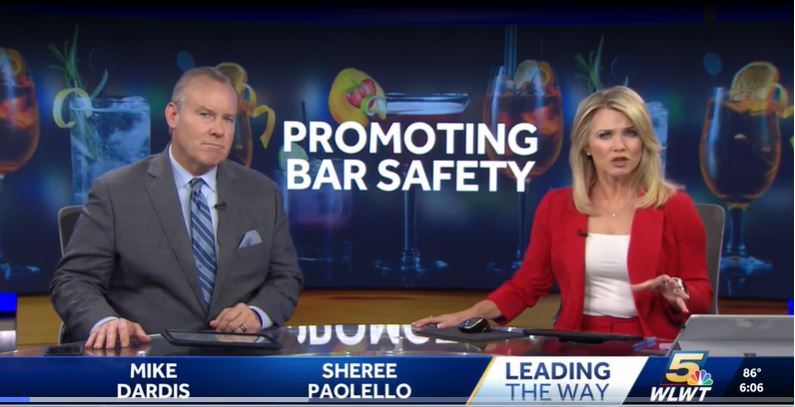
WLWT News 5 anchors Mike Dardis and Sheree Paolello on set discussing a "Promoting Bar Safety" segment, with a graphic showing cocktail glasses in the background.July 3, 2025, WLWT5

Women Helping Women, a Cincinnati-based nonprofit focused on ending gender-based violence, is offering its Brave Bar training to bar staff throughout the region. The two-hour, evidence-based program teaches employees how to recognize red flags, de-escalate risky situations, and step in when something doesn’t feel right.

Northside Tavern is among the first bars to complete the training and proudly displays the program’s poster outside its entrance.

“We’ve been here 23 years,” said owner Edward Rush. “It’s not just about the music and the drinks. We’ve always tried to create a space where everyone feels comfortable, especially women.”

Rush said the partnership with Women Helping Women was a natural fit. “We met up with Conor, and it was perfect.”

That’s Conor Jameson, a prevention educator for the organization. Jameson says the goal is to empower bar staff with tools to keep both patrons and employees safe, especially in environments where alcohol is involved.

“Alcohol is involved in 50 to 71 percent of sexual assaults,” Jameson said. “That means alcohol is strategically being used to make people vulnerable.”

In addition to in-person training, Women Helping Women also provides bars with discreet tools like code words and safety posters to help customers signal for help. Staff is taught to intervene when they see signs of power and control being exercised in a harmful way.

“The strategies that we offer really focus on ‘Where are you seeing power and control, and how can you shut that down?” Jameson added.

But it’s not just about protecting patrons.

Amber Malott, vice president of Women Helping Women, says the training also supports bar staff, especially in an industry where 71% of workers report experiencing sexual harassment.

“We’re not asking bartenders to be investigators,” Malott said. “We just want them to have the knowledge and information.”

She added, “It’s not only just for patrons to feel safe, but it’s also for folks working in this industry to be aware that their employer has their back.”

Bars interested in the Brave Bar training can sign up here.

If you or someone you know is experiencing abuse, help is available. Call or text Women Helping Women’s 24-hour crisis hotline at 513-381-5610 for immediate, confidential support.

By Hannah Thompson, BRAVE Peer Educator

BRAVE Peer Educators are part of a preventative program that educates Xavier’s campus on bystander intervention, healthy relationships and everything that falls under the umbrella of gender- and power-based violence. Although BRAVE effectively cultivates a safer campus that does not tolerate violence in any capacity, Xavier and every other university cannot promise that gender- and power-based violence will not happen, as it is most prevalent on college campuses. It will be a long and treacherous road to end the cycle of sexual violence on college campuses, so it is vital to know the resources that Xavier offers to survivors in case you or someone you know is affected by gender or power-based violence.

One of the first steps a survivor of gender or power-based violence can take is to contact the Campus Advocacy Coordinator (CAC), Susan Pelle. The CAC’s role is to provide confidential support, and they will not share any personal information with the university without the student’s consent.

The CAC provides immediate support, which can include just listening, providing options for the survivor to take so that they can make an informed decision that is best for themselves, and also ongoing support. Immediate relocation to a safe place and permanent housing relocation is also a support option.

The CAC also lets students know their rights, other campus resources, academic outreach to professors, medical and counseling referrals and legal referrals if the student decides to take legal action.

Medical support can include referrals, accompanying survivors to medical exams, testing and treatment and as accompaniment to the ER for a sexual assault exam. Safety planning is also included and can entail all of the steps needed to recreate a safe environment.

If a student is looking for more confidential on-campus resources, the Peer Support Volunteers are another great option. Xavier’s Peer Support Volunteers are a group of trained peers that provide confidential, trauma-informed support services for survivors. They also host survivor support groups and workshops centered around how to support a friend who is affected by gender-and power-based violence.

Other confidential resources on campus include the Center for Faith and Justice’s Abby King-Kaiser, Counseling Services and Psychological Services. After-hours support is also available through texting or calling Women Helping Women’s 24-Hour Crisis Line at 513-381-5610. A confidential advocate will be available to speak with, and for 24-hour confidential online chat support, visit womenhelpingwomen.org and select “Live Chat.” This resource serves all gender identities and sexual orientations.

Although non-confidential resources on campus may seem daunting to a survivor, these resources are also private, and the information stays between university officials and the survivor.

Kate Lawson and Talia Mason are a part of the Title IX & Interpersonal Violence Response office and can be contacted if a survivor wants to report the instance of violence they experienced. Title IX’s office oversees ensuring that student’s rights are protected and that sex discrimination does not have a place at Xavier. BRAVE Peer Educators can also provide non-confidential, immediate support to those who disclose to them, and will also direct them in making informed decisions about what comes next.

These resources are here at Xavier to let students know that they are not alone and that the university will do everything it can to make sure survivors feel supported. These resources are also here for friends and family of survivors and those who receive disclosures as well. Support for the community around survivors is equally as important. Most importantly, Xavier’s resources set the standard that the cycle of sexual violence on college campuses will not be perpetuated by ignorance. We hear you, we see you and we believe you.