
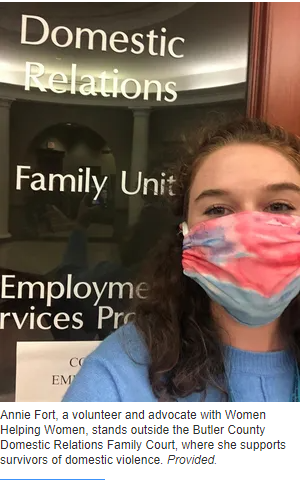
Woman Standing Outside Butler County Domestic Relations Family Court

Cincinnati City Council will give a quarter-million dollars to a nonprofit that works alongside the police to help survivors of domestic violence – a crime that has spiraled in the city during the COVID-19 pandemic.

Council unanimously voted Wednesday to approve the $250,000 in funding to Women Helping Women to use for the Domestic Violence Enhanced Response Team (DVERT).

Calls about partner violence are up, and more of the violence is life-threatening, said Kristin Shrimplin, the agency’s president and chief executive officer.

“It is staggering,” said Greg Landsman, the council member who proposed giving the financial help to the organization for the DVERT program.
Here’s how DVERT works: When Cincinnati police officers arrive at a domestic violence scene, they secure the scene, do a brief assessment and then call a DVERT advocate. The advocates, Women Helping Women employees who ensure the agency is staffed 24-7, have trauma-informed training. They help survivors get resources they need to be safe. They may go to a hospital with someone who’s hurt, provide shelter, get them legal help and sit in court with the survivor as the case moves forward.

Two Cincinnati Police Cruiser with Red and Blue Lights On

“Most of these survivors have children, and they are survivors too,” Landsman said. “If a survivor has a DVERT advocate there on the scene with our police … it makes an enormous difference in them getting support that they need.”

Calls to a Women Helping Women hotline jumped 53% this year in a 14-week period from March 16-June 30 compared to the same weeks in 2019, an analysis by the nonprofit shows. That came despite the difficulty that those experiencing partner violence had in making phone calls while their partner was in the same home, said Shrimplin said. The agency developed a texting method during this period to help keep callers safe.

Shrimplin said that, with the uncertainty that the pandemic causes, she fully anticipates a continuation of climbing calls. “This is not letting up.”

Women Helping Women advocates have seen more strangulation, more threatened gun use and more gun violence in their response to survivors, Shrimplin said.

Cincinnati in general has seen a rise in violence in general against women this year.

Early this month, the city reached a new high in homicides of women: By Sept. 9, more women had been killed  in the city than in any other year since at least 2000.

Chart of Women Killed Due to Homicidal Violence

Not all of the killings were domestic violence related, police said. But an Enquirer analysis of data from last year shows women killed in Cincinnati are more likely to be killed in partner violence or child abuse situations than any other reason.

Women Helping Women had a fundraising gap this year of $250,000, due to the pandemic, officials said. Yet the agency’s caseload of survivors has increased by 25%, its analysis shows.

Landsman said the DVERT program has proven to be helpful to mothers and children victimized by domestic assault.

“I think it’s up to us to invest in what we know is working,” he said, “and ensure that we are expanding that work so that no one in the city is left behind.”

Terry DeMio
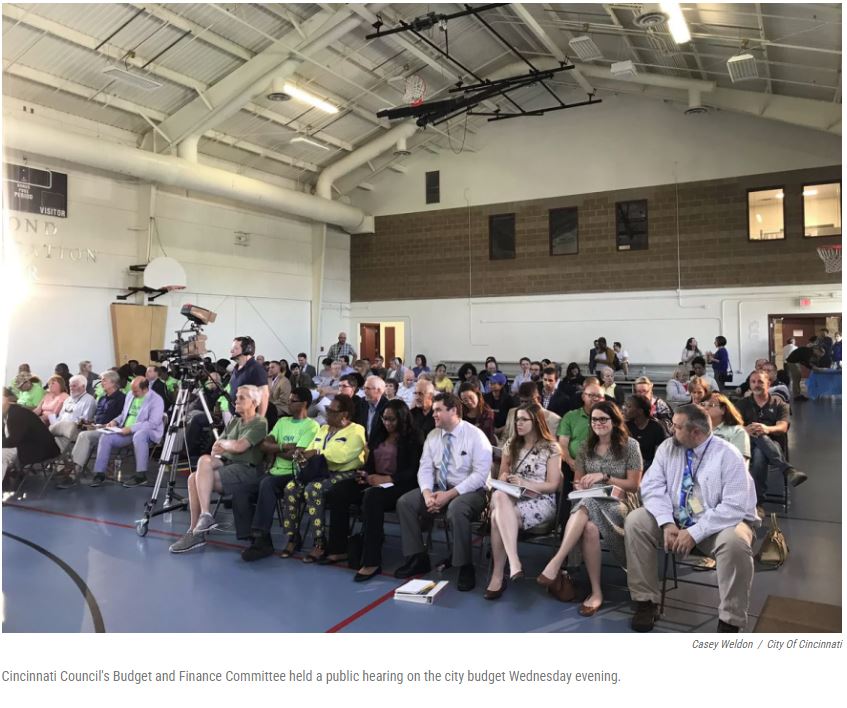
Cincinnati City Council Budget Meeting

91.7 WVXU | By Jay Hanselman

More than 60 people offered their thoughts on Cincinnati’s proposed budget during a public hearing Wednesday night.

Many of those offering comments spoke in favor of funding for the Center for Closing the Health Gap and agencies that provide human services.

Once again this year City Manager Patrick Duhaney’s spending plan didn’t include money for the Health Gap, and Mayor John Cranley also didn’t fund the group when he made his changes to the manager’s budget.

Trazana Staples told the Budget and Finance Committee that she had a stroke in 2017, and her connection with the Health Gap made a difference.

“I was able to reach out and receive information that I needed so I could have resources for my recovery,” Staples said. “It’s very important that the funding is restored.”

Mark Wilson said the organization does a lot for the community.

“The people are one of the most important things of the city, and I see the Health Gap investing back in the citizens of the city,” Wilson said. “I just ask that you continue to support and provide the funding they need.”

Human services agencies are urging city council to increase funding to 1.2% of the total city general fund budget. The manager and mayor did that in their proposals.

City council passed an ordinance last year to gradually increase that funding to 1.5% of the general fund budget. That’s the level it was traditionally at many years ago before the city began experiencing major deficits in the general fund.

“I believe that this council understands that the health of this city as a whole is not independent of the health of its least fortunate,” said Jim Holmstrom. “Those struggling with addictions such as mental health addiction, disability or any number of other formidable challenges.”

Kristin Smith-Shrimplin is the President and CEO of Women Helping Women and she spoke in favor of human services funding.

“For far too long survivors of dating violence, domestic violence and sexual violence and stalking have been told that they do not matter,” Shrimplin said. “And survivors and their children matter and that’s why we work hard at Women Helping Women 24/7 to respond to survivors in the greatest time of their need.”

Several people also asked that council restore funding to keep Larry Falkin as the head of the city’s Office of Environment and Sustainability. The city manager had eliminated that job in his budget proposal, and Falkin was going to be transferred to another city department outside the general fund.

Council member David Mann suggested during Wednesday night’s hearing that funding for the Center for Closing the Health Gap and Falkin’s position will be restored by city council when it finalizes the budget.

Other speakers asked council to maintain funding for economic development programs, neighborhoods and eviction prevention.

Two more budget hearings are set for next week. The one Monday will be held at the UC Innovation Hub at 2900 Reading Road. Tuesday’s will be at Madcap Theatre at 3064 Harrison Avenue. Both of those hearings start at 6 p.m.