
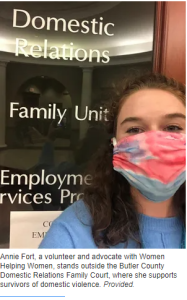
Woman Standing Outside Butler County Domestic Relations Family Court

Terry DeMio, Anne Saker and Cameron Knight

An upswing of domestic violence was a feared consequence of the coronavirus pandemic. Now Hamilton County has evidence for it.

Women Helping Women, the southwest Ohio nonprofit that advocates and cares for victims of gender-based violence, reported Thursday it had registered a 23% increase in the number of clients from March 16 to June 30 compared to the same period a year ago.

The agency’s analysis also showed calls to its hotline jumped 53% this year over the same 14 weeks when compared to the 2019 time frame.

“COVID doesn’t cause gender-based violence. Economic stress doesn’t cause gender violence,” said Kristin Shrimplin, the agency’s president and chief executive officer. “It just adds fuel to the fire.”


In March, Shrimplin said, calls for help rose rapidly, about 20%. After the stay-at-home order was issued in mid-month, the calls dropped because, Shrimplin said, fewer domestic violence survivors could feel safe calling a hotline while at home full time with a perpetrator.

Lt. Col. Mike John of the Cincinnati Police Department works with Shrimplin on a dedicated unit that responds to domestic violence calls with police and WHW advocates. John said that even though police haven’t seen a jump in criminal reports, he is not surprised by the increase in hotline calls.

“It’s not like a simple assault at a bar,” he said. “We are very much dedicated to finding who that aggressor is and removing him from that situation. They (Women Helping Women advocates) are left to pick up the pieces.”

Women Helping Women provides that support, he said, no matter if the survivor decides to press charges.

Domestic incidents have been more violent

Shrimplin said she found another cause for alarm. More people calling the hotline had experienced brutal assaults that can be omens of fatal violence in intimate relationships.

“Strangulation, sexual assault, use of weapons, they were all up,” Shrimplin said.

Women Helping Women, like many such agencies in the United States, uses the Danger Assessment tool, a system of identifying particular domestic violence – non-fatal strangulation, for example – that can lead to femicide, the killing of a woman.

The dedicated group of WHW advocates and Cincinnati police working together is called Domestic Violence Enhanced Response Team, or DVERT. Advocates go on domestic violence calls with police to help survivors.

“What we were hearing on those calls, what we were seeing on scene with survivors, they were getting increased red flags to be killed compared to last year,” Shrimplin said.

Assault Crimes are Up
New victims

The Women Helping Women report also found people who’d never before experienced physical violence at home now calling for help.

It’s an unsurprising development. The Substance Abuse and Mental Health Services Administration’s report on intimate-partner violence during the pandemic notes that loss of jobs, income in general, a disconnect of social services and help groups, a fear of getting COVID-19 and other issues now “may stimulate violence in families where it didn’t exist before and worsen situations in homes where mistreatment and violence has been a problem.”

The April shootings

In April, six female-identified victims were fatally shot in Hamilton County, compared to five for all of 2019. The Women Helping Women report said, “While COVID-19 was not cause of death, the impact on how society functioned greatly increased the harm and lethality of individuals who were already facing long standing system barriers to safety and resources.”

6 local women have been fatally shot during the stay-at-home order – more than all of 2019

Not all the homicides have been identified as domestic violence-related, police said.

But an Enquirer analysis of data from last year shows women killed in Cincinnati are more likely to be killed in partner violence or child abuse situations than any other reason.

Shrimplin said criminal reports will lag the number of calls to the agency’s hotline. “If people show up to hospitals and work with us, if we show up at different community points, if they call our hotline, that doesn’t mean that the survivors engage with the justice system.”

John of the Cincinnati police said of WHW, “That’s why their expertise is so important.”

How can victims get help

Women Helping Women has stepped up its services.

  • In April, with no additional funding, the agency added text-ability to its hotline.
  • Its volunteers bring masks, hand sanitizers and other personal protection products to the survivors it serves.
  • When possible, the agency provides families gift cards for groceries or Lyft rides.

The state of Ohio is funneling new money to programs for domestic violence survivors.

  • Attorney General Dave Yost announced $8.75 million from the federal CARES Act would go to support rape crisis centers and domestic violence shelters, in addition to $1 million to combat COVID-19 scams throughout the state.
  • Gov. Mike DeWine also announced that 66 local victim service projects have been awarded a total of $3.2 million to support victims of crime. The projects will be funded by grants through the Family Violence Prevention & Services Act grants program.

If you are threatened or harmed or know someone who may be in danger, call or text the Women Helping Women hotline: 513-381-5610.


Victims of domestic violence are cut off from resources while they stay shut in during the coronavirus pandemic.

By Scottie Andrew, CNN
Editor’s Note: A list of resources for domestic violence victims follows this article.

CNN-Home is the safest place to be while a pandemic rages outside. Health officials have said as much for weeks now.

But for some, home is not a haven from violence and abuse.

Self-isolation forces victims of domestic violence and their children into uncomfortable and dangerous circumstances: Riding out the  Covid-19 crisis, shut in with their abusers.

Life during the coronavirus outbreak has sapped victims’ outlets for relief: Running errands, speaking with counselors, visiting friends.

The pandemic has shattered exit plans that some victims have spent months developing.

And the deluge of stress and fear – of unemployment, of sickness, of death – is only intensifying the abuse they face.

The services designed to support even the most isolated of these victims are struggling to help from a distance.

“It is the perfect storm for someone who wants to isolate or hurt their partners,” said Val Kalei Kanuha, assistant dean of Diversity, Equity and Inclusion at the University of Washington’s School of Social Work.

Abuse survivors are familiar with the rules of social isolation already. Now, the pandemic is doing the work for abusers.

Domestic violence will likely increase in social isolation

The frequency and severity of domestic abuse will likely increase while Americans stay home for weeks or months during the pandemic, said Katie Ray-Jones, president and CEO of the National Domestic Violence Hotline, a service that connects victims of domestic violence with local resources.

Ray-Jones said the hotline saw an uptick in reports of partner abuse during the 2008 recession as unemployment surged. But then, victims weren’t told to shut themselves in with their abusers.

The calls National Hotline staff have received since the start of state shutdowns are startling, Ray-Jones said: One woman said when she tried to go to work at an essential business, her abusive partner began to load his firearm to scare her into staying. Another said that her partner threatened to expose her to the virus on purpose and swore he wouldn’t pay for treatment if she fell ill.

Communities under stay-at-home orders are already reporting higher call volumes to local domestic violence resources.

In New York’s Nassau County, east of New York City, domestic violence incidents are already up 10% compared to this time last year, Nassau County Police Commissioner Patrick Ryder told CNN affiliate WLNY. And Cincinnati-based organization Women Helping Women is receiving 30% more calls now since self-isolation started, CNN affiliate WCPO reported.

Stress heightens the likelihood for violence

Domestic violence cases spike in times of prolonged stress and disruption, like  financial crises and natural disasters.

But most Americans have never lived through anything quite like the Covid-19 pandemic, said Margaret Bassett, director of the Expert Witness Program at the University of Texas at Austin’s Institute on Domestic Violence & Sexual Assault.

“This is a really stressful time,” Bassett said. “And the more stress that a family experiences, there’s a greater risk for escalation on the part of a person who’s abusive.”

Some of that stress has driven people to firearms dealers and liquor stores.

Gun sales are surging nationwide, as they did after 9/11 and the stock market crash of 1987. It’s a symptom of uncertain times, industry analyst Rob Southwick told CNN last week. When people are afraid of the unknown, they’ll buy a gun – even if their enemy is a virus.

Abusers often use firearms to frighten victims, whether or not they use them, Ray-Jones said. But even an abuser’s possession of a firearm makes it five times more likely that a domestic violence victim will be killed, according to the Giffords Law Center to Prevent Gun Violence.

A record 3.28 million Americans filed for unemployment benefits this week – and unemployment is strongly tied to alcohol use disorder. A 2013 study reported that as unemployment rates rise, so do dangerous drinking behaviors. And the World Health Organization said evidence suggests that excessive alcohol consumption worsens the severity and frequency of domestic violence.

Coronavirus throws a wrench in victims’ plans

Abusers find ways to isolate victims without “shelter in place” mandates. But during any other time victims could still access resources like counselors and shelters.

It’s not so simple for survivors to up and leave their abuser either, and especially now, when access to hospitals and shelters is limited, Kanuha said.
“This particular situation with Covid-19 is so unusual because it really challenges all of us to think out of the ‘just leave’ box,” she said. “You can’t tell somebody to leave because there’s no place to go.”

Sexual assault victims may be hesitant to go to a hospital to receive a rape kit, with hospitals operating at full capacity and physicians pleading with the public to avoid burdening the health care system.

And typically advocates and counselors are on hand for support throughout the rape kit process. That isn’t possible anymore, said Laura Pelumbo, communications director at the National Sexual Violence Resource Center.

Many courts are closed, too, so requests for restraining orders are indefinitely delayed.

Some victims plan their exit strategies for months. They secretly save money and make arrangements to move with their counselors’ help. But the pandemic will almost certainly interrupt those plans by draining those funds, Ray-Jones said.

Child abuse is more prevalent

The children of abuse victims know where to go to get away from the violence: School, an after-school activity, a friend’s house. Anywhere but home.

Now that they’ve got nowhere to go, children’s risk of abuse  is heightened, said Jeffrey Edleson, professor and dean emeritus at the University of California-Berkeley’s School of Social Welfare.

“Many of the options that battered women and their children use as safety valves to get away from violence are no longer available,” he told CNN.

The social ties they rely on for relief are severed. Teachers, coaches and allies outside the home who may have reported the abuse aren’t with them every day. Parents may go so far as to cut off their access to electronics, which most American students now use to complete schoolwork, he said.

“A lot of young adults I’ve spoken with who’ve been exposed to violence at home often find close friends, friends’ parents, relatives and teachers who are supportive of them,” he said. “It helps buffer the impact of what’s going on at home. But all of that is missing.”

Coronavirus-related child abuse has already been reported. In Fort Worth, Texas, a children’s hospital said last week they treated six severe child abuse cases in the span of a week. Hospital staff said they typically see as many patients over a month, CNN affiliate KTVT reported.

Sometimes it’s the silence that’s concerning. The Oregonian reported that calls to Oregon’s state child abuse hotline have dropped by more than half, from 700 daily to 300 since the day the state’s schools closed. Child welfare advocates worry it’s because they’re not in classrooms, where teachers can report abuse on their behalf.

Even in families where conflict has never escalated to violence, children are now at a higher risk of physical abuse because of additional stressors like unemployment, Edleson said.

“That conflict can be pushed to a physical level,” he said. “And especially closed in small quarters.”

How services are adjusting

Local, regional and national coalitions are still operating as essential organizations under several states’ stay-at-home orders, but the way they deliver their services has changed.

In most cases, it’s no longer possible for victims to meet with case workers, and many women’s shelters have stopped accepting new clients to protect their current residents, Ray-Jones said.

Many victims are relying on hotlines to report their abuse and find help – but only those who are still able to safely contact them.

And once the stay-at-home orders are lifted, Ray-Jones said she expects victims to flood hotlines. They may not know how many victims there are until the coronavirus pandemic is over.

“People with abusive partners don’t reach out for help until the holidays are over,” Ray-Jones said. “We think there’s going to be a huge surge, potentially, once quarantines are lifted and people are returning to work.”

So social workers are preparing now, transitioning to remote work where they can and getting resources – numbers to call, mental health services available – in the hands of victims.

But there are still victims that advocates can’t reach.

That’s where all of us come in, Kanuha said.

For victims who don’t have access to websites, the phone or other people, friends, coworkers or neighbors should reach out to them and advocate on their behalf. Print out resources. Call a hotline if you fear for their safety. If you work together, seek them out under the guise of a work matter and ask how they’re doing. Listen rather than responding right away, Kanuha said.

“Just let people share and talk and ask for what they need, and then you can figure out if you can help them,” she said. “The best place to start is just to listen.”

There’s no blanket approach to help all victims of abuse. Their identities, whether they’re a child or adult, identify as LGBTQ+, are differently abled or an undocumented immigrant, change the help they need and are able to get, Kanuha said.

Covid-19 is another variable in their lives now. But it’s one abuse victims share with nearly everyone.

Resources for victims of domestic violence

National Domestic Violence Hotline Call1-800-799-7233 or text LOVEIS to 22522

Available 24/7. Can connect callers with local resources and immediate support. Also available through online chat tool.

National Sexual Assault Hotline 1-800-656-4673

Provided by RAINN (Rape, Abuse & Incest National Network). Available 24/7. Also available through online chat tool.

Crisis Text Line Text HOME to 741741

Available 24/7 for victims of abuse and any other type of crisis.

Childhelp National Child Abuse Hotline 1-800-422-4453

Available 24/7 in 170 different languages.

Office on Women’s Health Helpline 1-800-994-9662

A resource provided by the US Department of Health & Human Services.

Find a list of resources organized by state here, provided by the Department of Health & Human Services’ Office on Women’s Health.