Women Helping Women is deeply concerned by the Ohio Supreme Court decision that may allow individuals with certain domestic violence-related convictions to seek restoration of firearm rights.

Every day, we work alongside survivors whose lives have been forever changed by violence, coercion, threats, and intimidation.

We know from decades of experience and extensive research that access to a firearm in a domestic violence situation increases the risk of homicide by 500%.

While the Court’s decision addresses a legal question regarding the interaction of state and federal law, we must not lose sight of the human impact. Survivors deserve to know that their safety remains the highest priority in our communities and justice system.

Domestic violence is not a private matter. It is a public safety issue. Firearms can turn moments of fear into moments of irreversible tragedy.

Women Helping Women remains committed to advocating for policies and practices that prioritize survivor safety, hold offenders accountable, and reduce the risk of future violence. We encourage policymakers, law enforcement leaders, victim advocates, and community stakeholders to carefully consider the implications of this decision and its potential impact on survivors and families across Ohio.

Our message to survivors is simple: We see you. We believe you. We stand with you.

Anyone experiencing relationship abuse, stalking, sexual assault, or domestic violence can contact Women Helping Women’s 24-hour crisis line for confidential support and resources.

The Women Helping Women help line is staffed 24/7. If you are currently experiencing abuse, please call or text 513-381-5610.

Women Helping Women is heartbroken by the mass shooting in Shreveport and the lives impacted by this tragic act of violence. Our thoughts are with the victims, their families and the entire community.

While the details continue to unfold, the broader reality is that violence often intersects with patterns of domestic violence. Addressing that violence requires not only response, but prevention – through coordinated, community-based approaches that identify risk early and intervene before situations escalate.

Programs like the Domestic Violence Enhanced Response Team (DVERT), developed in Cincinnati and now expanded across 39 jurisdictions in Hamilton County, brings together domestic violence advocates and law enforcement as advocates rapidly respond 24/7 on-scene after 911 DV calls. This model is designed to disrupt cycles of domestic violence and create paths to safety before tragedy occurs. Since its launch in 2018, DVERT has responded to more than 11,000 survivors and their 10,000+ children with zero domestic violence homicides.

Violence does not delay. Nor can response.

Women Helping Women remains committed to expanding access to lifesaving resources and working toward a future where communities are equipped to recognize and respond to violence before it turns deadly.

If you or someone you know needs support, we are here to help 24/7 at (513) 381-5610.

Woman standing in front of a podium with law enforcement and other officials behind her

August 30, 2022, www.wvxu.org

Domestic violence has gotten worse during the pandemic. But a local rapid response team for survivors and their children is expanding to meet the growing need.

The Domestic Violence Enhanced Response Team provides 24/7, trauma-focused, on-call response to domestic violence situations in Cincinnati and some surrounding areas.

The program has served more than 5,700 survivors since 2018, according to Women Helping Women, a local organization working to address gender-based and intimate partner violence. That number includes big upswings in 2021 and so far in 2022.

Now, the DVERT program will be able to help more people with an expansion to all 49 municipal jurisdictions in Hamilton County — up from 20 jurisdictions in years past.

Joining Cincinnati Edition to discuss increasing domestic violence calls, DVERT’s expansion and how the program supports survivors are Women Helping Women President and CEO Kristin Shrimplin; DVERT Program Director Callie Ward; and Cincinnati Police Assistant Chief Lt. Colonel Michael John.

Listen to Cincinnati Edition live at noon M-F. Audio for this segment will be uploaded after 4 p.m. ET.

Never miss an episode by subscribing to our podcast:

Sheila Ruf had filed a protection order in Campbell County Court in mid-January, alleging Eric Lightfoot would hit and kick her, often coming in drunk and saying he was “going to kill her.”

March 24 2022, wcpo.com

NEWPORT, Ky. — Court documents show one of the women killed in a double homicide in Newport had previously filed a protection order against the man accused of murdering her and her friend.

Eric Lightfoot, 59, was charged with two counts of murder after police found 59-year-old Sheila Ruf and 61-year-old Diana Eddy dead inside a home on Ann Street March 16. A prosecutor said the two women were beaten to death, found after a property manager let officers in for a wellness check.

Ruf had filed a protection order in Campbell County Court in mid-January, alleging Lightfoot would hit and kick her, often coming in drunk and saying he was “going to kill her.” One week later, police said Lightfoot violated the order by showing up at her home.

Court documents show Ruf dismissed the protection order one month later.

About one month after Ruf dismissed the order, Eddy texted her daughter, telling her she was with Ruf and a man was there. Eddy said the man “might do something crazy.” Her daughter called police the next day, but officers could not get into the home. Three days later, they found Eddy and Ruf dead.

Kristin Shrimplin, president of Women Helping Women, said she believes the case highlights a disturbing trend of domestic violence.

“Domestic violence is a public health epidemic, that’s the bad news,” Shrimplin said. “One out of three women are experiencing this type of violence in their lifetime.”

Women Helping Women helped 7,500 survivors in Hamilton, Butler, Adams and Brown County in 2021. Shrimplin said that number is just the “tip of the iceberg.”

“That’s the message for all of us to hear loud and clear,” Shrimplin said. “If anyone ever discloses violence to you, please tell them immediately you’re not alone. It’s not your fault. I believe you. If you want it, there’s help available.”

Ruf’s niece said her aunt loved life and everyone she was around, her family remembering her by her caring smile.

If you are a victim of domestic abuse, you can call your local police department or contact Women Helping Women’s 24/7 hotline at 513-381-5610.

November 08 2021, cincinnati.com

Opinion contributor
protection order paper

Paula Pierce, 62, is a survivor of domestic violence. She said each morning she looks at the permanent protection order that was granted march 8, 2021, against Shane Fulmer, 48. Pierce had a 16 year relationship with him. Liz Dufour | The Enquirer

More than 131 people died in Ohio over the past year in cases connected to domestic violence. That’s according to the Ohio Domestic Violence Network, which reports a 62% increase in those deaths over the past two years.

In Cincinnati, domestic violence numbers are also trending upward, according to Kristin Shrimplin, president and CEO of Women Helping Women.

“We are seeing a continuing trend that has not been disrupted as it relates to intimate partner violence, domestic violence cases, the complexity of those cases, injuries that are resulting, and unfortunately and very sadly, homicide as a result of domestic violence and intimate partner violence homicide.”

Advocates hope bills pending in the Ohio Statehouse could protect victims. Aisha’s Law, HB 3, would require police to do a lethality assessment on a domestic violence call.

Joining Cincinnati Edition to discuss the rise in domestic violence cases is Ohio Domestic Violence Network Policy Director and Staff Attorney Micaela Deming; and Women Helping Women President and CEO Kristin Shrimplin.

Listen to Cincinnati Edition live at noon M-F. Audio for this segment will be uploaded after 4 p.m. ET.

Shadow of two people on rock terrain

Domestic violence numbers in the Greater Cincinnati and surrounding area began to see some of its highest rates ever when the pandemic started. More than 18 months later, that trend has not waned. One local leader says the situation is not hopeless, but it’s not good, either.

“I would quantifiably put it, that it is worse,” said Kristin Shrimplin, president and CEO of Women Helping Women. “We are seeing a continuing trend that has not been disrupted as it relates to intimate partner violence, domestic violence cases, the complexity of those cases, injuries that are resulting, and unfortunately and very sadly, homicide as a result of domestic violence and intimate partner violence homicide.”

Nineteen homicides this year have been linked to intimate partner or domestic violence. That’s higher than last year’s confirmed 16 cases, though that number may be as high as 20.

Shrimplin says the reasons behind the increase are complicated.

“The pandemic is not causing gender-based violence because gender-based violence has always been here. Economic strife is not causing gender-based violence because gender-based violence has always been here. However, these are additional stressors.”

Access to health care, behavioral care, education and remote working conditions all contribute to creating a powder keg situation for some. Continued health risks associated with the pandemic are also a factor, keeping people from seeking help.

“This is what we heard time and time again last year from survivors, where they knew that they were experiencing sexual assault injuries, domestic violence injuries, but were too scared to go to health care systems during a pandemic for fear of COVID,” Shrimplin said. “And I don’t think that some of those fears and challenges have abated.”

But local officials, she adds, have stepped up to try addressing some of these issues. New and improved partnerships between the police, city and county officials have made a difference.

For instance, the Domestic Violence Enhanced Response Team, which sends an advocate with police officers to domestic violence calls, expanded into 16 jurisdictions this year. The program was launched in Cincinnati.

The service has already helped 1,200 adult survivors and 1,800 children.

At both a statewide and local level, Shrimplin says more money has been allocated for domestic violence response services, which has been necessary to keep things operating as budget cuts happen elsewhere.

For instance, funding from the Victims of Crime Act has been slashed 71% in the past two years. That amounted to almost $600,000 in lost funding at an agency that has a $2 million budget.

“We’re very grateful, whether it’s a city or the county or private donors, corporations, foundations saying, ‘You know what, we’re all in this together, how can we help and be of service?’ ” Shrimplin says. “Because that is the only way we can now hire more staff. It’s not coming from some of that national support.”

Women Helping Women helps about 8,000 people per year. Its 24-hour hotline number is 513-381-5610. It can be called or texted. For more information about Women Helping Women, visit their website.

.

Purple Background

CINCINNATI — There’s another pandemic that is affecting communities nationwide and it is on the rise: Domestic violence.

What You Need To Know

  • Domestic violence seen as ‘the other pandemic’ – numbers have increased nationally and locally
  • Cincinnati has had nine domestic violence-related deaths so far this year. That’s more than the past two years combined.
  • Women Helping Women is working to make it easier for survivors to come forward
  • Experts say loved ones should watch for warning signs and be ready for “tough conversations”

Kristin Shrimplin, CEO and president of Women Helping Women (WHW), said domestic or gender-based violence is a “human rights abuse” that has long been and continues to be a public health crisis, especially during the time of isolation during the pandemic.

“The last year-plus has been a real challenge. A lot of the coordinated systems we rely on were fundamentally compromised — health care systems, social services. A lot of us, we were just trying to do the best we could to keep up,” said Shrimplin.

Despite its name, Women Helping Women serves all victims of domestic violence — regardless of gender or sexual identity.

“This is a problem that affects everyone, even if in different ways and capacities,” Shrimplin said.

One in every three women has been beaten, coerced into sex or otherwise abused in their lifetime, according to data from WHW’s website. Those numbers are getting worse during the COVID-19 pandemic.

WHW’s 24-hour support hotline is on pace to review nearly 12,000 calls for crisis support this year. Shrimplin said the text chat function is used around-the-clock.

But sometimes the calls and texts don’t come in time.

The Cincinnati Police Department said the city has already had nine domestic violence-related homicides in the first seven months of 2021. That’s more than the eight reported incidents Cincinnati has seen in the last two years combined.

Assistant Police Chief Lisa Davis said on average 6% to 8% of homicides in Cincinnati are related to domestic violence. This year, that number is closer to 18%.

“That is a big jump,” said Davis, who has been outspoken about the issue the past few weeks. Davis turned to social media to voice her frustrations following the shooting death of 31-year-old Michelle McDonald.

Police said McDonald was pregnant at the time she was gunned down by a man identified as her boyfriend.

She managed to give birth to the child she was carrying, but the newborn, Aaliyah McCoy, passed away Saturday.

“The death of Michelle McDonald and her baby are a true tragedy. [The Cincinnati Police Department] will do everything possible to hold [the suspect] accountable for their deaths,” Davis wrote in a tweet.

Shrimplin said she is not at all surprised, but for the community “this should be a very loud-sounding alarm bell.”

“Unless we enact systemic changes, what is going to keep us from having another domestic violence homicide next month,” she asked.

She explained that violence doesn’t always involve a gun or knife and there isn’t always punching or kicking. It can be verbal or emotional. Sometimes it’s sexual, even stalking.

But none of those is acceptable, Shrimplin said.

Shrimplin said it can be difficult for people experiencing domestic violence to just “pick up and leave.” Many times there are families, children, significant others involved.

WHW reports 81% of survivors report that the perpetrator is either a current or former intimate partner.

Davis said CPD responds to all domestic violence calls and will arrest or detain suspects per their policies, but there’s only so much they can do.

“That is a crime that until that person is ready to make a move, until they feel supported and able, they’re not going to,” she said. “We will keep going back to let them know that when they’re ready, we will support them. But they’ve got to make that choice themselves.”

Those first few minutes after a domestic violence incident are crucial, Shrimplin said. That’s why WHW created the Domestic Violence Enhanced Response Team (DVERT).

WHW sends DVERT staff to the scene of active domestic violence calls in Greater Cincinnati. They provide on-site resources and support to victims. They will also offer to help the survivors create a safety plan to avoid future violence. About 85% accept, Shrimplin said.

DVERT started in Cincinnati, but recently expanded to work with 15 law enforcement jurisdictions across Hamilton County.

Shrimplin said WHW team members are on pace to appear at 1,400 domestic violence police calls this year. That number is a 40% jump over last year, but Shrimplin is quick to point out it’s in part due to program expansion.

Davis said the issue is far too complex to draw conclusions about the cause of the spike. But she said pandemic-related stressors — things like a lost job, family health issues, or even being stuck at home — may exacerbate existing issues.

Shrimplin said the most important thing a person can do is be there and be aware. If you see something, say something. If someone tells you something, believe them.

“The most critical thing a person can do is listen. They need someone to say, ‘I believe you,'” she said. “Survivors need to hear that. Survivors often fear that no one will believe them so they don’t come forward.”

Domestic violence isn’t something that just happens. Davis said you’ll see “warning signs.”

“Look to see if someone is being controlling, or manipulative. Are they isolating friends and family? Those types of things you want to look for,” she said. “We all have to be willing to ask those tough questions.”

“We see many, many signs leading up to that,” Shrimplin added. “Violence can kill, but so can silence.”

The 24-hour hotline for calls or texts is 513-381-5610. More resources are available on the  Women Helping Women website.

Ohio Capital Building

State reps have introduced a bill to allow electronic monitoring of offenders when protection orders are violated, doing so in memory of Paulette Timko Propst, who was shot and killed by her estranged husband in 2011.

(TNS) — Two Ohio legislators introduced a bill last week designed to protect victims of domestic violence.

State Reps. John Patterson (D- Jefferson) and John Rogers (D- Mentor-on-the-Lake), introduced House Bill 778, to allow electronic monitoring of offenders when protection orders are violated.

The bill was developed in memory of New Lyme Township resident Paulette Timko Propst, who was shot and killed by her estranged husband in 2011.

“I feel this is a critically important piece of legislation to better protect those who may be vulnerable,” Patterson said. “With modern technology, a real time GPS tracking device placed on the ankle of a potential violator only makes sense. I am proud to support this legislation.”

The bill would grant the court discretion in its ability to require monitoring in response to all classifications of protection order violations. It would also expand the specifications of order violations in order to allow law enforcement to alert the order-protected-individual when the offender has violated the order, according to House Bill 778.

“HB 778 will strengthen law enforcement’s ability to effectively track and hold monitored abusers accountable,” Rogers said in a prepared statement. “More importantly, this measure will provide an additional layer of protection to victims of domestic violence and/or abusive harassment. Ultimately, it is our hope that protected individuals and their families can find a greater peace of mind knowing GPS technology is being actively used to ensure their safety and prevent unwanted, unlawful encounters with offenders.

The bill is the result of advocacy from Propst’s loved ones, as well community organizations, including Women Helping Women. It will bring public awareness and help protect victims of domestic violence in Ohio, Patterson said.

Patterson applauded the efforts of Robbi Zakowski, a friend of Paulette Propst, for helping get the bill to a place where it could be presented to the Ohio State House of Representatives.

Zakowski has been working with legislators, the criminal justice system and victims rights groups to raise money and create legislation to fight the problem.

“We are very excited … It is 10 years in the making,” Zakowski said.

Zakowski has worked with other domestic violence advocates from around the country to bring awareness to the problem. She said she is focused on ankle monitoring devices, she said.

Paulette Propst, 55, died of multiple gunshot wounds to the head, neck and trunk, according to the Ashtabula County Coroner’s Office.

Police believe Thomas J. Propst shot his wife with a .45 pistol a few hours after being served with divorce papers and a temporary protection order, Sheriff William Johnson said at the time. Propst also went to a barn and shot and killed his horse, the sheriff said.

The couple’s 18-year-old daughter was in the bathroom when her father came into the home. She heard voices, and sensing danger, she fled the home through a window and ran to a neighbor’s house to call 911, Johnson said.

Thomas Propst, 55, went missing after the shooting. A nationwide manhunt ensued and the U.S. Marshals offered a reward for information leading to his arrest.

Three weeks later, while out for a walk, a neighbor came across a vehicle matching Propst’s vehicle less than a mile from the murder scene. When police arrived, Propst was discovered dead inside his locked vehicle.

With a GPS tracker, if the abuser travels outside permitted boundaries or attempts to travel to the victim’s home or work, the police and the victim are alerted.

A lifelong county resident, Paulette Propst was the mother of four adult children and active in her church and community, according to her obituary.

The Propsts’ oldest daughter, Jennah Flegenheimer, said the bill will be life-changing.

“This will help so many women get the protection and peace of mind they deserve,” she said. “I’m so thankful for Robbi Zakowski who deserves the recognition for spearheading this idea. She was one of my mom’s best friends and saw that there was a need for this and I’m so proud of her.”

According to the National Statistics Domestic Violence Fact Sheet, one in three women and one in four men have experienced some form of physical violence by an intimate partner. This includes a range of behaviors, such as slapping, shoving and pushing that in some cases might not be considered domestic violence. One in seven women have been injured by an intimate partner.

HB 778 will soon be assigned to an Ohio House committee for initial consideration and public hearing.

Zakowski is helping coordinate a May 12 rally on the steps of the Ohio State Capital to create a visual representation of those who have lost their lives for have been harmed by domestic violence. The goal is to have people from all 88 Ohio counties attend the event, she said.

“We are going to give everyone a few moments to remember their loved ones,” she said

Survivors of domestic violence looking for resources and referrals in Ohio can visit ODVN.org or call 614-781-9651.

If you are in an emergency, call the 24/7 National Domestic Violence Hotline at 1-800-799-7233.

(c)2020 the Star Beacon (Ashtabula, Ohio). Distributed by Tribune Content Agency, LLC.

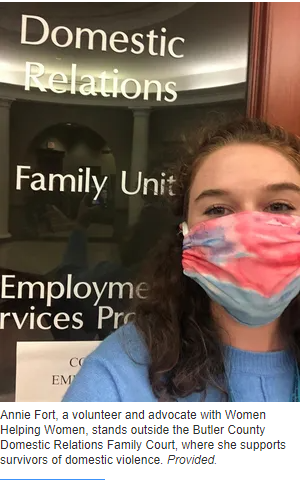
Woman Standing Outside Butler County Domestic Relations Family Court

Cincinnati City Council will give a quarter-million dollars to a nonprofit that works alongside the police to help survivors of domestic violence – a crime that has spiraled in the city during the COVID-19 pandemic.

Council unanimously voted Wednesday to approve the $250,000 in funding to Women Helping Women to use for the Domestic Violence Enhanced Response Team (DVERT).

Calls about partner violence are up, and more of the violence is life-threatening, said Kristin Shrimplin, the agency’s president and chief executive officer.

“It is staggering,” said Greg Landsman, the council member who proposed giving the financial help to the organization for the DVERT program.
Here’s how DVERT works: When Cincinnati police officers arrive at a domestic violence scene, they secure the scene, do a brief assessment and then call a DVERT advocate. The advocates, Women Helping Women employees who ensure the agency is staffed 24-7, have trauma-informed training. They help survivors get resources they need to be safe. They may go to a hospital with someone who’s hurt, provide shelter, get them legal help and sit in court with the survivor as the case moves forward.

Two Cincinnati Police Cruiser with Red and Blue Lights On

“Most of these survivors have children, and they are survivors too,” Landsman said. “If a survivor has a DVERT advocate there on the scene with our police … it makes an enormous difference in them getting support that they need.”

Calls to a Women Helping Women hotline jumped 53% this year in a 14-week period from March 16-June 30 compared to the same weeks in 2019, an analysis by the nonprofit shows. That came despite the difficulty that those experiencing partner violence had in making phone calls while their partner was in the same home, said Shrimplin said. The agency developed a texting method during this period to help keep callers safe.

Shrimplin said that, with the uncertainty that the pandemic causes, she fully anticipates a continuation of climbing calls. “This is not letting up.”

Women Helping Women advocates have seen more strangulation, more threatened gun use and more gun violence in their response to survivors, Shrimplin said.

Cincinnati in general has seen a rise in violence in general against women this year.

Early this month, the city reached a new high in homicides of women: By Sept. 9, more women had been killed  in the city than in any other year since at least 2000.

Chart of Women Killed Due to Homicidal Violence

Not all of the killings were domestic violence related, police said. But an Enquirer analysis of data from last year shows women killed in Cincinnati are more likely to be killed in partner violence or child abuse situations than any other reason.

Women Helping Women had a fundraising gap this year of $250,000, due to the pandemic, officials said. Yet the agency’s caseload of survivors has increased by 25%, its analysis shows.

Landsman said the DVERT program has proven to be helpful to mothers and children victimized by domestic assault.

“I think it’s up to us to invest in what we know is working,” he said, “and ensure that we are expanding that work so that no one in the city is left behind.”

Terry DeMio