Photo provided by Daisy Hernández | The Miami Student

Students who visit Daisy Hernández’s office in Bachelor Hall are immediately greeted with a collection of posters on the door.

One poster, “Yoga for Writers,” humorously connects English terms with yoga poses. Another reads, “We LOVE you and we HONOR you and we defend your right to be here.” Others advertise campus organizations such as Spectrum and Women Helping Women.

Three of the office’s walls are painted white, but a yellow one stands out. Hernández, an assistant professor of creative writing at Miami University, chose the color herself. A picture of June Jordan, a Black poet, hangs on the wall. Jordan wrote one of Hernández’s favorite poems, “Poem About My Rights.”

A bookshelf stands to the right, overflowing with literature. When talking about writers, a particular one stands out to Hernández: Sandra Cisneros.

“She’s a poet and her language is just so imagistic, so beautiful,” Hernández said. “She’s also Chicana, and she was writing in … mostly English, but she brings in Spanish and she was writing about her … immigrant community which is really different from mine, but there were points of similarities.”

An author as well as professor, Hernández’s most recent book, “The Kissing Bug,” which won the PEN/Jean Stein Book Award, is about Chagas disease, which is prominent in rural Latin American areas. For this book, Hernández had to pivot what she was reading from books to science articles, which required simplifying complex scientific concepts.

“When you’re writing about science or medicine, you’re basically doing translation work,” Hernández said. “How can I take this terminology, these concepts, and make them palpable for a general reader who doesn’t sit around reading science articles for fun?”

Hernández also poured her time into interviewing hundreds of people, ranging from patients with the disease to entomologists that study the triatomine bugs that transmit the disease. She spent seven years working on the book.

Along with the PEN award, Hernández also received a $75,000 prize. She said she was blown away by the honor.

“I wanted this book to raise awareness around this neglected disease that disproportionately impacts the Latinx immigrant community in the U.S.,” Hernández said. “This award definitely puts the book in front of people who maybe would not have even thought about picking up the book or weren’t thinking about the subject matter.”

The award’s impact was heightened by something personal to Hernández – the book was inspired by her aunt who died from Chagas disease.

“She lived for many, many years just going in and out of hospitals,” Hernández said. “And then she died in 2010 … You forget that this time could be it, because so many times it felt like ‘Oh my God, this could be it,’ and it wasn’t.”

The path to “The Kissing Bug” started with an assignment Hernández had to do back in middle school. Her science teacher told the class they had to write essays about why life might exist on other planets.

“I wrote a very compelling essay arguing that there was life on Neptune or something like that, and my teacher loved it,” Hernández said. “She read it to the class, and I remember while she was reading, I was looking around. All the little kids were nodding their heads, and I just remember feeling like if I can convince these fools that there’s life on Neptune, I can do anything. Oh my God, I was drunk on power.”

The moment inspired Hernández to continue writing.

“I loved it,” Hernández said. “I was like, ‘Woah, this is amazing.’ It was the first time as a child that I felt like, ‘Oh my gosh … you can touch people with your words. You can actually make them feel something, have them think a different way.’”

Hernández was raised in America in a home with parents who didn’t speak English. She started to notice the gap between her worlds while watching the family’s television.

“I also grew up with seeing two very different Americas because I was a little journalism nerd,” Hernández said. “The English news never, never looked like the Spanish language news.”

Hernández would watch Spanish news about civil wars in Central America or immigration status in the U.S., then switch over to English news and hear about local crime and the Reagan administration.

“There were just so many stories that were not in both worlds,” Hernández said. “I knew at that point … A) writing has power and B) I can bridge these two worlds somehow.”

When Hernández graduated from high school, she enrolled in William Paterson University. She wanted to major in journalism, but the degree was more focused on marketing and communications, so she majored in English instead.

Hernández then attended New York University to get her Master of Arts in both journalism and Latin American and Caribbean studies. Hernández also studied at the University of Miami where she got her Master of Fine Arts in creative writing.

As Hernández started to write more often, opportunities opened up. She’s been published in Ms. magazine, had an internship with The New York Times (NYT) editorial board in 2002 and then reported for NYT’s Metro desk.

While working for NYT, Hernández covered a multitude of stories, including fires, deaths, accidents, community gardens and bad weather. She even found some interesting stories through topics that are generally considered boring.

“I actually wrote about tax returns,” Hernández said. “That was my best story, actually, [it] was an undocumented immigrant family deciding whether or not to file a tax return … She wanted to file a tax return and start [a valuable] paper trail, but her husband did not.”

After the New York Times, Hernández joined “ColorLines” as a magazine editor. She then continued her journalism career freelancing for organizations such as National Geographic, The Atlantic and NPR. In 2014, she released a memoir titled “A Cup of Water Under My Bed: A Memoir,” which incorporates Spanish and English.

Since 2015, Hernández has taught creative writing at Miami. Hernández realized she wanted to be a professor while working for various media publications.

“I often found myself teaching even in my journalism [and] publishing career,” Hernández said. “I found myself really interested in teaching people who are not professional writers how to write op-eds or write essays about their lives, and then when I was working with actual interns and younger folks, I was really just fascinated by essentially showing them what others had shown me to do.”

Teaching creative writing also allows her to change pace from journalism.

“What I love about fiction is actually the intimacy that you can have with characters,” Hernández said. “That’s something that you cannot quite experience in nonfiction no matter how hard you try, because they’re not invented characters.”

This semester, Hernández teaches ENG323 Intermediate Creative Nonfiction and ENG254 Latinx Literature and the Americas.

Cass Hauck, a sophomore biology, creative writing and premedical studies major, enjoys having Hernández as a professor for ENG323.

“She really tries to make the class fun and engaging and offers many opportunities for student-led discussions,” Hauck said. “She also helps us and the English department get to meet with other authors and professionals, which is really cool.”

Madelyn Detloff, chair of the English department, had been teaching Hernández’s books in classes before Hernández even joined Miami’s faculty.

“Professor Hernández is an extremely talented writer and a gifted teacher,” Detloff said. “Her work sheds light on issues and realities that are often obscured or marginalized because they affect folks who are not associated with the dominant class and culture.”

For aspiring writers, Hernández recommends that they enroll in any writing classes they can.

“Take classes,” Hernández says. “You learn from your teachers, but you also learn from your peers. You learn from the other writers in the room so much.”

Hernández is now able to share her love for writing with students.

“When a sentence comes together on the page, it is so satisfying,” Hernández says. “The music of it or the images that come together or the way it just can seem more true than what you’ve actually lived.”

COSE partners with Miami University's COSE

Even though it has “social” in the name, the Council for Social Entrepreneurship isn’t just a place for like-minded students to meet. “We’re basically a club that provides opportunities to do things that are social-entrepreneurship related. We meet every other week and then we have speaker series, workshops, social events, and client projects,” co-president of COSE and senior strategic communication & entrepreneurship major Chi Pham explained. “We want students who not just come and hang out, we want them to be interactive. This is the opportunity to build a portfolio and to help others.”

Finding a client for the group’s first project wasn’t hard, thanks to COSE advisor Michael Conger. “He has actually been working with the director of Women Helping Women and said, ‘If you are looking for a client, they would love to do it,’ Pham said. “The client’s challenge was ‘How do we get students to be more aware of, and utilize Women Helping Women’s resources?’ They have a lot of services ranging from talking with survivors of sexual assault, helping with court hearings, or helping understand hospital procedures.”

“We have a problem and the problem is that we’re not seen on campus and we’re not very visible,” WHW campus advocate Morgan-Allison Moore said. “I really appreciated the experience because it allows students to use the skills they’re learning in a classroom on a real-life issue.”

This sort of project was part of what made junior theater/entrepreneurship major Alexandra Leurk interested in COSE to begin with. “I think it is really important to come at these social justice issues with an entrepreneurship mindset and a business mindset, just to balance out the different areas of knowledge that are coming in to solve those problems. I wanted to learn more about how we can approach these types of issues through that entrepreneurial mindset,” she said.

Divided into teams, 18 members of COSE got to work looking for solutions. ”Our pitch was to have student volunteers – not the organizers of Women Helping Women, but people who actually go to Miami — create a schedule and go to different departments each month, set up a spreadsheet of classes to go to and ask professors if they can go and give a two-minute quick pitch about WHW, what they offer, how students can get involved,” junior strategic communications/entrepreneurship major Caroline McManus said. “We gave them an example of how to do that by recording ourselves doing a pitch in a classroom.”

“A lot of the ideas that we were coming up with, we were gaining this understanding that social justice problems always involve a sense of personal accountability,” Leurk noted. “We all have to have a personal accountability for the problems so that it can be more of a personal situation that we can solve.”

“They surveyed their peers and asked questions about Women Helping Women and created a plan. I was taking a lot of notes when they were doing their presentations because they had amazing ideas,” Moore said. “Hearing how they feel like it should work as students, it gave me a lot of direction. I talked to my supervisor, prioritized the ideas, and started making the connections.”

COSE members said that taking part in the client project and helping WHW grow helped them learn as well. “It was a great experience. I’ve never done something like that before, and it was a great way to gain experience into what I’ll be doing in entrepreneurship classes later,” first-year economics major Mark Rick said.

“I think a major takeaway was understanding that things may look okay in everyday life, but there’s a lot of issues that our community is facing in different social justice factors and aspects,” Leurk said. “The whole world faces problems every single day, but unless we’re looking around in our local area first, I don’t think we can really always step into those other areas without seeing what’s happening in the area around us first.”

Kristin Shrimplin is president and CEO of Women Helping Women. A nonprofit assisting survivors of domestic violence

Byron McCauley
Cincinnati Enquirer

The partner of my aunt, an elementary school teacher, once used his meaty fists to break her face, leaving her face a bloody, unrecognizable mess.

This wouldn’t have been the first time he hit her, but it certainly was the most damaging. My aunt suffered grave injuries that required hospitalization. The whole town knew it. Yet, her abuser was walking the streets the next day.

As the pretty young wife of a jealous husband, my aunt’s daughter was a survivor, too. Her skinny husband executed a bloody attack on a hot afternoon in front of a group of terrified and petrified kids. Another cousin’s husband cracked her skull with a brick. Thankfully, she lived. All the of the abusers remained free.

I attended the Women Helping Women 2nd annual breakfast Thursday. Women Helping Women offers resources to deal with domestic violence and sex crimes. If only my kin had such support — especially when they could not count on the law to be on their side. Back then, it was not uncommon for a local lawman to help the abuser “cool off” by driving him around for a while.

Sadly, in Greater Cincinnati, the need is increasingly significant. Women Helping Women in 2017 reported helping nearly 5,800 new survivors. So far this year, it has served nearly 6,000 survivors with more than two months remaining in the year. The #MeToo movement and the U.S. Supreme Court hearing spurred more people to tell their truth. In September, the group helped 1,028 survivors.

President and CEO Kristin Smith Shrimplin reflected on the national conversation around gender-based violence. “The national narrative has changed in its belief of survivors and its treatment for survivors,” Shrimplin said during the breakfast. “Supporting survivors is not open for political debate.”

Women Helping Women volunteers are doing yeoman’s work. They go to victims’ homes with police to remove them. They staff a crisis line 24 hours a day, every day. They meet rape survivors in hospital emergency rooms. They support survivors in court. They train leaders in the workplace to recognize a victim of gender-based violence on their team.

They have campus advocates at Miami University and the University of Cincinnati.

They help families. In February, the organization partnered with the Cincinnati Police Department to start the DVERT program. So far, the program has helped 472 adults and 588 children out of domestic violence.

The insidious thing about gender-based violence is its stealth. Horrified victims don’t tell other people what they are going through. When they miss work or are chronically tardy, an HR issue arises, and the real problem is masked. They may not have visible evidence of abuse, but their scars show up in other ways.

All of us need to be better equipped to spot someone who may be suffering, to engage them and be an advocate for them. The numbers in our community are trending upward across the board. And today, largely because of organizations like Women Helping Women, a strategic approach to help is available.

No one needs to suffer in silence anymore. Byron McCauley Enquirer Columnist

Byron McCauley writes about education and family life. He also serves on the Enquirer editorial board. Email: [email protected]. Social: @byronmccauley.

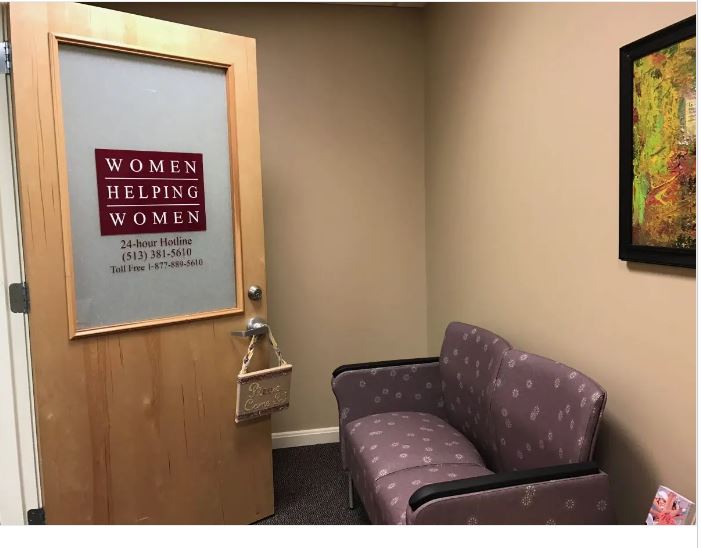
Office Door with Hotline Number of Women Helping Women

 By Hannah Fierle

Organization situated in Oxford strives to empower and support women both on Miami’s campus and in the greater tri-county area.

Miami University journalism student

With the increased focus of late on women’s rights and women’s issues, organizations that advocate for and support women have an opportunity to grab the spotlight.  Women Helping Women is one of those organizations, focusing specifically on the areas of sexual assault and domestic violence.

Started in the 1970’s, Women Helping Women initially sought to empower women by teaching them to do what were considered traditionally masculine tasks, like changing a tire. The organization took on its contemporary role when women involved expressed a need for services in situations of domestic violence and sexual assault.

“Our job is to do whatever the survivor needs,” says volunteer coordinator Bre Shisso. “We want to inform them of all their options and resources and support them every step of the way.”

Women Helping Women has two offices, one in Cincinnati and one in Oxford. The Cincinnati branch responds to the city and its surroundings, while the Oxford branch serves the greater Oxford, Middletown, Hamilton, and West Chester communities.

The organization’s office in Cincinnati handles cases of domestic violence, sexual assault and stalking, while the Oxford location deals only with sexual assault cases. Although the name may imply the agency is just for women, they stress that services are available to individuals of any gender identity.

Personal Service For Survivors

For the three full time employees at Women Helping Women’s Oxford office, their goal is to provide personalized, individual support for survivors of sexual assault. This may include accompanying clients to hospital visits or any legal meetings or hearings or providing emotional support and counseling.

The organization is completely confidential, and employees cannot offer legal advice, nor are they obligated to report an incident to law enforcement.

“Our service is very individualized, since each person will find healing through different things,” Shisso says. “Some people find healing through getting a protection order or being validated through a court process, while some people just need the emotional support and meeting other survivors in group sessions to begin to recover.”

In addition to interpersonal resources, the agency also offers a 24-hour hotline.

In 2015, the agency served more than 14,000 clients through both offices. While the numbers for 2016 are not yet available, the organization was on track after the third quarter to serve 16,000 individuals between both locations.

With its location in Oxford, Women Helping Women has begun a partnership with Miami University, providing students another resource when dealing with cases of sexual assault on campus. In November, Miami graduate Nora McVey began work as the organization’s Campus-Based Interpersonal Violence Support Specialist.

“We hear statistics and we know these incidents are taking place, but when I’m on campus and working closely with students, it becomes very real,” says McVey. “It’s rewarding to meet people who become comfortable sharing their stories and realize that they have someone in their corner, but it’s also very challenging when dealing with this sort of trauma.”

Challenging And Rewarding Work

The women at Women Helping Women emphasized both the challenges and rewards of their work. Although they may encounter individuals at their most vulnerable, they say they’re also able to witness the triumph of healing and recovery.

For Caitlin Rettenmaier, Director of Butler County Services, she is often confronted with a different set of needs due to the rural demographic of the Butler County area. This can mean arranging transportation for clients to get to the hospital or legal appointments or arranging temporary shelter if it’s deemed unsafe for an individual to return home.

“This is the most meaningful job I’ve ever had,” says Rettenmaier. “It’s most rewarding for me to see how the community comes together as partners in a time of crisis. That’s the biggest lasting impact that we hope to carry forth.”

For more information about Women Helping Women and its services, visit https://www.womenhelpingwomen.org or call the Oxford office at (513) 977-5541

The lobby of Women Helping Women’s office situated in Oxford’s Stewart Square. — Photo by Hannah Fierle