Episode Notes:
With the back-to-school season comes an opportunity to acknowledge how we can best support youth in the Greater Cincinnati region. Trauma-informed educational practices stand out, promoting resilience and enabling healthy communities. Sachika Singh, MA and Sarah Zawaly, MSW join the conversation to unpack the impacts of trauma, what it means to be trauma-informed, and the significance of these practices to violence prevention education.
Sarah Zawaly, LISW, is a committed Program Manager at the Mayerson Center for Safe and Healthy Children at Cincinnati Children’s Hospital Medical Center. As part of the Joining Forces for Children initiative, she focuses on implementing trauma-informed practices and building resilience to address the effects of Adverse Childhood Experiences (ACEs). Drawing on her background as a former teacher and clinical social worker, Sarah provides practical strategies for fostering healing environments for children, families, and staff. Her expertise includes co-creating curriculums, presenting at national and regional conferences, and offering consultation to a variety of organizations. Sarah’s dedication to promoting healthy well-being is evident through her work, showcasing her passion for creating supportive environments that bolster resilience and mitigate the impact of ACEs.
Sachika Singh, MA is a Clinical Research Coordinator at the Mayerson Center for Safe & Healthy Children. She holds both a bachelor’s and Master’s degree in Sociology from the University of Cincinnati. Sachika formerly consulted with grassroots health organizations in international, anti-oppressive partnerships and health equity. Through this work, Sachika came to understand how to manipulate organizational structures – how we collect data, the voices we include in decision-making, and how we define success – to execute more equitable, sustainable, and inclusive work. Sachika now supports the research and evaluation behind Joining Forces for Children’s community-centered, evidence-based projects related to mitigating stress and trauma in children, promoting protective factors in families, and building community resilience. She partners closely with local schools and youth-serving organizations like Women Helping Women, to support them in evaluating the impact of trauma on their organization and implementing trauma-informed systems change.
Follow this link to connect with Joining Forces for Children: https://www.joiningforcesforchildren.org
Episode Notes:
Engaging men and boys in prevention work is critical to ending gender-based violence. To do so, we must acknowledge social norms that hinder not only prevention but also accessibility of resources for male survivors. In emphasizing the importance of male-identifying-focused programs and initiatives, this episode unpacks the ways masculinity, mental health, and violence intersect. Jeff Puster joins the conversation to provide insight into these dynamics, such as best practices for engaging these populations and strategies to address challenges.
Jeff is a violence prevention and engaging men specialist who has worked for 16 years in the field of intimate-partner violence prevention. Much of that time was spent establishing safe environments for children to visit with a parent during supervised visitations and co-founding a non-profit organization in Tennessee. Since moving back to Ohio in 2017 with his family, Jeff has worked with OhioHealth’s Sexual Assault Response Network of Central Ohio (SARNCO), providing training on college campuses and at facilities for young men who are incarcerated. Jeff has been a member of the Ohio Men’s Action Network (OHMAN) and is currently providing contract work with the Ohio Domestic Violence Network.

Follow this link to connect with Joining Forces for Children: https://www.joiningforcesforchildren.org/.

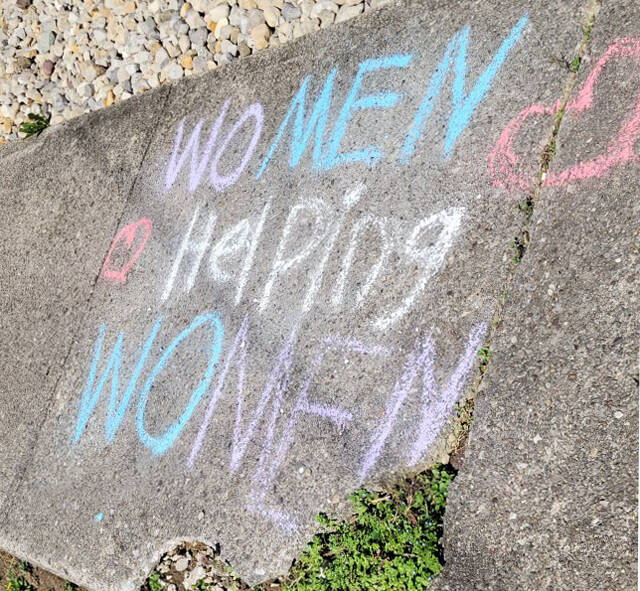
Chalk drawing states Women Helping Women on sidewalk

Submitted News

Once again this year for Sexual Assault Awareness Month (April), Women Helping Women asked local businesses and agencies to participate in the “Chalk the Walk” Event. The task was simple: April 13 and 14 chalk the sidewalk at your establishment with a note of encouragement to survivors of sexual assault.

This has been a very successful campaign in Adams and Brown Counties the last few years, led by Davina Cooper, the Rural Program Manager for Women Helping Women. Women Helping Women provides local court and hospital accompaniment, one-on-one crisis counseling, operates a 24-hour hotline and currently offers virtual support groups. They expanded their sexual assault services to both Adams and Brown Counties in January of 2017. All services are free and confidential. Davina Cooper can be reached at (513) 262-1788.

Weather made it challenging, but was nothing compared to the challenges survivors face. If you or someone you know are in need of services please do not hesitate to reach out on our 24/7 hotline which also now features a text to chat option. (513) 381-5610

Over 20 local agencies and businesses participated in “Chalk the Walk” including: Adams County Board of DD, Adams County Homeless Shelter, West Union High School, Mosier’s Furniture, Blake Pharmacy, Shelton Law Office, Ohio Country Properties: Huff Realty, Venture Productions Inc., Raven Perch Tattoo Studio, DC Engineering & Consulting, West Union Electric & Plumbing, FRS, Tan & Tone and Creative Spark Studio.

More than 131 people died in Ohio over the past year in cases connected to domestic violence. That’s according to the Ohio Domestic Violence Network, which reports a 62% increase in those deaths over the past two years.

In Cincinnati, domestic violence numbers are also trending upward, according to Kristin Shrimplin, president and CEO of Women Helping Women.

“We are seeing a continuing trend that has not been disrupted as it relates to intimate partner violence, domestic violence cases, the complexity of those cases, injuries that are resulting, and unfortunately and very sadly, homicide as a result of domestic violence and intimate partner violence homicide.”

Advocates hope bills pending in the Ohio Statehouse could protect victims. Aisha’s Law, HB 3, would require police to do a lethality assessment on a domestic violence call.

Joining Cincinnati Edition to discuss the rise in domestic violence cases is Ohio Domestic Violence Network Policy Director and Staff Attorney Micaela Deming; and Women Helping Women President and CEO Kristin Shrimplin.

Listen to Cincinnati Edition live at noon M-F. Audio for this segment will be uploaded after 4 p.m. ET.

Ohio Capital Building

State reps have introduced a bill to allow electronic monitoring of offenders when protection orders are violated, doing so in memory of Paulette Timko Propst, who was shot and killed by her estranged husband in 2011.

(TNS) — Two Ohio legislators introduced a bill last week designed to protect victims of domestic violence.

State Reps. John Patterson (D- Jefferson) and John Rogers (D- Mentor-on-the-Lake), introduced House Bill 778, to allow electronic monitoring of offenders when protection orders are violated.

The bill was developed in memory of New Lyme Township resident Paulette Timko Propst, who was shot and killed by her estranged husband in 2011.

“I feel this is a critically important piece of legislation to better protect those who may be vulnerable,” Patterson said. “With modern technology, a real time GPS tracking device placed on the ankle of a potential violator only makes sense. I am proud to support this legislation.”

The bill would grant the court discretion in its ability to require monitoring in response to all classifications of protection order violations. It would also expand the specifications of order violations in order to allow law enforcement to alert the order-protected-individual when the offender has violated the order, according to House Bill 778.

“HB 778 will strengthen law enforcement’s ability to effectively track and hold monitored abusers accountable,” Rogers said in a prepared statement. “More importantly, this measure will provide an additional layer of protection to victims of domestic violence and/or abusive harassment. Ultimately, it is our hope that protected individuals and their families can find a greater peace of mind knowing GPS technology is being actively used to ensure their safety and prevent unwanted, unlawful encounters with offenders.

The bill is the result of advocacy from Propst’s loved ones, as well community organizations, including Women Helping Women. It will bring public awareness and help protect victims of domestic violence in Ohio, Patterson said.

Patterson applauded the efforts of Robbi Zakowski, a friend of Paulette Propst, for helping get the bill to a place where it could be presented to the Ohio State House of Representatives.

Zakowski has been working with legislators, the criminal justice system and victims rights groups to raise money and create legislation to fight the problem.

“We are very excited … It is 10 years in the making,” Zakowski said.

Zakowski has worked with other domestic violence advocates from around the country to bring awareness to the problem. She said she is focused on ankle monitoring devices, she said.

Paulette Propst, 55, died of multiple gunshot wounds to the head, neck and trunk, according to the Ashtabula County Coroner’s Office.

Police believe Thomas J. Propst shot his wife with a .45 pistol a few hours after being served with divorce papers and a temporary protection order, Sheriff William Johnson said at the time. Propst also went to a barn and shot and killed his horse, the sheriff said.

The couple’s 18-year-old daughter was in the bathroom when her father came into the home. She heard voices, and sensing danger, she fled the home through a window and ran to a neighbor’s house to call 911, Johnson said.

Thomas Propst, 55, went missing after the shooting. A nationwide manhunt ensued and the U.S. Marshals offered a reward for information leading to his arrest.

Three weeks later, while out for a walk, a neighbor came across a vehicle matching Propst’s vehicle less than a mile from the murder scene. When police arrived, Propst was discovered dead inside his locked vehicle.

With a GPS tracker, if the abuser travels outside permitted boundaries or attempts to travel to the victim’s home or work, the police and the victim are alerted.

A lifelong county resident, Paulette Propst was the mother of four adult children and active in her church and community, according to her obituary.

The Propsts’ oldest daughter, Jennah Flegenheimer, said the bill will be life-changing.

“This will help so many women get the protection and peace of mind they deserve,” she said. “I’m so thankful for Robbi Zakowski who deserves the recognition for spearheading this idea. She was one of my mom’s best friends and saw that there was a need for this and I’m so proud of her.”

According to the National Statistics Domestic Violence Fact Sheet, one in three women and one in four men have experienced some form of physical violence by an intimate partner. This includes a range of behaviors, such as slapping, shoving and pushing that in some cases might not be considered domestic violence. One in seven women have been injured by an intimate partner.

HB 778 will soon be assigned to an Ohio House committee for initial consideration and public hearing.

Zakowski is helping coordinate a May 12 rally on the steps of the Ohio State Capital to create a visual representation of those who have lost their lives for have been harmed by domestic violence. The goal is to have people from all 88 Ohio counties attend the event, she said.

“We are going to give everyone a few moments to remember their loved ones,” she said

Survivors of domestic violence looking for resources and referrals in Ohio can visit ODVN.org or call 614-781-9651.

If you are in an emergency, call the 24/7 National Domestic Violence Hotline at 1-800-799-7233.

(c)2020 the Star Beacon (Ashtabula, Ohio). Distributed by Tribune Content Agency, LLC.