COSE partners with Miami University's COSE

Even though it has “social” in the name, the Council for Social Entrepreneurship isn’t just a place for like-minded students to meet. “We’re basically a club that provides opportunities to do things that are social-entrepreneurship related. We meet every other week and then we have speaker series, workshops, social events, and client projects,” co-president of COSE and senior strategic communication & entrepreneurship major Chi Pham explained. “We want students who not just come and hang out, we want them to be interactive. This is the opportunity to build a portfolio and to help others.”

Finding a client for the group’s first project wasn’t hard, thanks to COSE advisor Michael Conger. “He has actually been working with the director of Women Helping Women and said, ‘If you are looking for a client, they would love to do it,’ Pham said. “The client’s challenge was ‘How do we get students to be more aware of, and utilize Women Helping Women’s resources?’ They have a lot of services ranging from talking with survivors of sexual assault, helping with court hearings, or helping understand hospital procedures.”

“We have a problem and the problem is that we’re not seen on campus and we’re not very visible,” WHW campus advocate Morgan-Allison Moore said. “I really appreciated the experience because it allows students to use the skills they’re learning in a classroom on a real-life issue.”

This sort of project was part of what made junior theater/entrepreneurship major Alexandra Leurk interested in COSE to begin with. “I think it is really important to come at these social justice issues with an entrepreneurship mindset and a business mindset, just to balance out the different areas of knowledge that are coming in to solve those problems. I wanted to learn more about how we can approach these types of issues through that entrepreneurial mindset,” she said.

Divided into teams, 18 members of COSE got to work looking for solutions. ”Our pitch was to have student volunteers – not the organizers of Women Helping Women, but people who actually go to Miami — create a schedule and go to different departments each month, set up a spreadsheet of classes to go to and ask professors if they can go and give a two-minute quick pitch about WHW, what they offer, how students can get involved,” junior strategic communications/entrepreneurship major Caroline McManus said. “We gave them an example of how to do that by recording ourselves doing a pitch in a classroom.”

“A lot of the ideas that we were coming up with, we were gaining this understanding that social justice problems always involve a sense of personal accountability,” Leurk noted. “We all have to have a personal accountability for the problems so that it can be more of a personal situation that we can solve.”

“They surveyed their peers and asked questions about Women Helping Women and created a plan. I was taking a lot of notes when they were doing their presentations because they had amazing ideas,” Moore said. “Hearing how they feel like it should work as students, it gave me a lot of direction. I talked to my supervisor, prioritized the ideas, and started making the connections.”

COSE members said that taking part in the client project and helping WHW grow helped them learn as well. “It was a great experience. I’ve never done something like that before, and it was a great way to gain experience into what I’ll be doing in entrepreneurship classes later,” first-year economics major Mark Rick said.

“I think a major takeaway was understanding that things may look okay in everyday life, but there’s a lot of issues that our community is facing in different social justice factors and aspects,” Leurk said. “The whole world faces problems every single day, but unless we’re looking around in our local area first, I don’t think we can really always step into those other areas without seeing what’s happening in the area around us first.”

Ohio Capital Building

State reps have introduced a bill to allow electronic monitoring of offenders when protection orders are violated, doing so in memory of Paulette Timko Propst, who was shot and killed by her estranged husband in 2011.

(TNS) — Two Ohio legislators introduced a bill last week designed to protect victims of domestic violence.

State Reps. John Patterson (D- Jefferson) and John Rogers (D- Mentor-on-the-Lake), introduced House Bill 778, to allow electronic monitoring of offenders when protection orders are violated.

The bill was developed in memory of New Lyme Township resident Paulette Timko Propst, who was shot and killed by her estranged husband in 2011.

“I feel this is a critically important piece of legislation to better protect those who may be vulnerable,” Patterson said. “With modern technology, a real time GPS tracking device placed on the ankle of a potential violator only makes sense. I am proud to support this legislation.”

The bill would grant the court discretion in its ability to require monitoring in response to all classifications of protection order violations. It would also expand the specifications of order violations in order to allow law enforcement to alert the order-protected-individual when the offender has violated the order, according to House Bill 778.

“HB 778 will strengthen law enforcement’s ability to effectively track and hold monitored abusers accountable,” Rogers said in a prepared statement. “More importantly, this measure will provide an additional layer of protection to victims of domestic violence and/or abusive harassment. Ultimately, it is our hope that protected individuals and their families can find a greater peace of mind knowing GPS technology is being actively used to ensure their safety and prevent unwanted, unlawful encounters with offenders.

The bill is the result of advocacy from Propst’s loved ones, as well community organizations, including Women Helping Women. It will bring public awareness and help protect victims of domestic violence in Ohio, Patterson said.

Patterson applauded the efforts of Robbi Zakowski, a friend of Paulette Propst, for helping get the bill to a place where it could be presented to the Ohio State House of Representatives.

Zakowski has been working with legislators, the criminal justice system and victims rights groups to raise money and create legislation to fight the problem.

“We are very excited … It is 10 years in the making,” Zakowski said.

Zakowski has worked with other domestic violence advocates from around the country to bring awareness to the problem. She said she is focused on ankle monitoring devices, she said.

Paulette Propst, 55, died of multiple gunshot wounds to the head, neck and trunk, according to the Ashtabula County Coroner’s Office.

Police believe Thomas J. Propst shot his wife with a .45 pistol a few hours after being served with divorce papers and a temporary protection order, Sheriff William Johnson said at the time. Propst also went to a barn and shot and killed his horse, the sheriff said.

The couple’s 18-year-old daughter was in the bathroom when her father came into the home. She heard voices, and sensing danger, she fled the home through a window and ran to a neighbor’s house to call 911, Johnson said.

Thomas Propst, 55, went missing after the shooting. A nationwide manhunt ensued and the U.S. Marshals offered a reward for information leading to his arrest.

Three weeks later, while out for a walk, a neighbor came across a vehicle matching Propst’s vehicle less than a mile from the murder scene. When police arrived, Propst was discovered dead inside his locked vehicle.

With a GPS tracker, if the abuser travels outside permitted boundaries or attempts to travel to the victim’s home or work, the police and the victim are alerted.

A lifelong county resident, Paulette Propst was the mother of four adult children and active in her church and community, according to her obituary.

The Propsts’ oldest daughter, Jennah Flegenheimer, said the bill will be life-changing.

“This will help so many women get the protection and peace of mind they deserve,” she said. “I’m so thankful for Robbi Zakowski who deserves the recognition for spearheading this idea. She was one of my mom’s best friends and saw that there was a need for this and I’m so proud of her.”

According to the National Statistics Domestic Violence Fact Sheet, one in three women and one in four men have experienced some form of physical violence by an intimate partner. This includes a range of behaviors, such as slapping, shoving and pushing that in some cases might not be considered domestic violence. One in seven women have been injured by an intimate partner.

HB 778 will soon be assigned to an Ohio House committee for initial consideration and public hearing.

Zakowski is helping coordinate a May 12 rally on the steps of the Ohio State Capital to create a visual representation of those who have lost their lives for have been harmed by domestic violence. The goal is to have people from all 88 Ohio counties attend the event, she said.

“We are going to give everyone a few moments to remember their loved ones,” she said

Survivors of domestic violence looking for resources and referrals in Ohio can visit ODVN.org or call 614-781-9651.

If you are in an emergency, call the 24/7 National Domestic Violence Hotline at 1-800-799-7233.

(c)2020 the Star Beacon (Ashtabula, Ohio). Distributed by Tribune Content Agency, LLC.

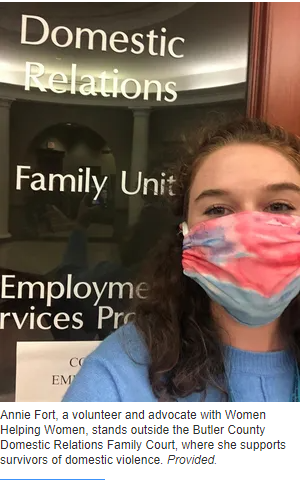
Woman Standing Outside Butler County Domestic Relations Family Court

Cincinnati City Council will give a quarter-million dollars to a nonprofit that works alongside the police to help survivors of domestic violence – a crime that has spiraled in the city during the COVID-19 pandemic.

Council unanimously voted Wednesday to approve the $250,000 in funding to Women Helping Women to use for the Domestic Violence Enhanced Response Team (DVERT).

Calls about partner violence are up, and more of the violence is life-threatening, said Kristin Shrimplin, the agency’s president and chief executive officer.

“It is staggering,” said Greg Landsman, the council member who proposed giving the financial help to the organization for the DVERT program.
Here’s how DVERT works: When Cincinnati police officers arrive at a domestic violence scene, they secure the scene, do a brief assessment and then call a DVERT advocate. The advocates, Women Helping Women employees who ensure the agency is staffed 24-7, have trauma-informed training. They help survivors get resources they need to be safe. They may go to a hospital with someone who’s hurt, provide shelter, get them legal help and sit in court with the survivor as the case moves forward.

Two Cincinnati Police Cruiser with Red and Blue Lights On

“Most of these survivors have children, and they are survivors too,” Landsman said. “If a survivor has a DVERT advocate there on the scene with our police … it makes an enormous difference in them getting support that they need.”

Calls to a Women Helping Women hotline jumped 53% this year in a 14-week period from March 16-June 30 compared to the same weeks in 2019, an analysis by the nonprofit shows. That came despite the difficulty that those experiencing partner violence had in making phone calls while their partner was in the same home, said Shrimplin said. The agency developed a texting method during this period to help keep callers safe.

Shrimplin said that, with the uncertainty that the pandemic causes, she fully anticipates a continuation of climbing calls. “This is not letting up.”

Women Helping Women advocates have seen more strangulation, more threatened gun use and more gun violence in their response to survivors, Shrimplin said.

Cincinnati in general has seen a rise in violence in general against women this year.

Early this month, the city reached a new high in homicides of women: By Sept. 9, more women had been killed  in the city than in any other year since at least 2000.

Chart of Women Killed Due to Homicidal Violence

Not all of the killings were domestic violence related, police said. But an Enquirer analysis of data from last year shows women killed in Cincinnati are more likely to be killed in partner violence or child abuse situations than any other reason.

Women Helping Women had a fundraising gap this year of $250,000, due to the pandemic, officials said. Yet the agency’s caseload of survivors has increased by 25%, its analysis shows.

Landsman said the DVERT program has proven to be helpful to mothers and children victimized by domestic assault.

“I think it’s up to us to invest in what we know is working,” he said, “and ensure that we are expanding that work so that no one in the city is left behind.”

Terry DeMio

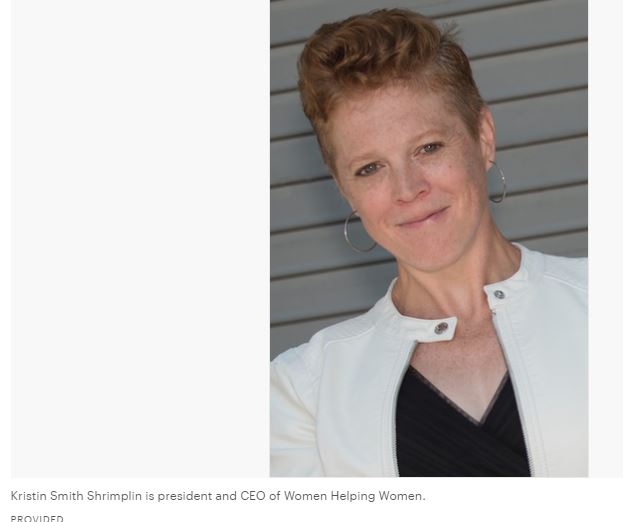
Kristin Shrimplin is president and CEO of Women Helping Women. A nonprofit assisting survivors of domestic violence

Byron McCauley
Cincinnati Enquirer

The partner of my aunt, an elementary school teacher, once used his meaty fists to break her face, leaving her face a bloody, unrecognizable mess.

This wouldn’t have been the first time he hit her, but it certainly was the most damaging. My aunt suffered grave injuries that required hospitalization. The whole town knew it. Yet, her abuser was walking the streets the next day.

As the pretty young wife of a jealous husband, my aunt’s daughter was a survivor, too. Her skinny husband executed a bloody attack on a hot afternoon in front of a group of terrified and petrified kids. Another cousin’s husband cracked her skull with a brick. Thankfully, she lived. All the of the abusers remained free.

I attended the Women Helping Women 2nd annual breakfast Thursday. Women Helping Women offers resources to deal with domestic violence and sex crimes. If only my kin had such support — especially when they could not count on the law to be on their side. Back then, it was not uncommon for a local lawman to help the abuser “cool off” by driving him around for a while.

Sadly, in Greater Cincinnati, the need is increasingly significant. Women Helping Women in 2017 reported helping nearly 5,800 new survivors. So far this year, it has served nearly 6,000 survivors with more than two months remaining in the year. The #MeToo movement and the U.S. Supreme Court hearing spurred more people to tell their truth. In September, the group helped 1,028 survivors.

President and CEO Kristin Smith Shrimplin reflected on the national conversation around gender-based violence. “The national narrative has changed in its belief of survivors and its treatment for survivors,” Shrimplin said during the breakfast. “Supporting survivors is not open for political debate.”

Women Helping Women volunteers are doing yeoman’s work. They go to victims’ homes with police to remove them. They staff a crisis line 24 hours a day, every day. They meet rape survivors in hospital emergency rooms. They support survivors in court. They train leaders in the workplace to recognize a victim of gender-based violence on their team.

They have campus advocates at Miami University and the University of Cincinnati.

They help families. In February, the organization partnered with the Cincinnati Police Department to start the DVERT program. So far, the program has helped 472 adults and 588 children out of domestic violence.

The insidious thing about gender-based violence is its stealth. Horrified victims don’t tell other people what they are going through. When they miss work or are chronically tardy, an HR issue arises, and the real problem is masked. They may not have visible evidence of abuse, but their scars show up in other ways.

All of us need to be better equipped to spot someone who may be suffering, to engage them and be an advocate for them. The numbers in our community are trending upward across the board. And today, largely because of organizations like Women Helping Women, a strategic approach to help is available.

No one needs to suffer in silence anymore. Byron McCauley Enquirer Columnist

Byron McCauley writes about education and family life. He also serves on the Enquirer editorial board. Email: [email protected]. Social: @byronmccauley.

M. B ReillyBy M.B. Reilly . (513) 556-1824

In working to continually find better ways to prevent and respond to cases of sexual harassment, assault and misconduct, the University of Cincinnati is adding to the range of options it already offers in the form of advocacy, training, prevention and resources related to

Title IX

In a new agreement between UCs Division of Student Affairs and Women Helping Women (WHW), the community organization will provide an on-call, confidential campus advocate/response to provide comprehensive support to those who have or are experiencing (or have witnessed) gender-based violence, such as sexual assault, domestic violence or stalking. That 24/7 on-call service begins this week, and will be available to all students, not just women. The service will also be available to all faculty and staff.

WHW will provide confidential services that are focused on the survivor and include individual crisis intervention, hospital accompaniment, campus reporting assistance, accompany students through Title IX and law enforcement or legal processes, assist with campus-based accommodations, provide referrals for health and wellness services, and assist survivors who seek interim measures. Again, while primarily focused on serving students, the advocate will also be available to campus faculty and staff as well.

  • An on-call campus advocate from Women Helping Women can be reached 24/7 at 513-381-5610, the WHW hotline.
  • By Oct. 30, a full-time WHW campus advocate will be housed on campus, in an office in the Steger Student Life Center.
  • With the start of the new school year, UC is also expanding prevention options with new bystander training.
  • With the start of the new school year, UC has developed a Support Services Coordination Team to bring together all those addressing gender-based violence and sexual assault.
  • UC has added two Title IX investigators and just hosted (on Aug. 15-16) a level one Title IX investigator training session, led by the Association of Title IX Administrators.
  • Annually, incoming UC students take ‘Think About It’ online training highlighting the role alcohol often plays in terms of sexual assault. That training also focuses on accountability and consequences, laws and policies governing sexual assault.
  • The new offerings add to those already available to students, including confidential medical services, UCPDs victim services coordinator, and UCs Counseling and Psychological Services Center 24/7 service to students in crisis due to sexual harassment, misconduct and assault. For a complete list of resources, visit UCs Title IX site.

Our new advocate, to be dedicated to serving the campus community, will provide confidential support for students. We believe survivors, and we support survivors. The advocate’s role is to listen to the survivor, outline options, link survivors to services that they want and to focus on empowerment,” said Kristin Smith Shrimplin, president and CEO of WHW.

According to Debra Merchant, vice president of UCs Division of Student Affairs, students need a variety of support options, and this new partnership with WHW provides another confidential support on campus, in the same way that there are counselors in UCs Counseling and Psychological Services who specifically provide assistance to survivors of sexual assault or harassment.

She stated, this adds to what we can provide to students. Some of the support is what we call confidential (like that offered by a counselor or this advocate). Some of it is what we call non-confidential or of public record, like going to UCPD. In order to provide the best service, it’s important to provide these confidential options as well.

The main responsibilities of the on-call campus advocate are as follows:

  • Provide direct crisis-intervention services to campus survivors of sexual assault, domestic violence and stalking.
  • Provide telephone and one-on-one crisis intervention, hospital advocacy, civil and criminal court accompaniment, campus-based referrals, and accompaniment to campus hearings.
  • Assist students with safety planning and provide information and referrals with each student as appropriate.
  • Accompany clients to proceedings/appointments/meetings as needed to provide information, advocacy, support and safety.
  • Advocate for survivors based on survivor-defined goals and with the consent of the survivor.

Additional Contacts
John Bach  | Director of Executive Communications | Marketing + Communications | 513-556-2019

Kristin Shrimplin CEO of Women Helping Women

Kristin Smith Shrimplin is the president and CEO of Women Helping Women, an agency that serves all survivors of sexual assault, stalking and domestic violence in Hamilton and Butler counties.

The story about a Stanford University student who committed sexual assault caught national and local attention. But this is not a new narrative. This is a story that is very worn out. As the leader of Women Helping Women, I am unapologetically angry at the repetitive nature of this story. It’s 2016, and our nation, our communities and our campuses remain besieged by rape culture. This is an epidemic, and it is time for radical change.

Let’s start by changing the narrative. Media: Please tell us the stories of all of the actions and the words of the male friends of Brock Turner who went to the party with him. Tell us about how they stepped in at every point that he and any other individual targeted a woman for domination and control. Tell us about what Stanford University taught Brock Turner and all of its students about consent culture during first-year orientation. Tell us what Brock Turner’s father told him as a young man going off to college about how to respect women’s autonomy. Tell us what the teachers taught Brock Turner in middle and high school on prevention of sexual violence. Tell us what Brock Turner’s swim coach taught him when he was 8 years old about character, integrity and being a true champion.

Brock Turner (right) makes his way into the Santa Clara Superior Courthouse in Palo Alto, California, on June 2. He received a six-month jail sentence for raping a young woman.

Tell us. We will listen. But no one can tell us those stories because no one can find those headlines. The headlines can’t be reported because that’s not what happened that night or at all the points in time before that night. This is what is happening:

  • 98 percent of rapists never see a day in jail or prison.Brock Turner entering Santa Clara Superior Courthouse
  • 1 out of 3 women are sexually assaulted or physically abused in their lifetime.
  • 1 out of 4 girls experience sexual assault before the age of 18.
  • A rapist’s father complains about his son’s sentence of 6 months of prison for “20 minutes of action,” and the woman raped must live with the impact of the trauma for the rest of her life.
  • In 2015, WHW responded over 15,000 times to the hospitals, to the courts, to the hotline, to support groups, and to one-on-one crisis intervention to serve survivors in Hamilton and Butler counties alone.
  • In the first quarter of 2016, WHW hit a record of responding over 4,000 times to survivors.

Let’s change the narrative by changing what we tell women and girls. Men: Be brave and talk to your sons, grandsons, nephews and friends about sexual assault, rape and consent culture. Promote prevention. Listen to the women and girls in your life. When women and girls tell you their stories, stand beside them with full support and model the Stanford survivor’s powerful words:

“… to girls everywhere, I am with you. On nights when you feel alone, I am with you. When people doubt you or dismiss you, I am with you… you are important, unquestionably, you are untouchable, you are beautiful, you are to be valued, respected, undeniably, every minute of every day, you are powerful, and nobody can take that away from you. To girls everywhere, I am with you…”

Let’s change the narrative and unite as a community to combat this violence. This public health epidemic demands attention as if it were toxic, lead-laden water in our public pipelines. Policymakers, institutions, universities, and community members: Let’s work together to dismantle immaterial language that describes a rapist. Individuals who commit sexual violence make a decision to commit a crime to victimize and violate another individual. It is immaterial that a rapist is an athlete with a promising swimming career who can no longer enjoy a steak because of the crime he committed. These irrelevant words serve as a manufactured smokescreen that takes us away from the real story.

The real story is that the rape culture violates our community’s ability to thrive. WHW trustees, advocates, prevention educators, volunteers and survivors call for a “forever cure” to this public health crisis. All leaders, supporters and major institutions must intensely use their influence and resources to shine a light on a crime that hides in the dark behind dumpsters. Humans are not trash.

We can no longer dismiss this issue as merely a “women’s issue.” This is a human rights issue in which humans are stripped of their autonomy and self-agency of their very own bodies. Sexual assault is a crime – a debilitating, soul-stripping crime. And now is the time to change it all: Change the media’s framing of the narrative. Change the judicial institutions’ response. Change patriarchy. Change oppression. Change apathy. Change the system.

WHW believes in the radical notion that all of our community members deserve to thrive in a culture of accountability, prevention and consent. Let’s all be “upstanders” and build that community together to support survivors and promote prevention.