Editor’s note: This story mentions stalking and sexual assault.

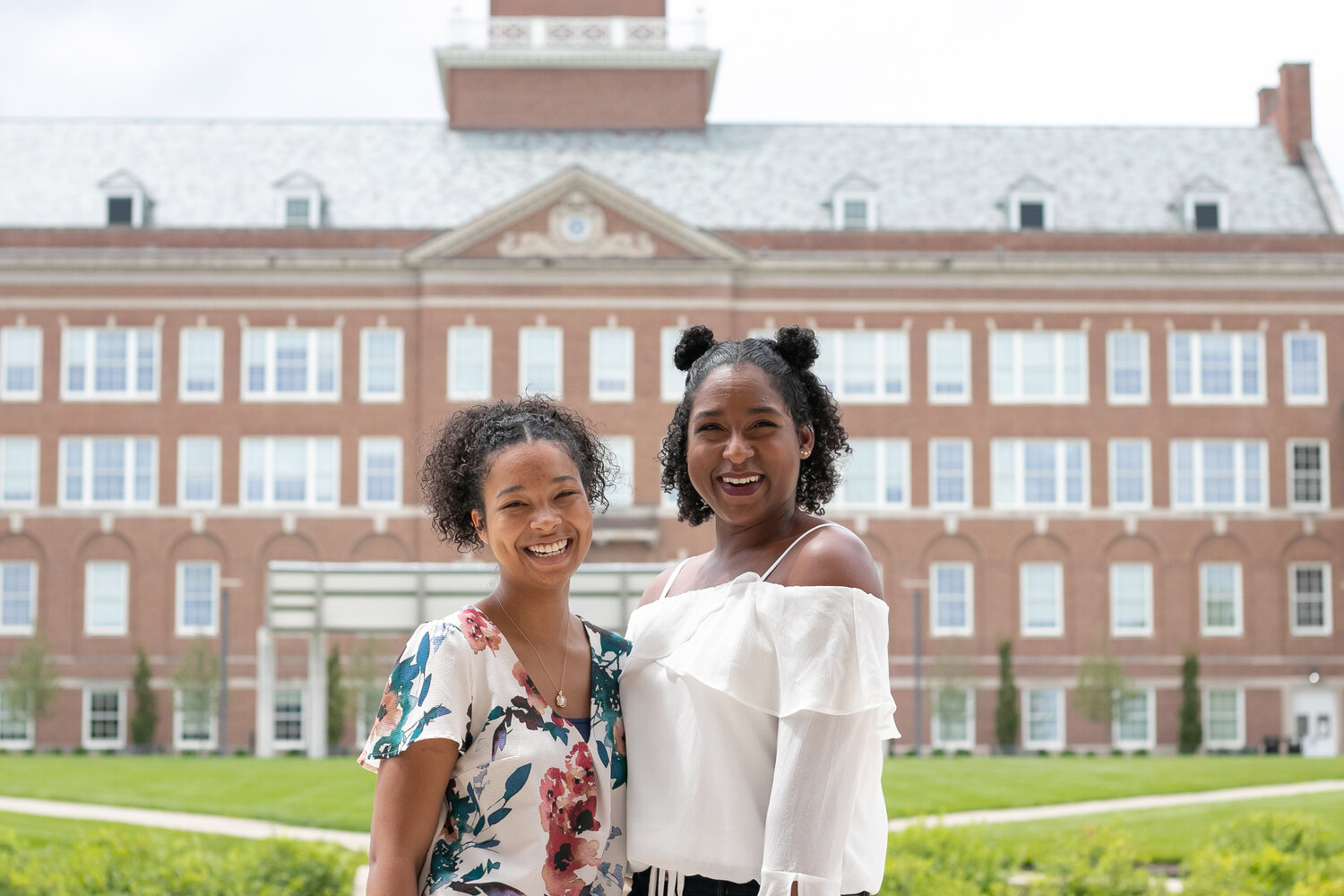
This January marks the seventeenth year of the National Stalking Awareness Month (NSAM), and Women Helping Women’s University of Cincinnati (UC) campus advocates have been using their platform to address the important issue. Zoe Miller and Claudia Uchtman, both campus advocates for Women Helping Women (WHW), make it a point to bring awareness to the serious problem of stalking in their work with WHW and on UC’s campus.

“We serve students, staff and faculty,” Miller said. “We’ve even had people that have graduated, reach back out to us, and then we get them connected to our main agency. But yeah, we see everybody. Anybody can be a survivor, and we’re here to help everyone.”

Miller has been a campus advocate for WHW for about a year and a half and went to the UC for her bachelor’s and master’s degree in social work.

Uchtman went to Northern Kentucky University and graduated with a bachelor’s in criminal justice. She first began work with WHW as a member of the DVERT program, the Domestic Violence Enhanced Response Team. Uchtman has been a campus-based advocate at UC since last October.

“I realized there was a need for advocacy work, so that’s why I was drawn to this field,” she said.

The goal of Stalking Awareness Month is to bring attention to stalking, especially in the age range of college students.

“I don’t think [students] realize how prevalent [stalking] is,” Miller said. “And now adding the pandemic and adding all the access we have to digital platforms, it really increases the likelihood if someone wants to stalk somebody else, they have a lot of avenues now digitally, to be able to accomplish that.”

“A lot of times, people that are in domestic violence situations, they’re also stalked,” said Uchtman. “Or sexual assault survivors, they’re also stalked. So, it’s like they all intersect and intertwine.”

Miller reiterates that, unfortunately, college campuses allow stalkers more access to the individuals they’re stalking, especially students or people working together.

“Say we have a protection in order in place, and it’s outside school bounds,” Miller said. “A lot of times, the orders will have an exception when they’re in the classroom, to where the person that they’re asking for protection from gets adjusted while they’re in that classroom, and they just have to sit on opposite ends of the class. How does a survivor focus on their presentation, or information they’re getting from their professor, when their stalker is sitting right behind them?”

According to the National Stalking Awareness website, one in six women and one in 17 men have experienced stalking, with about 90% of stalking victims falling between 18 and 24. About half of college students who were sexually assaulted also experienced stalking.

Miller adds that stalking can be confusing. By law, the definition of stalking includes that it has to be a pattern of two or more times. This can cause a gray area, especially if a stalker is subtle.

When students come to the campus-based advocates, the advocates do what the students want, according to Uchtman.

“We, as advocates, don’t tell anybody what to do,” she said. “We listen to what they’re saying, give suggestions and refer to the Title IX office if they need academic accommodations. Some people don’t know that they can get a protection order, so it’s explaining that process, or going to the police station or referring them to counseling. Anything that they possibly could need, we can get them connected with resources.”

Uchtman and Miller will go to court with survivors if the survivor wishes to file a protection order or to interviews with detectives.

After partnering with UC’s Student Government, Uchtman and Miller now run a UC safe fund that provides survivors with items that they may not be able to get. In the past, they have provided security cameras for a survivor who felt like someone was lurking outside of their apartment.

“Talking that financial stress and strain off of them is what we’re here to do,” Miller said.

Though its name is Women Helping Women, Uchtman and Miller support women, men and/or nonbinary survivors.

Miller and Uchtman work with the Student Wellness Center, and their office is located at 559 Steger Student Life Center.

The office is open Monday thru Friday, 9 a.m. to 5 p.m., and accepts appointments and walk-ins. Those who feel like they may be a victim of gender-based violence can call or text (513) 431-3807/1563 or message uc_whwcampusadv on Instagram. There is also a 24-hour hotline outside of office hours, (513) 381-5610. Services are available to all UC students on Clermont, Blue Ash or Uptown campus.
Interview by Emma Segrest. Photography by Chelsie Walter.

Trigger Warning: This article/interview contains references to sexual assault, rape, and gender-based violence.

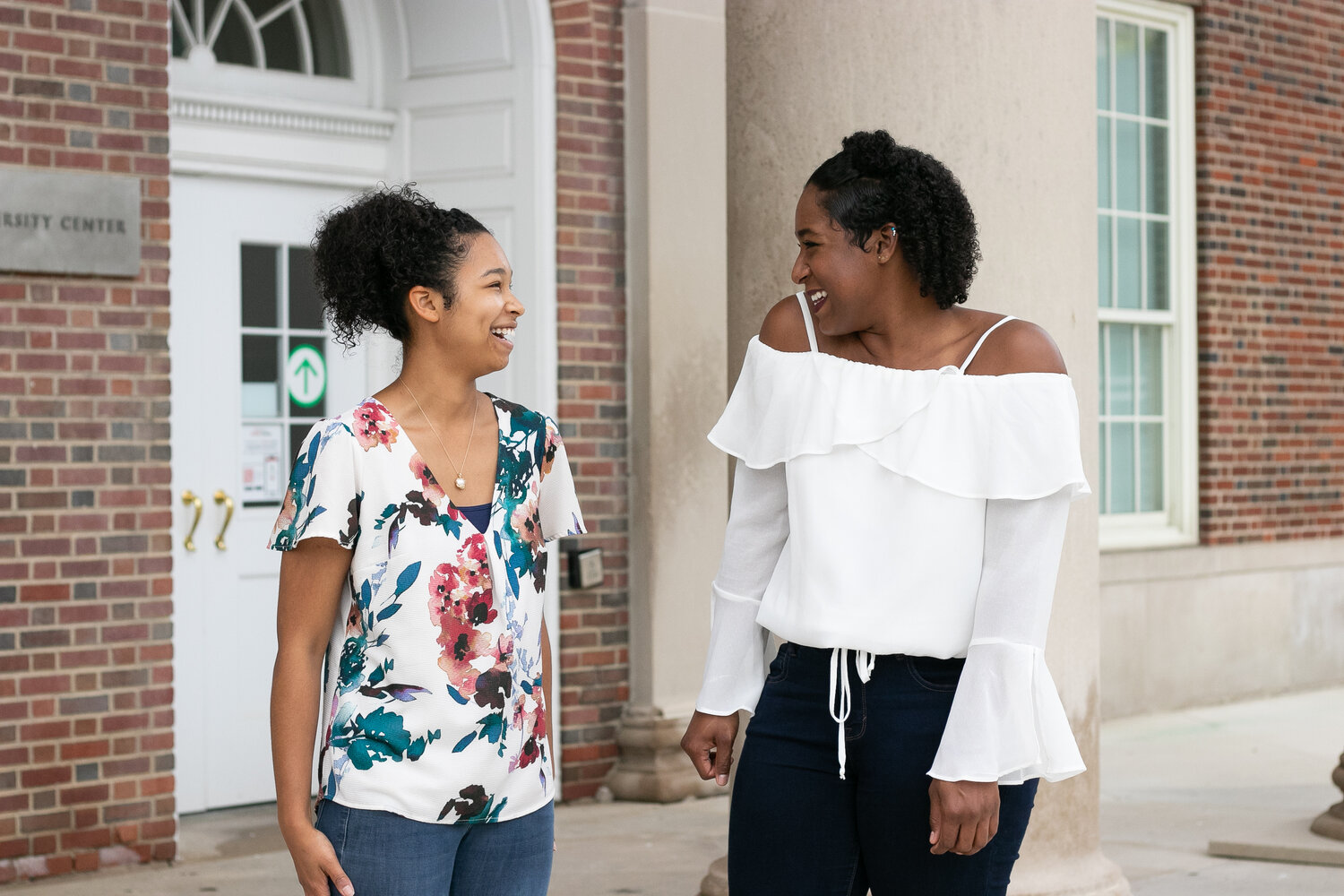
two women smiling for a picture

I’m going into my fourth year as a journalism and creative writing major at the University of Cincinnati. Last semester, I was able to take on a story in my investigative journalism class exposing the faults in the university’s protocols for alerting students about sexual assaults that happened on our campus. My co-writers and I found that over a five-year period, the University of Cincinnati only told students about one in every five rapes that happened on campus.

The revelation was discouraging and left me feeling frustrated and disappointed. Even more so when I talked to former Women of Cincy interviewee Grace Cunningham, who further confirmed the lack of care her story received from the university. It left me wondering what was available to students who go through these types of traumatic experiences, where can they turn to on a campus that carries these troubling trends?

When researching what resources were available and were genuinely helpful to students, I found the Women Helping Women (W.H.W) Campus Advocates Zoe Miller and Cheniece Wilson. Zoe and Cheniece’s presence when I first had the opportunity to talk to them over Zoom can be described as a warm hug. They radiated compassion, professionalism, and care for the work they do. After my previous experiences of trying to contact people at U.C. about how the university handles sexual assault reports on campus, talking to Zoe and Cheniece showed me what this experience should be like for students every time.

As the official Campus Advocates for the University of Cincinnati, Zoe and Cheniece are responsible for creating awareness and education around gender-based violence. The pair focus on connecting students who have experienced gender-based violence to appropriate resources, being a confidential support system for survivors, and more. These women do it all and do it with the utmost love for their work and the students they help every day.

Both women have local roots; Zoe received her master’s degree from U.C. in 2018 for social work and Cheniece graduated from Xavier in 2019 with a bachelor’s degree in social work and a minor in gender and diversity studies. They have worked in courts, police departments, schools, shelters, and more. Their dedication to their advocacy is nothing short of awe-inspiring and gives me more restored hope in how U.C.’s community can continue to tackle these issues of gender-based violence on our campus.

The following Q&A is based on the interviewee’s firsthand account of their experiences and opinions alone.

As campus advocates, the general premise of your role is to provide resources to students who are impacted by gender-based violence and create awareness for this. Could you tell me what some more specifics of this role are?

Cheniece: As a campus advocate, our primary role is to serve students, staff, and faculty members of U.C.’s community. So some of the things we do are one-on-one appointments in crisis interventions, court advocacy, hospital accompaniments for survivors of gender-based violence (G. B. V.), assistance with Title IX hearings and academic accommodations with this, any referrals to outside resources, and we host a weekly support group.

I think on a college campus there are a lot of instances of rape culture that go unchecked every day. Would you be able to provide some examples of what rape culture can look like or how to identify it?

Zoe: Rape culture, I feel like right now has become sort of a buzzword in a way.

Cheniece: I agree.

Zoe: I think sometimes people don’t know what it means. Rape culture is this sociological theory of a setting in which rape is pervasive and normalized due to societal attitudes about gender and sexuality.

So when we’re talking about rape culture, we are talking about dismantling that idea. To break it down with what we do on campus, we discuss what it is in a lot of our prevention programming. We have a program called bystander training which is where we discuss this spectrum of violence and recognize the frequency of this behavior.

quote discussing rape culture

You know, there’s a scale of what rape culture can look like. A lot of times these “less harmful” words or behaviors can be more frequently used and accepted as normal by people.

I’m guessing this is a dangerous viewpoint?

Cheniece: Absolutely, because this means that rape culture is still happening, gender-based violence is still happening, but on the lower end of this scale. It paves the way towards increasing violence and tolerance of this behavior.

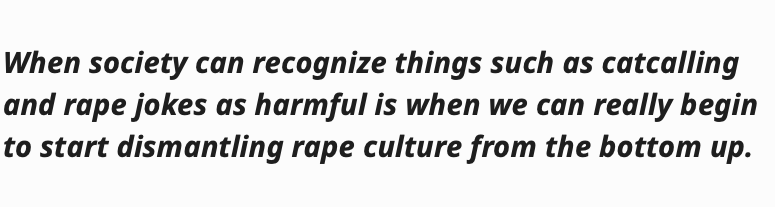
Zoe: When society can recognize things such as catcalling and rape jokes as harmful is when we can really begin to start dismantling rape culture from the bottom up. When I say the bottom up, usually when we talk about this we are looking at the spectrum or like a pyramid of things, and at the bottom is kind of where that catcalling and rape jokes live.

So for example with our programming, we do a thing called “In Reel Life” where we have a conversation and identify examples of what rape culture behavior can look like on film, and point out where society is accepting pervasive attitudes and behaviors.

Cheniece: We did one about “Twilight” that went really well.

Zoe: It did, it started off our series.

Cheniece: The whole time we talked about how much of a stalker Edward was.

Zoe: Yes, I remember when I watched it when I was younger we were told that everything he’s doing is romantic. So there’s a point in the movie where Edward is in Bella’s bedroom, but Bella never gave consent for him to enter, and she’s sleeping. He’s just standing over her watching. This is not only an example of him stalking but his behaviors escalating as well. Had Edward been represented as his true 104-year-old self the audience would have had a completely different reaction to this.

Cheniece: Beyond this, we have training for jobs, bars, and more. Rape culture can be perceived in totally different ways for all these locations. We have to be able to have different conversations in different settings to be able to educate on all levels.

two Cincinnati women laughing together in front of building

Why do we need a focus on gender-based violence on a college campus specifically? Why have all these tailored resources just for college students?

Zoe: On a college campus, college students might be, and typically are, more vulnerable to gender-based violence because of a potential lack of exposure or understanding of healthy relationship dynamics.

Cheniece: We work to try and educate students on healthy relationship habits, what this gender-based violence can look like, and offer them a safe place to go should they experience it.

quote discussing empowering survivors

Zoe: So on a college campus there is something called a “red zone” and what that is, is a period of time typically in the fall semester where the majority of sexual assaults will happen on campus. This influx of new students, in a new environment, leaves a lot of people open to being potentially harmed.

What do you hope is people’s biggest takeaway upon learning about the work you two do?

Cheniece: As campus advocates, we are available to everybody a part of the U.C. community. So that includes the main campus, the branch campuses, virtual school, and faculty and staff. If you are part of the community we are here for you. 

Zoe: We work with all survivors regardless of racial, sexual, gender, or religious identity. Our name says Women Helping Women, which oftentimes might deter somebody, but we are here to help everyone who may need it.

When we talk about gender-based violence, there is a big push to use the word survivor instead of the word victim. Do you wanna talk about that?

Cheniece: For some people, being referred to as a victim has a very negative connotation. Using the term survivor can empower the individual and allow them to see themselves as a true survivor to what they have experienced. It really gives them back that control over their autonomy. On the flip side of that, some survivors do prefer to be called victims. We do try to reflect what terms and verbiage our clients are using, whatever they feel connected to is the right choice for them. But it is personal.

Can you walk me through an average day on the job?

Cheniece: Yeah! I would say for both of us, every day is kind of new. I love when we get asked this question, you know our day can get filled up with things like one-on-one interventions or collaborations with other offices on campus, training, support groups, the list goes on! All of that being said, when doing this crisis work, all of that can change in an instant. Sometimes we have to push away that to-do list until the next day because at the end of the day my number one priority is really making sure our survivors are being served properly.

Zoe: I would agree with Cheniece on that. Advocacy work is a lot of flexibility in what you do. You never know when your services are going to be needed, and how they’ll be needed. Helping our survivors is always the end goal though.

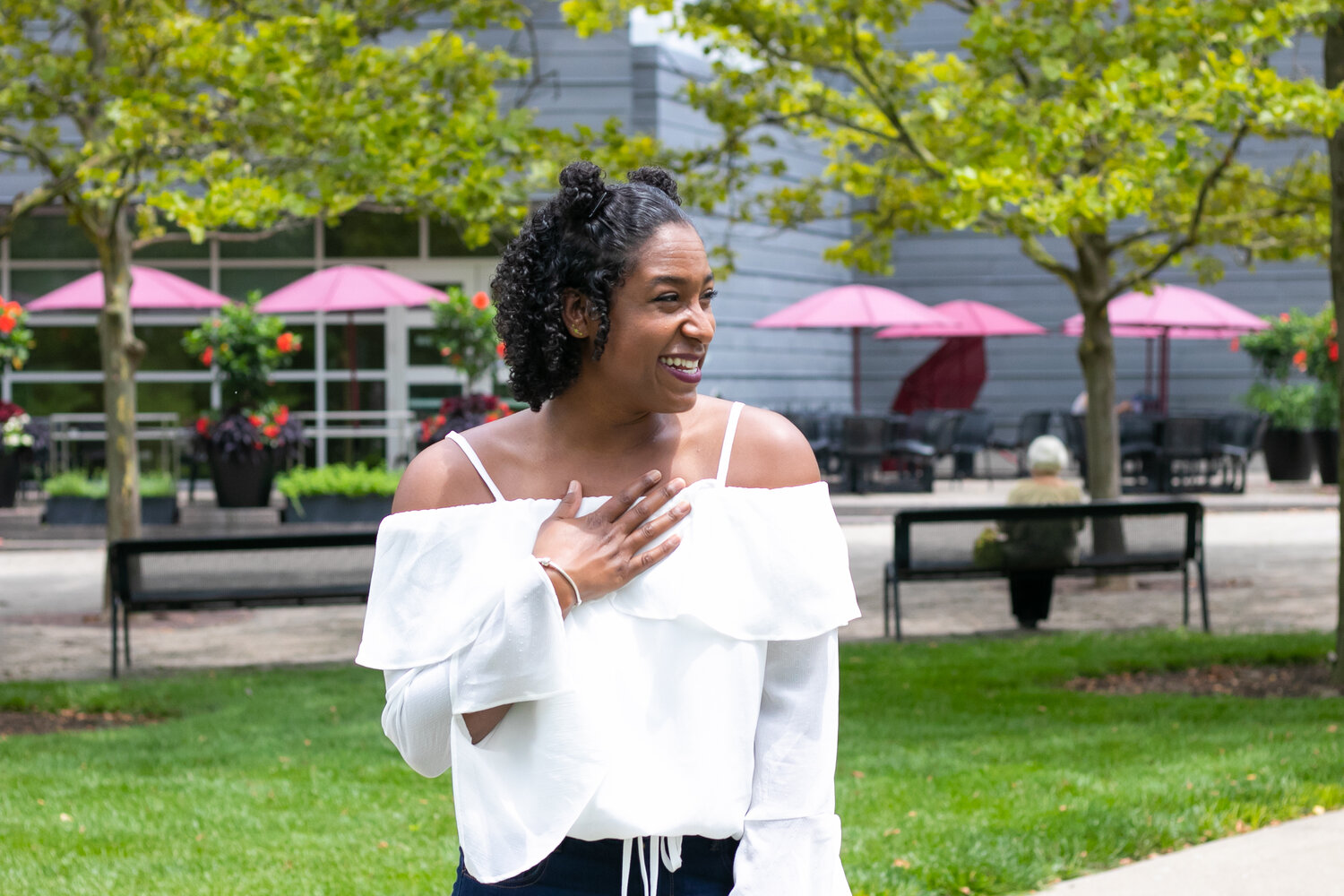
woman smiling with her hand on her white shirt

I noticed that a lot of the campus events you had this year, whether on campus or virtual, were tailored to specific groups on our campus. I noticed a ton of great work that came after the Atlanta Spa Shooting, creating programs that explained specific gender-based violence in the A.A.P.I community, so why is it important to have these tailored events for specific communities of people versus a general awareness type thing? 

Cheniece: The number one thing to note is that there are a lot of cultural and identity intersectionalities that intertwine with gender-based violence. This ends up putting some individuals at higher risk for gender-based violence. About 45 percent of our clients are Black P.O.C. identifying, and about 27 percent are a part of the L.G.B.T.Q.+ community.

I had never heard those statistics before, hearing statistics like that always takes you aback just a little bit. Going further into this, what steps do you take to tailor your programs to students of various gender identities and sexualities? 

Zoe: We do a lot of outreach on differing identities on our social media page. We use social media in every aspect of the work that we do. Some examples of things we’ve posted on there we provided different stats regarding gender-based violence in the L.G.B.T.Q. community like the one we just shared with you; we created a spotlight of different gender-based violence advocates both local and around the world of all types of identities, we made posts highlighting the stats of B.I.P.O.C. and gender-based violence, we collaborate a lot with the L.G.B.T.Q. Center and the Gender Equity and Inclusion office, too.

I think that’s awesome how much care you both put into making your programs a place where everyone can feel safe and heard. I saw that another way you do this is with your peer advocacy program, can you tell me about that?

Cheniece: Absolutely! Our program is called Peers Helping Peers or P.H.P for short. It’s really just a volunteer program where students are able to provide education to their peers about the things we work on here. They also promote a campus culture that really believes in empowering survivors, they do great work for that.

You know, our volunteers usually do advocacy training where they learn about our ethics and more about what gender-based violence looks like. Then on top of that, they get to become super immersed in what Women Helping Women is. They care a lot about the work they do and it shows, it really does.

If you could say anything to those who volunteer with you right now what would it be?

Zoe: We love our P.H.P. members. We need to give huge props to all the work they do on campus. From social media posts to service presentations they really do the most. With all the work Cheniece and I do, we wouldn’t be able to do everything and reach as many people as we do, without them by our side.

It’s encouraging to know that even when they leave the U.C. community, they’ll take the information that they learned and be pioneers in their future spaces.

Can you please explain what gender-based violence is? I feel like we hear the term a lot but there’s rarely a definition given to it.

Cheniece: We can really describe it as a thing that jeopardizes a woman’s life, mind, body, psychological integrity, and freedom. Using the term gender-based is to highlight the fact that violence against women is an expression of power and control, and the inequalities between men and women.

Zoe: Absolutely we recognize that gender-based violence can happen to all genders, but women are disproportionately affected by this issue. At Women Helping Women our job is to support and serve all survivors regardless of gender identity.

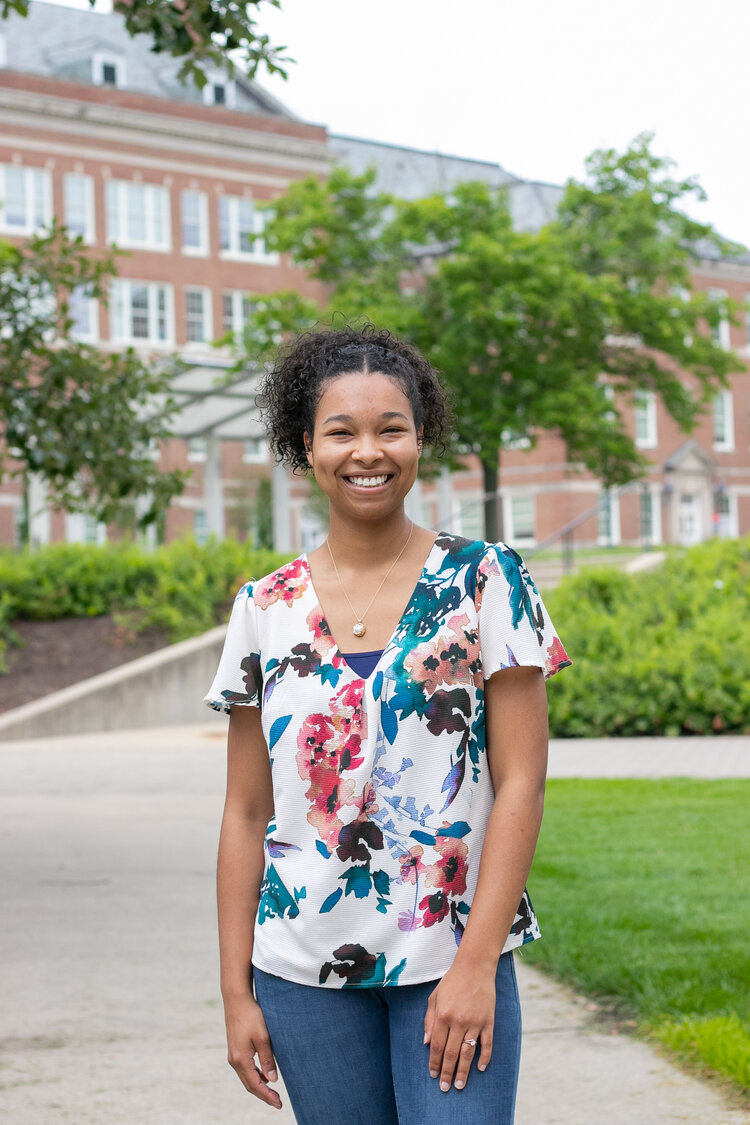
woman standing smiling in pink and blue blouse

I imagine it can get difficult sometimes to have to talk about these events and witness these things often. Does it ever get hard to continuously talk about these heavy subjects?

Zoe: Honestly talking about these topics can come pretty easy to us because we are so passionate about our work. I would say that what does become difficult is turning off our brains and shifting into that self-care mode. Luckily W.H.W. is super supportive and understands that need for self-care. So, recently they’ve implemented self-care days for us which we can take any time we need.

If I need to take a self-care day tomorrow, if it’s good to go then I can kind of take that time to rest and take care of myself. I feel we are truly lucky to have those.

What are some of your guys’ favorite self-care rituals?

Cheniece: It can be difficult to take care of myself sometimes. While this work is super rewarding, as advocates we have to be aware of vicarious trauma. A definition for that is just receiving trauma by listening to survivors’ trauma. I would say I really try hard to be in tune with my body and mind and spirit, just because of this.

Like everybody else, of course, I do bubble baths or paint my nails or do my makeup to make my physical self feel good. But when thinking about my mind and spirit I like to do things like painting while listening to podcasts, writing poems, scheduling appointments like therapy or other doctor appointments. I’m a big believer in therapy. And exercising too is another thing I do. I feel like oftentimes as advocates we emphasize to survivors how important it is to use different kinds of grounding techniques and coping mechanisms. So I just try hard to do the same.

Zoe: For me, my normal go-to is talking through things. I am a talker in regard to debriefing. I also hike, I have two dogs so I like going on walks with them and my husband. Also, binge-watching my favorite shows really help me disconnect from the work I came from and taking that time to relax.

Recently I have been more intentional about disconnecting myself from things and my phone in particular. Instead, I try to focus on my health and well-being, making sure I’m eating right and doing more movement. Honestly, I started doing it over quarantine like a lot of other people.

I noticed a huge difference in my mood and my energy and I realized, truly, the stuff that we preach works. Small lifestyle changes can impact us on a larger scale over time. It’s funny because we are always telling our clients about coping mechanisms and the importance of self-care.

In this line of work, we as providers often don’t listen to our own advice because we are on such a mission. We can’t really help others unless we take care of ourselves, take a step back and be like ‘You know I told my client to sit down and relax and disconnect and I need to do the same.’

2 woman on college campus

If you could say anything to survivors who are out there right now who are struggling, not sure how to get help, or even really where to start, what would you say to them?

Cheniece: I don’t like to give advice, but I will offer suggestions. But I know what I would say; ‘What has happened to you is real, it is valid and no matter what anyone tells you, including yourself, you are not crazy. It is not all in your head. Reach out to supportive friends, family, or W.H.W.’

Zoe: My words to a survivor would be ‘You are incredibly strong and resilient, and so much more. No matter how you decide to move forward in your life, please know that W.H.W. is here to listen and support you.’

Kristin Shrimplin is president and CEO of Women Helping Women. A nonprofit assisting survivors of domestic violence

Byron McCauley
Cincinnati Enquirer

The partner of my aunt, an elementary school teacher, once used his meaty fists to break her face, leaving her face a bloody, unrecognizable mess.

This wouldn’t have been the first time he hit her, but it certainly was the most damaging. My aunt suffered grave injuries that required hospitalization. The whole town knew it. Yet, her abuser was walking the streets the next day.

As the pretty young wife of a jealous husband, my aunt’s daughter was a survivor, too. Her skinny husband executed a bloody attack on a hot afternoon in front of a group of terrified and petrified kids. Another cousin’s husband cracked her skull with a brick. Thankfully, she lived. All the of the abusers remained free.

I attended the Women Helping Women 2nd annual breakfast Thursday. Women Helping Women offers resources to deal with domestic violence and sex crimes. If only my kin had such support — especially when they could not count on the law to be on their side. Back then, it was not uncommon for a local lawman to help the abuser “cool off” by driving him around for a while.

Sadly, in Greater Cincinnati, the need is increasingly significant. Women Helping Women in 2017 reported helping nearly 5,800 new survivors. So far this year, it has served nearly 6,000 survivors with more than two months remaining in the year. The #MeToo movement and the U.S. Supreme Court hearing spurred more people to tell their truth. In September, the group helped 1,028 survivors.

President and CEO Kristin Smith Shrimplin reflected on the national conversation around gender-based violence. “The national narrative has changed in its belief of survivors and its treatment for survivors,” Shrimplin said during the breakfast. “Supporting survivors is not open for political debate.”

Women Helping Women volunteers are doing yeoman’s work. They go to victims’ homes with police to remove them. They staff a crisis line 24 hours a day, every day. They meet rape survivors in hospital emergency rooms. They support survivors in court. They train leaders in the workplace to recognize a victim of gender-based violence on their team.

They have campus advocates at Miami University and the University of Cincinnati.

They help families. In February, the organization partnered with the Cincinnati Police Department to start the DVERT program. So far, the program has helped 472 adults and 588 children out of domestic violence.

The insidious thing about gender-based violence is its stealth. Horrified victims don’t tell other people what they are going through. When they miss work or are chronically tardy, an HR issue arises, and the real problem is masked. They may not have visible evidence of abuse, but their scars show up in other ways.

All of us need to be better equipped to spot someone who may be suffering, to engage them and be an advocate for them. The numbers in our community are trending upward across the board. And today, largely because of organizations like Women Helping Women, a strategic approach to help is available.

No one needs to suffer in silence anymore. Byron McCauley Enquirer Columnist

Byron McCauley writes about education and family life. He also serves on the Enquirer editorial board. Email: [email protected]. Social: @byronmccauley.

M. B ReillyBy M.B. Reilly (513) 556-1824

In working to continually find better ways to prevent and respond to cases of sexual harassment, assault and misconduct, the University of Cincinnati is adding to the range of options it already offers in the form of advocacy, training, prevention and resources related to

Title IX

In an agreement between UC’s Division of Student Affairs and Women Helping Women (WHW), the community organization is providing two full-time, on-campus, confidential advocates to provide comprehensive support to those who have or are experiencing (or have witnessed) gender-based violence, such as sexual assault, domestic violence or stalking.

  • Starting in this new role on Oct. 20 is Courtney Harchaoui. She can be reached by stopping by 559 Steger Student Life Center, at 513-556-4418, or via e-mail at [email protected]
  • Starting as a second confidential advocate on Nov. 1 as part of the same agreement is Susan Pelle. She can be reached by stopping by 559 Steger Student Life Center, at 513-556-4418, or via e-mail at [email protected]

These advocates will provide confidential services that are focused on the survivor and include individual crisis intervention, hospital accompaniment, campus reporting assistance, accompaniment through Title IX and law enforcement or legal processes, assistance with campus-based accommodations, referrals for health and wellness services, and assistance with interim measures. While primarily focused on serving all students, the advocate will also be available to campus faculty and staff as well.

In addition to these full-time, on-campus advocates, the Women Helping Women hotline is available 24/7 at

513-381-5610

the WHW hotline.

Our new advocates, to be dedicated to serving the campus community, will provide confidential support for students. We believe survivors, and we support survivors. The advocate’s role is to listen to the survivor, outline options, link survivors to services that they want and to focus on empowerment,” said Kristin Smith Shrimplin, president and CEO of WHW.

According to Debra Merchant, vice president of UCs Division of Student Affairs, students need a variety of support options, and this new partnership with WHW provides another confidential support on campus, in the same way that there are counselors in UC’s Counseling and Psychological Services who specifically provide assistance to survivors of sexual assault or harassment.

She stated, this adds to what we can provide to students. Some of the support is what we call confidential (like that offered by a counselor or this advocate). Some of it is what we call non-confidential or of public record, like going to UCPD. In order to provide the best service, its important to provide these confidential options as well.

Other Title IX News:

  • With the start of the new school year, UC expanded prevention options with new bystander training.
  • With the start of the new school year, UC has developed a Support Services Coordination Team to bring together all those addressing gender-based violence and sexual assault.
  • UC has added two Title IX investigators and recently hosted (on Aug. 15-16) a level one Title IX investigator training session, led by the Association of Title IX Administrators.
  • Annually, incoming UC students take ‘Think About It’ online training highlighting the role alcohol often plays in terms of sexual assault. That training also focuses on accountability and consequences, laws and policies governing sexual assault.
  • The new offerings add to those already available to students, including confidential medical services, UCPDs victim services coordinator, and UCs Counseling and Psychological Services Center 24/7 service to students in crisis due to sexual harassment, misconduct and assault. For a complete list of resources, visit UCs Title IX site.

Kristin Shrimplin CEO of Women Helping Women

By Kristin Smith Shrimplin

Kristin Smith Shrimplin is the president and CEO of Women Helping Women, an agency that serves all survivors of sexual assault, stalking and domestic violence in Hamilton and Butler counties.

September marks the back-to-school season. Incoming college first-year students are adjusting to new routines of dorm life, parental freedom, rigorous class schedules and the buzz of a thriving academic and social life on campus.

But there is another reality that is currently happening in their environment. Many of them, primarily women, are surrounded by the “Red Zone.” According to the 2007 Campus Sexual Assault Study, more than 50 percent of college sexual assaults occur in either August, September, October or November. The CSA’s findings also indicate “that women who are victimized during college are most likely to be victimized early on in their college tenure.

This is why this time on campus is so critical. As students are exchanging innovative ideas and debating critical concepts – their teachings must involve discussions of consent culture. But how much of their tuition costs will cover mandatory classes on gender-equality and social justice? How much time and space will our university presidents, deans of students, athletic coaches, professors, residential hall advisors, and Greek Life campus leaders allocate to the promotion of consent culture – waving it proudly like a symbol of excellence on a school banner? Does consent culture even get discussed in our lecture halls, in our campus board rooms, on the football fields, in the bars, at the parties, or in the dorm rooms?

It does not. In fact, our region, along with the nation, struggles to even address rape culture. We struggle to form budget-backed policies with best practice actions that truly dismantle and eradicate a public health epidemic that attacks one out of four campus students who will experience sexual assault this year. And those statistics are low. We know that sexual assault has already happened at our campuses this year – in the first week. This is not theory. This is fact. These are our students. These are our children. These are our future leaders. But now we call them survivors. We leave them to fend for themselves in a culture where others’ entitlement trumps autonomy of one’s own body.

Let’s talk about that – when did violence rise to the level of normative acceptance? History would suggest that such an entitled culture was born when our country was founded. The genocide of Native Americans and our country’s institutionalization of slavery was the beginning of people becoming property. But we are nearing 2017 and there is no room for someone to not own the decisions and safety of their own body. Yet here we are – struggling with rape culture to the point where we cannot even hear our own voices trying to teach about consent.

Women Helping Women (WHW) believes in building a culture of empowerment that dismantles gender-based violence. We have expanded our services to campuses to keep up with demand of victimization – but we cannot generate change alone. We need all members of our diverse community to cultivate a culture where consent and equality are valued over normalized violence and entitlement.

The solution is not easy – culture change never is. Ending rape culture requires us to end inequality with gender, race, class and all intersections of oppression. It mandates that all forms of social injustices cease being “justified.”

It demands that our city leaders generate budget-backed policies for prevention. It demands that our academic institutions provide as much funding to campus sexual assault prevention as they do for athletic scholarships and recruitment strategies. It demands that our K-12 schools open up all of their health classes to dating violence and sexual violence prevention curriculum. It demands that corporate board rooms open up their portfolios to back agencies working on the front lines with survivors and to invest in equal pay for women. It demands that every male – coach, teacher, parent, friend, colleague – exercises true strength and promotes equality, empowerment and safety of women and girls.

We are in the Red Zone, and the fact is that many sexual assaults and rapes have already occurred this academic year. This is not how we welcome students to their “higher education.” We did not raise them for this. So, we must rise up, dig deep, get real and invest with our dollars, our policies, our actions, our campaigns, and our words to promote a culture where consent is the norm, and entitlement holds no place on our campuses or in our communities.

M. B ReillyBy M.B. Reilly . (513) 556-1824

In working to continually find better ways to prevent and respond to cases of sexual harassment, assault and misconduct, the University of Cincinnati is adding to the range of options it already offers in the form of advocacy, training, prevention and resources related to

Title IX

In a new agreement between UCs Division of Student Affairs and Women Helping Women (WHW), the community organization will provide an on-call, confidential campus advocate/response to provide comprehensive support to those who have or are experiencing (or have witnessed) gender-based violence, such as sexual assault, domestic violence or stalking. That 24/7 on-call service begins this week, and will be available to all students, not just women. The service will also be available to all faculty and staff.

WHW will provide confidential services that are focused on the survivor and include individual crisis intervention, hospital accompaniment, campus reporting assistance, accompany students through Title IX and law enforcement or legal processes, assist with campus-based accommodations, provide referrals for health and wellness services, and assist survivors who seek interim measures. Again, while primarily focused on serving students, the advocate will also be available to campus faculty and staff as well.

  • An on-call campus advocate from Women Helping Women can be reached 24/7 at 513-381-5610, the WHW hotline.
  • By Oct. 30, a full-time WHW campus advocate will be housed on campus, in an office in the Steger Student Life Center.
  • With the start of the new school year, UC is also expanding prevention options with new bystander training.
  • With the start of the new school year, UC has developed a Support Services Coordination Team to bring together all those addressing gender-based violence and sexual assault.
  • UC has added two Title IX investigators and just hosted (on Aug. 15-16) a level one Title IX investigator training session, led by the Association of Title IX Administrators.
  • Annually, incoming UC students take ‘Think About It’ online training highlighting the role alcohol often plays in terms of sexual assault. That training also focuses on accountability and consequences, laws and policies governing sexual assault.
  • The new offerings add to those already available to students, including confidential medical services, UCPDs victim services coordinator, and UCs Counseling and Psychological Services Center 24/7 service to students in crisis due to sexual harassment, misconduct and assault. For a complete list of resources, visit UCs Title IX site.

Our new advocate, to be dedicated to serving the campus community, will provide confidential support for students. We believe survivors, and we support survivors. The advocate’s role is to listen to the survivor, outline options, link survivors to services that they want and to focus on empowerment,” said Kristin Smith Shrimplin, president and CEO of WHW.

According to Debra Merchant, vice president of UCs Division of Student Affairs, students need a variety of support options, and this new partnership with WHW provides another confidential support on campus, in the same way that there are counselors in UCs Counseling and Psychological Services who specifically provide assistance to survivors of sexual assault or harassment.

She stated, this adds to what we can provide to students. Some of the support is what we call confidential (like that offered by a counselor or this advocate). Some of it is what we call non-confidential or of public record, like going to UCPD. In order to provide the best service, it’s important to provide these confidential options as well.

The main responsibilities of the on-call campus advocate are as follows:

  • Provide direct crisis-intervention services to campus survivors of sexual assault, domestic violence and stalking.
  • Provide telephone and one-on-one crisis intervention, hospital advocacy, civil and criminal court accompaniment, campus-based referrals, and accompaniment to campus hearings.
  • Assist students with safety planning and provide information and referrals with each student as appropriate.
  • Accompany clients to proceedings/appointments/meetings as needed to provide information, advocacy, support and safety.
  • Advocate for survivors based on survivor-defined goals and with the consent of the survivor.

Additional Contacts
John Bach  | Director of Executive Communications | Marketing + Communications | 513-556-2019

Kristin Shrimplin CEO of Women Helping Women

Kristin Smith Shrimplin is the president and CEO of Women Helping Women, an agency that serves all survivors of sexual assault, stalking and domestic violence in Hamilton and Butler counties.

The story about a Stanford University student who committed sexual assault caught national and local attention. But this is not a new narrative. This is a story that is very worn out. As the leader of Women Helping Women, I am unapologetically angry at the repetitive nature of this story. It’s 2016, and our nation, our communities and our campuses remain besieged by rape culture. This is an epidemic, and it is time for radical change.

Let’s start by changing the narrative. Media: Please tell us the stories of all of the actions and the words of the male friends of Brock Turner who went to the party with him. Tell us about how they stepped in at every point that he and any other individual targeted a woman for domination and control. Tell us about what Stanford University taught Brock Turner and all of its students about consent culture during first-year orientation. Tell us what Brock Turner’s father told him as a young man going off to college about how to respect women’s autonomy. Tell us what the teachers taught Brock Turner in middle and high school on prevention of sexual violence. Tell us what Brock Turner’s swim coach taught him when he was 8 years old about character, integrity and being a true champion.

Brock Turner (right) makes his way into the Santa Clara Superior Courthouse in Palo Alto, California, on June 2. He received a six-month jail sentence for raping a young woman.

Tell us. We will listen. But no one can tell us those stories because no one can find those headlines. The headlines can’t be reported because that’s not what happened that night or at all the points in time before that night. This is what is happening:

  • 98 percent of rapists never see a day in jail or prison.Brock Turner entering Santa Clara Superior Courthouse
  • 1 out of 3 women are sexually assaulted or physically abused in their lifetime.
  • 1 out of 4 girls experience sexual assault before the age of 18.
  • A rapist’s father complains about his son’s sentence of 6 months of prison for “20 minutes of action,” and the woman raped must live with the impact of the trauma for the rest of her life.
  • In 2015, WHW responded over 15,000 times to the hospitals, to the courts, to the hotline, to support groups, and to one-on-one crisis intervention to serve survivors in Hamilton and Butler counties alone.
  • In the first quarter of 2016, WHW hit a record of responding over 4,000 times to survivors.

Let’s change the narrative by changing what we tell women and girls. Men: Be brave and talk to your sons, grandsons, nephews and friends about sexual assault, rape and consent culture. Promote prevention. Listen to the women and girls in your life. When women and girls tell you their stories, stand beside them with full support and model the Stanford survivor’s powerful words:

“… to girls everywhere, I am with you. On nights when you feel alone, I am with you. When people doubt you or dismiss you, I am with you… you are important, unquestionably, you are untouchable, you are beautiful, you are to be valued, respected, undeniably, every minute of every day, you are powerful, and nobody can take that away from you. To girls everywhere, I am with you…”

Let’s change the narrative and unite as a community to combat this violence. This public health epidemic demands attention as if it were toxic, lead-laden water in our public pipelines. Policymakers, institutions, universities, and community members: Let’s work together to dismantle immaterial language that describes a rapist. Individuals who commit sexual violence make a decision to commit a crime to victimize and violate another individual. It is immaterial that a rapist is an athlete with a promising swimming career who can no longer enjoy a steak because of the crime he committed. These irrelevant words serve as a manufactured smokescreen that takes us away from the real story.

The real story is that the rape culture violates our community’s ability to thrive. WHW trustees, advocates, prevention educators, volunteers and survivors call for a “forever cure” to this public health crisis. All leaders, supporters and major institutions must intensely use their influence and resources to shine a light on a crime that hides in the dark behind dumpsters. Humans are not trash.

We can no longer dismiss this issue as merely a “women’s issue.” This is a human rights issue in which humans are stripped of their autonomy and self-agency of their very own bodies. Sexual assault is a crime – a debilitating, soul-stripping crime. And now is the time to change it all: Change the media’s framing of the narrative. Change the judicial institutions’ response. Change patriarchy. Change oppression. Change apathy. Change the system.

WHW believes in the radical notion that all of our community members deserve to thrive in a culture of accountability, prevention and consent. Let’s all be “upstanders” and build that community together to support survivors and promote prevention.