
Kristin Shrimplin CEO of Women Helping Women

Kristin Smith-Shrimplin

Kristin Smith-Shrimplin is the president and CEO of Women Helping Women.

Women Helping Women strongly advocates that community leaders speak up for survivors and speak out against domestic violence and sexual assault. On Friday, April 28, the Cincinnati Bengals drafted Joe Mixon to become a new member of their team. As the leading regional agency in serving nearly 7,000 survivors of domestic violence and sexual assault per year, Women Helping Women advocates that the Bengals, as well as any other Cincinnati corporation, take a strong stance against domestic violence and sexual assault.

We expect businesses in our great city, and this includes sports teams, to place a high value on speaking out against both domestic violence and sexual assault. Athletes are recruited and hired for their skills and talent both on and off the field. We need our beloved home teams to hire positive role models and champions for our community, and this means that champions do not commit violence against women.

Violence against women and girls is a crime and a public health epidemic. Our area has already seen far too many domestic violence assaults as well as domestic violence homicides this year. While Women Helping Women is constantly working at capacity as it serves nearly 7,000 survivors a year, we need all members of our vital community to join us and to stand up for survivors. No one deserves to be abused or assaulted.

Read more: Mike Brown: We took a risk on Mixon

Misguided decision lets Mixon off the hook

No shortage of opinions on Mixon

Letters: For Bengals, Mixon draft is business as usual

Women Helping Women encourages the Brown family, Marvin Lewis and all others in the Cincinnati Bengals administration, as well as all influential leaders in our great city to use their power to shape a winning culture, both on and off the field. We expect that franchises and leaders with such power to represent our city and to encourage a culture that reflects our Cincinnati values.

The Bengals have an opportunity to send a message to their fans. There is an opportunity to teach our children about character-building, team work, and respect – both on and off the field. There is an opportunity to message to young athletes at our high schools and on college campuses what we expect in a champion. We expect players to lead by example.

Violence holds no honor and should hold no position on a team. Violence is already too rampant where 1 in 3 women experiences physical or sexual violence in their lifetime. Our community deserves better.

Corporations, sports teams, policymakers and consumers have a powerful opportunity to promote community social responsibility in our region. Women Helping Women advocates that we all operate from the same playbook, working together as a team to combat gender-based violence and to promote a safe and thriving community.
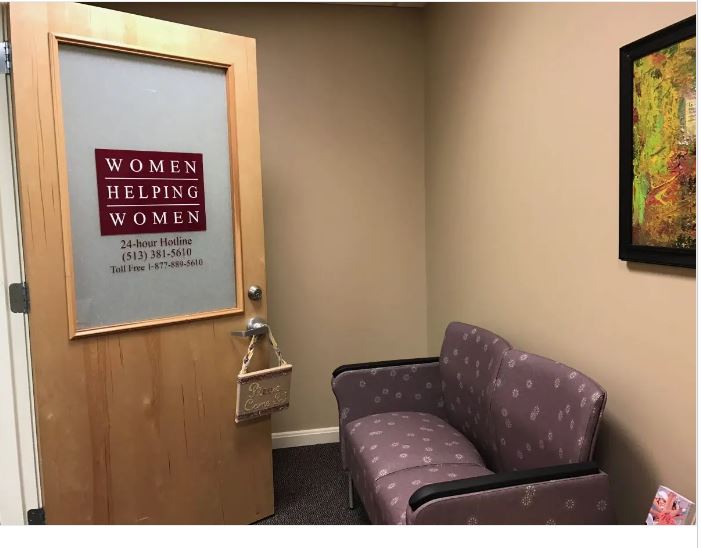
Office Door with Hotline Number of Women Helping Women

 By Hannah Fierle

Organization situated in Oxford strives to empower and support women both on Miami’s campus and in the greater tri-county area.

Miami University journalism student

With the increased focus of late on women’s rights and women’s issues, organizations that advocate for and support women have an opportunity to grab the spotlight.  Women Helping Women is one of those organizations, focusing specifically on the areas of sexual assault and domestic violence.

Started in the 1970’s, Women Helping Women initially sought to empower women by teaching them to do what were considered traditionally masculine tasks, like changing a tire. The organization took on its contemporary role when women involved expressed a need for services in situations of domestic violence and sexual assault.

“Our job is to do whatever the survivor needs,” says volunteer coordinator Bre Shisso. “We want to inform them of all their options and resources and support them every step of the way.”

Women Helping Women has two offices, one in Cincinnati and one in Oxford. The Cincinnati branch responds to the city and its surroundings, while the Oxford branch serves the greater Oxford, Middletown, Hamilton, and West Chester communities.

The organization’s office in Cincinnati handles cases of domestic violence, sexual assault and stalking, while the Oxford location deals only with sexual assault cases. Although the name may imply the agency is just for women, they stress that services are available to individuals of any gender identity.

Personal Service For Survivors

For the three full time employees at Women Helping Women’s Oxford office, their goal is to provide personalized, individual support for survivors of sexual assault. This may include accompanying clients to hospital visits or any legal meetings or hearings or providing emotional support and counseling.

The organization is completely confidential, and employees cannot offer legal advice, nor are they obligated to report an incident to law enforcement.

“Our service is very individualized, since each person will find healing through different things,” Shisso says. “Some people find healing through getting a protection order or being validated through a court process, while some people just need the emotional support and meeting other survivors in group sessions to begin to recover.”

In addition to interpersonal resources, the agency also offers a 24-hour hotline.

In 2015, the agency served more than 14,000 clients through both offices. While the numbers for 2016 are not yet available, the organization was on track after the third quarter to serve 16,000 individuals between both locations.

With its location in Oxford, Women Helping Women has begun a partnership with Miami University, providing students another resource when dealing with cases of sexual assault on campus. In November, Miami graduate Nora McVey began work as the organization’s Campus-Based Interpersonal Violence Support Specialist.

“We hear statistics and we know these incidents are taking place, but when I’m on campus and working closely with students, it becomes very real,” says McVey. “It’s rewarding to meet people who become comfortable sharing their stories and realize that they have someone in their corner, but it’s also very challenging when dealing with this sort of trauma.”

Challenging And Rewarding Work

The women at Women Helping Women emphasized both the challenges and rewards of their work. Although they may encounter individuals at their most vulnerable, they say they’re also able to witness the triumph of healing and recovery.

For Caitlin Rettenmaier, Director of Butler County Services, she is often confronted with a different set of needs due to the rural demographic of the Butler County area. This can mean arranging transportation for clients to get to the hospital or legal appointments or arranging temporary shelter if it’s deemed unsafe for an individual to return home.

“This is the most meaningful job I’ve ever had,” says Rettenmaier. “It’s most rewarding for me to see how the community comes together as partners in a time of crisis. That’s the biggest lasting impact that we hope to carry forth.”

For more information about Women Helping Women and its services, visit https://www.womenhelpingwomen.org or call the Oxford office at (513) 977-5541

The lobby of Women Helping Women’s office situated in Oxford’s Stewart Square. — Photo by Hannah Fierle

M. B ReillyBy M.B. Reilly (513) 556-1824

In working to continually find better ways to prevent and respond to cases of sexual harassment, assault and misconduct, the University of Cincinnati is adding to the range of options it already offers in the form of advocacy, training, prevention and resources related to

Title IX

In an agreement between UC’s Division of Student Affairs and Women Helping Women (WHW), the community organization is providing two full-time, on-campus, confidential advocates to provide comprehensive support to those who have or are experiencing (or have witnessed) gender-based violence, such as sexual assault, domestic violence or stalking.

  • Starting in this new role on Oct. 20 is Courtney Harchaoui. She can be reached by stopping by 559 Steger Student Life Center, at 513-556-4418, or via e-mail at [email protected]
  • Starting as a second confidential advocate on Nov. 1 as part of the same agreement is Susan Pelle. She can be reached by stopping by 559 Steger Student Life Center, at 513-556-4418, or via e-mail at [email protected]

These advocates will provide confidential services that are focused on the survivor and include individual crisis intervention, hospital accompaniment, campus reporting assistance, accompaniment through Title IX and law enforcement or legal processes, assistance with campus-based accommodations, referrals for health and wellness services, and assistance with interim measures. While primarily focused on serving all students, the advocate will also be available to campus faculty and staff as well.

In addition to these full-time, on-campus advocates, the Women Helping Women hotline is available 24/7 at

513-381-5610

the WHW hotline.

Our new advocates, to be dedicated to serving the campus community, will provide confidential support for students. We believe survivors, and we support survivors. The advocate’s role is to listen to the survivor, outline options, link survivors to services that they want and to focus on empowerment,” said Kristin Smith Shrimplin, president and CEO of WHW.

According to Debra Merchant, vice president of UCs Division of Student Affairs, students need a variety of support options, and this new partnership with WHW provides another confidential support on campus, in the same way that there are counselors in UC’s Counseling and Psychological Services who specifically provide assistance to survivors of sexual assault or harassment.

She stated, this adds to what we can provide to students. Some of the support is what we call confidential (like that offered by a counselor or this advocate). Some of it is what we call non-confidential or of public record, like going to UCPD. In order to provide the best service, its important to provide these confidential options as well.

Other Title IX News:

  • With the start of the new school year, UC expanded prevention options with new bystander training.
  • With the start of the new school year, UC has developed a Support Services Coordination Team to bring together all those addressing gender-based violence and sexual assault.
  • UC has added two Title IX investigators and recently hosted (on Aug. 15-16) a level one Title IX investigator training session, led by the Association of Title IX Administrators.
  • Annually, incoming UC students take ‘Think About It’ online training highlighting the role alcohol often plays in terms of sexual assault. That training also focuses on accountability and consequences, laws and policies governing sexual assault.
  • The new offerings add to those already available to students, including confidential medical services, UCPDs victim services coordinator, and UCs Counseling and Psychological Services Center 24/7 service to students in crisis due to sexual harassment, misconduct and assault. For a complete list of resources, visit UCs Title IX site.

Kristin Shrimplin CEO of Women Helping Women

By Kristin Smith Shrimplin

Kristin Smith Shrimplin is the president and CEO of Women Helping Women, an agency that serves all survivors of sexual assault, stalking and domestic violence in Hamilton and Butler counties.

September marks the back-to-school season. Incoming college first-year students are adjusting to new routines of dorm life, parental freedom, rigorous class schedules and the buzz of a thriving academic and social life on campus.

But there is another reality that is currently happening in their environment. Many of them, primarily women, are surrounded by the “Red Zone.” According to the 2007 Campus Sexual Assault Study, more than 50 percent of college sexual assaults occur in either August, September, October or November. The CSA’s findings also indicate “that women who are victimized during college are most likely to be victimized early on in their college tenure.

This is why this time on campus is so critical. As students are exchanging innovative ideas and debating critical concepts – their teachings must involve discussions of consent culture. But how much of their tuition costs will cover mandatory classes on gender-equality and social justice? How much time and space will our university presidents, deans of students, athletic coaches, professors, residential hall advisors, and Greek Life campus leaders allocate to the promotion of consent culture – waving it proudly like a symbol of excellence on a school banner? Does consent culture even get discussed in our lecture halls, in our campus board rooms, on the football fields, in the bars, at the parties, or in the dorm rooms?

It does not. In fact, our region, along with the nation, struggles to even address rape culture. We struggle to form budget-backed policies with best practice actions that truly dismantle and eradicate a public health epidemic that attacks one out of four campus students who will experience sexual assault this year. And those statistics are low. We know that sexual assault has already happened at our campuses this year – in the first week. This is not theory. This is fact. These are our students. These are our children. These are our future leaders. But now we call them survivors. We leave them to fend for themselves in a culture where others’ entitlement trumps autonomy of one’s own body.

Let’s talk about that – when did violence rise to the level of normative acceptance? History would suggest that such an entitled culture was born when our country was founded. The genocide of Native Americans and our country’s institutionalization of slavery was the beginning of people becoming property. But we are nearing 2017 and there is no room for someone to not own the decisions and safety of their own body. Yet here we are – struggling with rape culture to the point where we cannot even hear our own voices trying to teach about consent.

Women Helping Women (WHW) believes in building a culture of empowerment that dismantles gender-based violence. We have expanded our services to campuses to keep up with demand of victimization – but we cannot generate change alone. We need all members of our diverse community to cultivate a culture where consent and equality are valued over normalized violence and entitlement.

The solution is not easy – culture change never is. Ending rape culture requires us to end inequality with gender, race, class and all intersections of oppression. It mandates that all forms of social injustices cease being “justified.”

It demands that our city leaders generate budget-backed policies for prevention. It demands that our academic institutions provide as much funding to campus sexual assault prevention as they do for athletic scholarships and recruitment strategies. It demands that our K-12 schools open up all of their health classes to dating violence and sexual violence prevention curriculum. It demands that corporate board rooms open up their portfolios to back agencies working on the front lines with survivors and to invest in equal pay for women. It demands that every male – coach, teacher, parent, friend, colleague – exercises true strength and promotes equality, empowerment and safety of women and girls.

We are in the Red Zone, and the fact is that many sexual assaults and rapes have already occurred this academic year. This is not how we welcome students to their “higher education.” We did not raise them for this. So, we must rise up, dig deep, get real and invest with our dollars, our policies, our actions, our campaigns, and our words to promote a culture where consent is the norm, and entitlement holds no place on our campuses or in our communities.