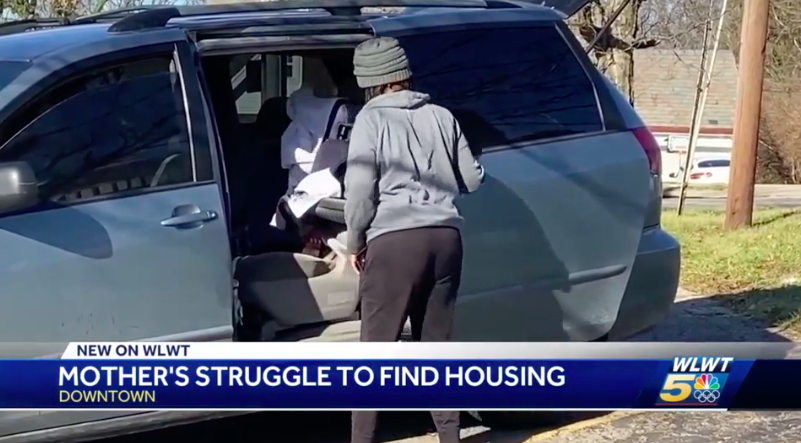
CINCINNATI — A woman living in a van with her four kids in Cincinnati now has temporary housing with the Salvation Army, thanks to help from the community.

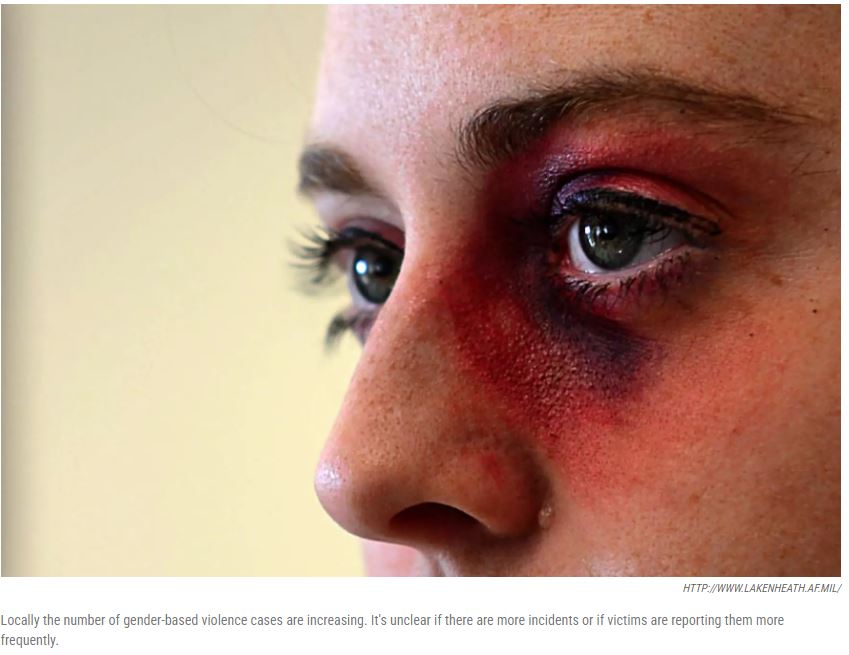
On Wednesday, WLWT told you how Jamie Coleman has struggled with finding affordable housing after she said she left a home due to domestic violence.

Coleman and her four kids, all CPS students ages 5-17, had been living in a van as she desperately tried to find a warm place to live.

She was a recipient of a one-year rapid re-housing program. But the term ended in August.

Coleman is a medical assistant who picks up 12 hours shift where she can, but between that and raising her kids, she says it’s difficult to navigate the hurdles of finding Section 8 housing.

She said she had been trying to make things as routine as possible for her kids.

“I make sure they wash they face and brush they teeth even if we have to go to our gas station in a bathroom,” said Jamie Coleman.

She says the children are trying to understand, especially the 5-year-old.

“[She asks] can we go home? Can we go home? and it’s hard because I don’t have a home to go to,” said Coleman.

Coleman says the hotline for these situations is only available once a week and many times she gets put on a waitlist or doesn’t get a call back.

She said it’s been dead end after dead end.

But after being connected with multiple organizations, all looking to step up, including Women Helping Women and the YWCA, the Salvation Army was able to get her and her kids in a home while she looks for a permanent place.

Coleman expressed she is so grateful for the community’s help.

November 08 2021, cincinnati.com

Opinion contributor
protection order paper

Paula Pierce, 62, is a survivor of domestic violence. She said each morning she looks at the permanent protection order that was granted march 8, 2021, against Shane Fulmer, 48. Pierce had a 16 year relationship with him. Liz Dufour | The Enquirer

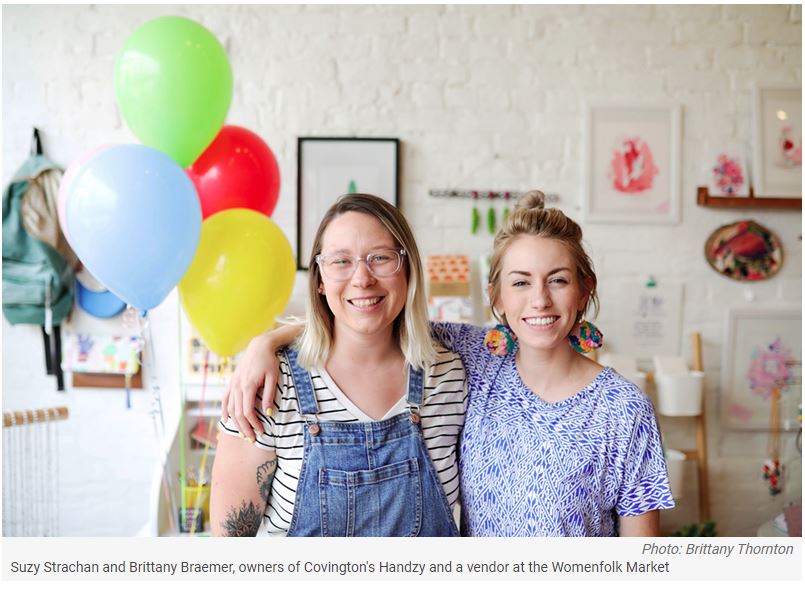
Suzy Strachan and Brittany Braemer, owners of Covington's Handzy and a vendor at the Womenfolk Marke

In celebration of International Women’s Day (March 8), the organizers behind Cincinnati’s City Flea have planned a special pop-up market dedicated to female-owned businesses

By Hailey Bollinger

In celebration of International Women’s Day on March 8, the organizers behind Cincinnati’s City Flea have planned a special maker pop-up dedicated to female-owned businesses.

The Womenfolk Market will take over Over-the-Rhine’s The Transept from 11 a.m.-4 p.m. on March 8, bringing more than 40 vendors together under one roof; ticket-buyers can browse, shop and support local ladies and their ventures.

Expect to see Greater Cincinnati favorites including Parlour, Fern, Grateful Grahams, Lucca, Coda Co., Charnee’s Doughnuts and Handzy.
In celebration of International Women’s Day on March 8, the organizers behind Cincinnati’s City Flea have planned a special maker pop-up dedicated to female-owned businesses.

The  Womenfolk Market will take over Over-the-Rhine’s The Transept from 11 a.m.-4 p.m. on March 8, bringing more than 40 vendors together under one roof; ticket-buyers can browse, shop and support local ladies and their ventures.

Expect to see Greater Cincinnati favorites including Parlour, Fern, Grateful Grahams, Lucca, Coda Co., Charnee’s Doughnuts and Handzy.

Purple Background

By: Lucy May

CINCINNATI — The city of Cincinnati’s 6,000 employees can feel a bit safer these days.

That’s because the city has enhanced its policies addressing gender-based violence with the help of Women Helping Women and its WorkStrong  program.

Women Helping Women used WorkStrong to help city officials examine and strengthen Cincinnati’s administrative regulation protecting city employees. The effort also included training city employees and department directors to recognize the signs of gender-based violence and help co-workers who experience it.

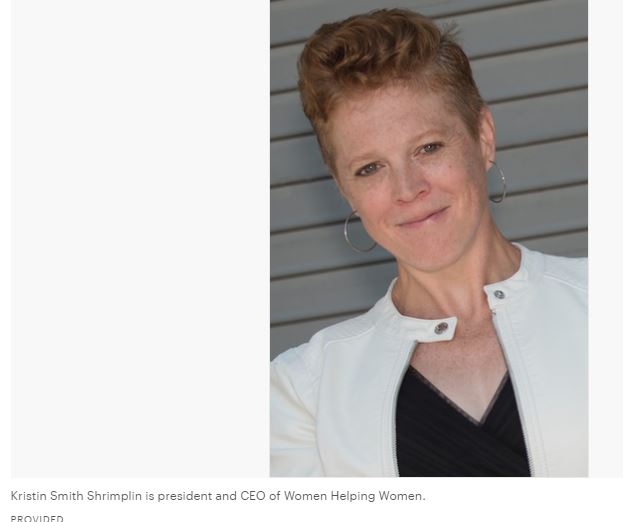
“Any workforce that size in this region, state and nation is going to be experiencing gender-based violence,” said Kristin Smith Shrimplin, Women Helping Women’s president and CEO. “What we’re really trying to do is empower our coworkers in the community to respond: ‘I believe you. It’s really not your fault, and there’s help.’”

RELATED:  The ‘hidden problem’ keeping women from getting ahead at work

Assistant City Manager Sheryl Long said city leaders were drawn to WorkStrong because it offers a tool kit for managers and employees in addition to the training the program provides.

The city regularly reviews policies and procedures to ensure they are consistent with best practices and reflect the world in which we live, she said.

Sheryl Long City Cincinnati Assistant Manager

“Anything we can do to provide our employees with resources is always helpful,” Long said. “We all want to make sure that they have an environment where they can come to work and feel safe and do the work on behalf of taxpayers.”

The problem of gender-based violence enters the workplace in many ways, ranging from lost productivity to homicide, Smith Shrimplin said.

Gender-based violence results in $8.3 billion in lost productivity nationally, according to Women Helping Women. In addition, the agency notes that:

  • Almost half of all full-time working adults work alongside a survivor of intimate partner violence.
  • More than 87% of employees who experience sexual harassment do not file a complaint.
  • 56% of employees who experience gender-based violence are late to work at least five times in a month.
  • 25% of rape survivors lose their jobs within a year of an assault.
  • And 67% of people who experience gender-based violence report that the perpetrator came to their workplace.

“We know violence against women and girls and just gender-based violence exists. We know that,” Smith Shrimplin said. “What we don’t all know is that there are innovative, workable solutions that we can all have a piece in activating.”

Women Helping Women and the city hope to publicize their work together in advance of October, which is Domestic Violence Awareness Month.

“When you have one out of three women in their lifetime experiencing gender-based violence, when you have one out of four teens before the age of 18 experiencing sexual violence, when you have one out of three teens experiencing dating violence, it’s a public health epidemic,” Smith Shrimplin said.

“WorkStrong is part of a movement to really say it’s on all of us, whether you’re a corporation, a workforce, a government entity, a nonprofit, whether you’re a coach, a student, a campus — how are we all going to lean in and understand that absolutely, unequivocally gender-based violence is preventable?”

Kristin Smith Shrimplin
Long said city leaders hope the city’s participation in the program will encourage other employers in the region.

“There’s a lot of people usually suffering in silence with this,” she said. “Things like this make people feel like they’re not alone.”

Smith Shrimplin said the goal is to reduce gender-based violence.

The city of Cincinnati also has committed to work with Women Helping Women in October for a social media campaign designed to raise awareness about the effects of domestic violence and gender-based violence both inside and outside the workplace.

“We don’t need to keep getting 11,000 calls on our hotline every single year at this agency,” she said. “Not every city in America is doing this, and I am proud of Cincinnati in being part of that movement to lead from the front and lead from the edge and say, ‘We don’t have to wait until there’s a horrific issue to put this on the map. We’re putting it on the map now.’”

More information about Women Helping Women  and WorkStrong is available online. If you or someone you know is experiencing gender-based violence, you can call the Women Helping Women 24-hour hotline at (513) 381-5610.

Lucy May writes about the people, places and issues that define our region – to celebrate what makes the Tri-State great and shine a spotlight on issues we need to address. To reach Lucy, email [email protected]. Follow her on Twitter @LucyMayCincy.

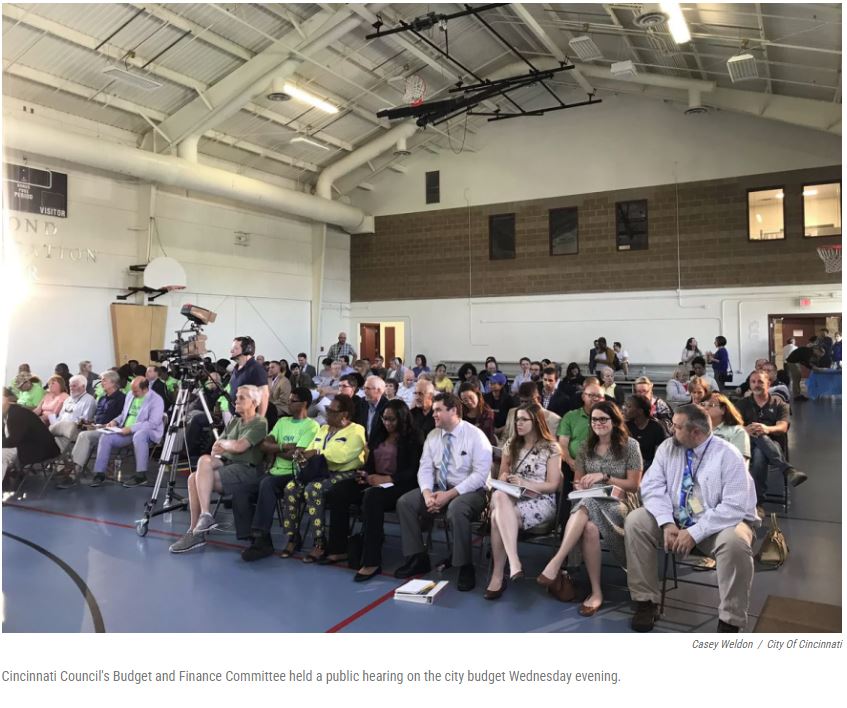
Cincinnati City Council Budget Meeting

91.7 WVXU | By Jay Hanselman

More than 60 people offered their thoughts on Cincinnati’s proposed budget during a public hearing Wednesday night.

Many of those offering comments spoke in favor of funding for the Center for Closing the Health Gap and agencies that provide human services.

Once again this year City Manager Patrick Duhaney’s spending plan didn’t include money for the Health Gap, and Mayor John Cranley also didn’t fund the group when he made his changes to the manager’s budget.

Trazana Staples told the Budget and Finance Committee that she had a stroke in 2017, and her connection with the Health Gap made a difference.

“I was able to reach out and receive information that I needed so I could have resources for my recovery,” Staples said. “It’s very important that the funding is restored.”

Mark Wilson said the organization does a lot for the community.

“The people are one of the most important things of the city, and I see the Health Gap investing back in the citizens of the city,” Wilson said. “I just ask that you continue to support and provide the funding they need.”

Human services agencies are urging city council to increase funding to 1.2% of the total city general fund budget. The manager and mayor did that in their proposals.

City council passed an ordinance last year to gradually increase that funding to 1.5% of the general fund budget. That’s the level it was traditionally at many years ago before the city began experiencing major deficits in the general fund.

“I believe that this council understands that the health of this city as a whole is not independent of the health of its least fortunate,” said Jim Holmstrom. “Those struggling with addictions such as mental health addiction, disability or any number of other formidable challenges.”

Kristin Smith-Shrimplin is the President and CEO of Women Helping Women and she spoke in favor of human services funding.

“For far too long survivors of dating violence, domestic violence and sexual violence and stalking have been told that they do not matter,” Shrimplin said. “And survivors and their children matter and that’s why we work hard at Women Helping Women 24/7 to respond to survivors in the greatest time of their need.”

Several people also asked that council restore funding to keep Larry Falkin as the head of the city’s Office of Environment and Sustainability. The city manager had eliminated that job in his budget proposal, and Falkin was going to be transferred to another city department outside the general fund.

Council member David Mann suggested during Wednesday night’s hearing that funding for the Center for Closing the Health Gap and Falkin’s position will be restored by city council when it finalizes the budget.

Other speakers asked council to maintain funding for economic development programs, neighborhoods and eviction prevention.

Two more budget hearings are set for next week. The one Monday will be held at the UC Innovation Hub at 2900 Reading Road. Tuesday’s will be at Madcap Theatre at 3064 Harrison Avenue. Both of those hearings start at 6 p.m.

Kristin Shrimplin CEO of Women Helping Women

Submitted by Sarah Gideonse/Share

Kristin Shrimplin, CEO of Women Helping Women, will speak at the Woman’s City Club’s annual Agnes B. Seasongood luncheon on the topic, “Pay Attention to Your Path: It is Your Purpose.”

Her talk will include a discussion of the modern environment regarding violence against and sexual harassment of women. Women Helping Women’s mission is to prevent gender-based violence and to empower all survivors in Greater Cincinnati.

Shrimplin is active in multiple initiatives concerning violence against women and gender equality at the local, regional and state level. But her greatest role, she said, “is being an ‘Auntie’ to two nephews who inspire [her] daily to work toward a world that is inclusive, welcoming and safe for all.”

The event will take place from 11:30 a.m. to 1 p.m. Friday, May 3, 2019, at The Summit, A Dolce Hotel, 5345 Medpace Way at Red Bank Expressway in Cincinnati.

Luncheon Price: $45.

RSVP Deadline: Tuesday, April 30, 2019.

Prospective attendees can click or tap here to pay online, or mail a check (payable to “Woman’s City Club”) to Woman’s City Club, 103 Wm. H. Taft Rd., Cincinnati, OH, 45219

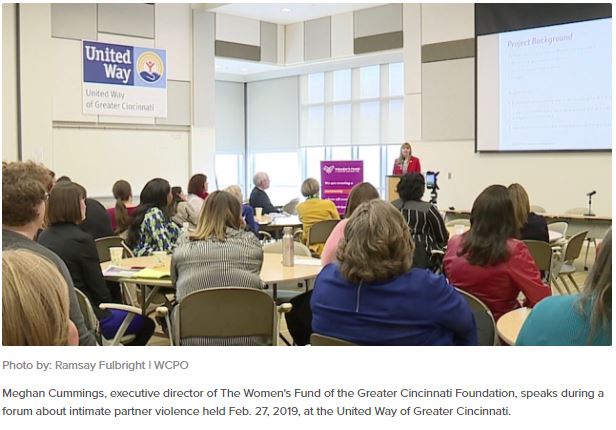
Meghan Cummings, executive director of The Women's Fund of the Greater Cincinnati Foundation, speaks during a forum about intimate partner violence
‘Biggest hidden problem we’ve ever encountered’
By: Lucy May
CINCINNATI — Although it’s been decades since Karen Bankston was married to him, her second husband’s cruelty is never far from the surface.
His abuse permeated her life, she said, at home, at church and even at work.
“On the job, when I got promoted, he accused me of sleeping with my supervisors,” said Bankston, an adjunct professor at the University of Cincinnati’s College of Nursing. “The emotional abuse is just as horrible as any physical abuse. It was never, ‘I’m proud of you.’ You really begin to question yourself.”
Bankston took the promotion and ended that marriage. She has been happily married to a different man for nearly three decades.
But her experience as a survivor of abuse is far from unique.
After a 2016 study found intimate partner violence interferes with the ability of local women to build better lives for themselves and their children, The Women’s Fund of the Greater Cincinnati Foundation wanted to help.
“We talk about all these challenges to women in the workplace, and this is like the biggest hidden problem we’ve ever encountered,” said Meghan Cummings, executive director of The Women’s Fund. “It’s the one that goes unnamed. It’s the one we just don’t talk about, and it’s so prevalent in a person’s ability to move up and into different careers.”
The Women’s Fund worked with a group of nonprofit organizations and businesses over the past 18 months to better understand how intimate partner violence interferes with working women’s ability to become self-sufficient.
Four survivors were at the center of the effort, helping the other participants understand their experiences and what could have helped them at work.
The goal was to increase understanding and empathy among employers when it comes to intimate partner violence. The group also developed recommendations for policies and procedures that businesses and nonprofit organizations can adopt to help employees who are struggling.
‘Calls we don’t want to get’
Nationally, one out of three women experience some form of physical violence at the hands of an intimate partner, according to the National Coalition Against Domestic Violence. Gender-based violence affects women across the region, said Kristin Shrimplin, CEO of Women Helping Women.
“What we know is survivors walk amongst us everywhere in this region,” she said. “So of course that means they’re in the workforce.”
Unfortunately, some companies react by ending a woman’s employment after they discover the problem, she said.
“It’s through the lens of liability or through the lens of other things that go on paper that are really through the lens of risk mitigation,” Shrimplin said. “They’re being held responsible for the violence.”
Having four survivors of intimate partner violence at the center of the latest effort was critically important, said Sarah Corlett, director of community development and strategy for Design Impact.
The Women’s Fund enlisted Design Impact to help guide the group’s work.
Corlett said everyone agreed it was important not to duplicate the efforts of other local organizations. Women Helping Women, for example, has a program called WorkStrong that helps corporations, governments and nonprofit organizations craft policies that help employees who are experiencing intimate partner violence.
Shrimplin said her agency developed that program after several employers contacted Women Helping Women because they had employees die as the result of domestic violence homicides.
“Those are the calls we don’t want to get anymore,” she said.
The recommendations that came out of the Design Impact work are more general, Cummings said.
One suggestion is to give all employees an explanation of the company’s policies related to intimate partner violence when they start, she said.
That way people who are struggling with the issue don’t get singled out.
Design Impact created what Cummings calls a “visual map” that companies could use to explain polices and what employees should expect if they make supervisors aware of the problem.
Meghan Cummings, at podium, speaks at a Feb. 27 forum on intimate partner violence.
“Survivors share with us that employers often have the best intentions, but some of their interventions are not helpful at all,” Cumming said.
Hot spots
A male manager walking into a company parking lot to confront a violent husband, for example, could make things even worse for the employee the manager is trying to protect once that employee gets home, Shrimplin said.
The employers involved in the effort were open to what the survivors, especially, had to say, Corlett said.
“I was pleasantly surprised by the vulnerability and the willingness of employers in the room to stop and listen, admit where they were failing and where they could do better,” Corlett said.
One employer involved in the effort, for example, asked her home health care staff how many of them had experienced intimate partner violence. She was shocked to find that roughly 75 percent of her employees said they had, Cummings said.
“When we have low-wage jobs that are female-dominated at the lower socio-economic level, we think these are just real hot spots for this type of behavior,” she said.
That behavior ranges from intimidation or undermining efforts to get ahead all the way to physical violence.
Some survivors said their partners would turn off alarm clocks so they would be late for work or for job training, for example, while others said the physical abuse got worse as they got raises or promotions.
“I would hope that what the community is going to get now is action,” Shrimplin said.
That’s not to say employers can end intimate partner violence through office policies, she said, but employers must understand that there’s a business case for getting better at dealing with the problem.
“For corporate decision-makers, this is about bottom line,” she said, “and this is about productivity, and this is about retention and recruitment.”
Above all, Shrimplin said, employers must trust their employees to be the experts in what they need.
Those needs can be complicated when it comes to surviving an abusive relationship, Bankston added.
“Even when I got a divorce, and I intellectually felt it was the right thing to do, emotionally I felt like I had failed again,” Bankston said. “It’s just emotionally a horrible feeling on top of any smacks in the face or getting pushed down that you may also experience.”
More information about The Women’s Fund of the Greater Cincinnati Foundation  is available online. Information about the Women Helping Women WorkStrong program  is available online, too.
Lucy May writes about the people, places and issues that define our region – to celebrate what makes the Tri-State great and shine a spotlight on issues we need to address. To reach Lucy, email [email protected]. Follow her on Twitter @LucyMayCincy.
Copyright 2019 Scripps Media, Inc. All rights reserved. This material may not be published, broadcast, rewritten, or redistributed.

Local Number of Gender Base Violence Cases Increase

By Ann Thompson

Citing a growing number of reported gender-based violence cases in Greater Cincinnati, Women Helping Women President and CEO Kristin Smith Shrimplin says there is a disturbing pattern with the way victims are treated.

Smith Shrimplin spoke Thursday at the organization’s annual Community Leader breakfast at The Westin Cincinnati. She says Women Helping Women is not a political agency, only commenting on policy and actions that negatively affect survivors.

Referencing the  #MeToo movement she said, “The national narrative has changed in its belief of survivors and its treatment of survivors. Supporting survivors is not open for political debate.”

“We have had enough of the fundamental disrespect and disregard, the violation and victimization in our region and in the U.S. of survivors,” Smith Shrimplin told a crowd that broke into applause.

The Numbers Continue To Go Up

So far in 2018, Women Helping Women says it served 5,939 survivors compared to a total of 5,792 in 2017. Smith Shrimplin says this is the new normal. This year a new team of volunteers,  DVERT, is helping as they respond to calls with police and take survivors and their children to safe places.

Assistant Cincinnati Police Chief Michael John also spoke Thursday, citing numbers for the last three years. He says in 2015 there were 1,700 reports of gender-based violence; 1,800 in 2016; and 1,943 in 2017. Nine people died in 2017.

Gender-based violence on college campuses also continues to be a problem. Women Helping Women increased its services there by 60 percent.

At the Thursday breakfast, the organization also called for businesses to take on a greater role in identifying possible victims by participating in the program WorkStrong.

Kristin Shrimplin CEO of Women Helping Women

Kristin Smith-Shrimplin

Kristin Smith-Shrimplin is the president and CEO of Women Helping Women.

Women Helping Women strongly advocates that community leaders speak up for survivors and speak out against domestic violence and sexual assault. On Friday, April 28, the Cincinnati Bengals drafted Joe Mixon to become a new member of their team. As the leading regional agency in serving nearly 7,000 survivors of domestic violence and sexual assault per year, Women Helping Women advocates that the Bengals, as well as any other Cincinnati corporation, take a strong stance against domestic violence and sexual assault.

We expect businesses in our great city, and this includes sports teams, to place a high value on speaking out against both domestic violence and sexual assault. Athletes are recruited and hired for their skills and talent both on and off the field. We need our beloved home teams to hire positive role models and champions for our community, and this means that champions do not commit violence against women.

Violence against women and girls is a crime and a public health epidemic. Our area has already seen far too many domestic violence assaults as well as domestic violence homicides this year. While Women Helping Women is constantly working at capacity as it serves nearly 7,000 survivors a year, we need all members of our vital community to join us and to stand up for survivors. No one deserves to be abused or assaulted.

Read more: Mike Brown: We took a risk on Mixon

Misguided decision lets Mixon off the hook

No shortage of opinions on Mixon

Letters: For Bengals, Mixon draft is business as usual

Women Helping Women encourages the Brown family, Marvin Lewis and all others in the Cincinnati Bengals administration, as well as all influential leaders in our great city to use their power to shape a winning culture, both on and off the field. We expect that franchises and leaders with such power to represent our city and to encourage a culture that reflects our Cincinnati values.

The Bengals have an opportunity to send a message to their fans. There is an opportunity to teach our children about character-building, team work, and respect – both on and off the field. There is an opportunity to message to young athletes at our high schools and on college campuses what we expect in a champion. We expect players to lead by example.

Violence holds no honor and should hold no position on a team. Violence is already too rampant where 1 in 3 women experiences physical or sexual violence in their lifetime. Our community deserves better.

Corporations, sports teams, policymakers and consumers have a powerful opportunity to promote community social responsibility in our region. Women Helping Women advocates that we all operate from the same playbook, working together as a team to combat gender-based violence and to promote a safe and thriving community.