By David Holthaus – Courier contributor
Oct 25, 2018
Women Helping Women, the region’s leading advocate for survivors of sexual assault and domestic violence, is launching a workplace program that can provide employers with a toolkit and support for preventing workplace incidents and for assisting employees who are victims of abuse.
Kristin Smith-Shrimplin is the president and CEO of Women Helping Women.
Women Helping Women strongly advocates that community leaders speak up for survivors and speak out against domestic violence and sexual assault. On Friday, April 28, the Cincinnati Bengals drafted Joe Mixon to become a new member of their team. As the leading regional agency in serving nearly 7,000 survivors of domestic violence and sexual assault per year, Women Helping Women advocates that the Bengals, as well as any other Cincinnati corporation, take a strong stance against domestic violence and sexual assault.
We expect businesses in our great city, and this includes sports teams, to place a high value on speaking out against both domestic violence and sexual assault. Athletes are recruited and hired for their skills and talent both on and off the field. We need our beloved home teams to hire positive role models and champions for our community, and this means that champions do not commit violence against women.
Violence against women and girls is a crime and a public health epidemic. Our area has already seen far too many domestic violence assaults as well as domestic violence homicides this year. While Women Helping Women is constantly working at capacity as it serves nearly 7,000 survivors a year, we need all members of our vital community to join us and to stand up for survivors. No one deserves to be abused or assaulted.
Women Helping Women encourages the Brown family, Marvin Lewis and all others in the Cincinnati Bengals administration, as well as all influential leaders in our great city to use their power to shape a winning culture, both on and off the field. We expect that franchises and leaders with such power to represent our city and to encourage a culture that reflects our Cincinnati values.
The Bengals have an opportunity to send a message to their fans. There is an opportunity to teach our children about character-building, team work, and respect – both on and off the field. There is an opportunity to message to young athletes at our high schools and on college campuses what we expect in a champion. We expect players to lead by example.
Violence holds no honor and should hold no position on a team. Violence is already too rampant where 1 in 3 women experiences physical or sexual violence in their lifetime. Our community deserves better.
Corporations, sports teams, policymakers and consumers have a powerful opportunity to promote community social responsibility in our region. Women Helping Women advocates that we all operate from the same playbook, working together as a team to combat gender-based violence and to promote a safe and thriving community.
In working to continually find better ways to prevent and respond to cases of sexual harassment, assault and misconduct, the University of Cincinnati is adding to the range of options it already offers in the form of advocacy, training, prevention and resources related to
In an agreement between UCs Division of Student Affairs and Women Helping Women (WHW), the community organization is providing two full-time, on-campus, confidential advocates to provide comprehensive support to those who have or are experiencing (or have witnessed) gender-based violence, such as sexual assault, domestic violence or stalking.
Starting in this new role on Oct. 20 is Courtney Harchaoui. She can be reached by stopping by 559 Steger Student Life Center, at 513-556-4418, or via e-mail at [email protected]
Starting as a second confidential advocate on Nov. 1 as part of the same agreement is Susan Pelle. She can be reached by stopping by 559 Steger Student Life Center, at 513-556-4418, or via e-mail at [email protected]
These advocates will provide confidential services that are focused on the survivor and include individual crisis intervention, hospital accompaniment, campus reporting assistance, accompaniment through Title IX and law enforcement or legal processes, assistance with campus-based accommodations, referrals for health and wellness services, and assistance with interim measures. While primarily focused on serving all students, the advocate will also be available to campus faculty and staff as well.
In addition to these full-time, on-campus advocates, the Women Helping Women hotline is available 24/7 at
513-381-5610
the WHW hotline.
Our new advocates, to be dedicated to serving the campus community, will provide confidential support for students. We believe survivors, and we support survivors. The advocate’s role is to listen to the survivor, outline options, link survivors to services that they want and to focus on empowerment,” said Kristin Smith Shrimplin, president and CEO of WHW.
According to Debra Merchant, vice president of UCs Division of Student Affairs, students need a variety of support options, and this new partnership with WHW provides another confidential support on campus, in the same way that there are counselors in UCs Counseling and Psychological Services who specifically provide assistance to survivors of sexual assault or harassment.
She stated, this adds to what we can provide to students. Some of the support is what we call confidential (like that offered by a counselor or this advocate). Some of it is what we call non-confidential or of public record, like going to UCPD. In order to provide the best service, its important to provide these confidential options as well.
Other Title IX News:
With the start of the new school year, UC expanded prevention options with new bystander training.
With the start of the new school year, UC has developed a Support Services Coordination Team to bring together all those addressing gender-based violence and sexual assault.
UC has added two Title IX investigators and recently hosted (on Aug. 15-16) a level one Title IX investigator training session, led by the Association of Title IX Administrators.
Annually, incoming UC students take ‘Think About It’ online training highlighting the role alcohol often plays in terms of sexual assault. That training also focuses on accountability and consequences, laws and policies governing sexual assault.
The new offerings add to those already available to students, including confidential medical services, UCPDs victim services coordinator, and UCs Counseling and Psychological Services Center 24/7 service to students in crisis due to sexual harassment, misconduct and assault. For a complete list of resources, visit UCs Title IX site.
In working to continually find better ways to prevent and respond to cases of sexual harassment, assault and misconduct, the University of Cincinnati is adding to the range of options it already offers in the form of advocacy, training, prevention and resources related to
In a new agreement between UCs Division of Student Affairs and Women Helping Women (WHW), the community organization will provide an on-call, confidential campus advocate/response to provide comprehensive support to those who have or are experiencing (or have witnessed) gender-based violence, such as sexual assault, domestic violence or stalking. That 24/7 on-call service begins this week, and will be available to all students, not just women. The service will also be available to all faculty and staff.
WHW will provide confidential services that are focused on the survivor and include individual crisis intervention, hospital accompaniment, campus reporting assistance, accompany students through Title IX and law enforcement or legal processes, assist with campus-based accommodations, provide referrals for health and wellness services, and assist survivors who seek interim measures. Again, while primarily focused on serving students, the advocate will also be available to campus faculty and staff as well.
An on-call campus advocate from Women Helping Women can be reached 24/7 at 513-381-5610, the WHW hotline.
By Oct. 30, a full-time WHW campus advocate will be housed on campus, in an office in the Steger Student Life Center.
With the start of the new school year, UC is also expanding prevention options with new bystander training.
With the start of the new school year, UC has developed a Support Services Coordination Team to bring together all those addressing gender-based violence and sexual assault.
UC has added two Title IX investigators and just hosted (on Aug. 15-16) a level one Title IX investigator training session, led by the Association of Title IX Administrators.
Annually, incoming UC students take ‘Think About It’ online training highlighting the role alcohol often plays in terms of sexual assault. That training also focuses on accountability and consequences, laws and policies governing sexual assault.
The new offerings add to those already available to students, including confidential medical services, UCPDs victim services coordinator, and UCs Counseling and Psychological Services Center 24/7 service to students in crisis due to sexual harassment, misconduct and assault. For a complete list of resources, visit UCs Title IX site.
Our new advocate, to be dedicated to serving the campus community, will provide confidential support for students. We believe survivors, and we support survivors. The advocate’s role is to listen to the survivor, outline options, link survivors to services that they want and to focus on empowerment,” said Kristin Smith Shrimplin, president and CEO of WHW.
According to Debra Merchant, vice president of UCs Division of Student Affairs, students need a variety of support options, and this new partnership with WHW provides another confidential support on campus, in the same way that there are counselors in UCs Counseling and Psychological Services who specifically provide assistance to survivors of sexual assault or harassment.
She stated, this adds to what we can provide to students. Some of the support is what we call confidential (like that offered by a counselor or this advocate). Some of it is what we call non-confidential or of public record, like going to UCPD. In order to provide the best service, it’s important to provide these confidential options as well.
The main responsibilities of the on-call campus advocate are as follows:
Provide direct crisis-intervention services to campus survivors of sexual assault, domestic violence and stalking.
Provide telephone and one-on-one crisis intervention, hospital advocacy, civil and criminal court accompaniment, campus-based referrals, and accompaniment to campus hearings.
Assist students with safety planning and provide information and referrals with each student as appropriate.
Accompany clients to proceedings/appointments/meetings as needed to provide information, advocacy, support and safety.
Advocate for survivors based on survivor-defined goals and with the consent of the survivor.
Additional Contacts John Bach | Director of Executive Communications | Marketing + Communications [email protected] | 513-556-2019
Em Joy, Women Helping Women’s school and community educator, created this placement with the help of Hali Nacdimen, an industrial designer with downtown-based Kaleidoscope, as part of the Studio C program.
By: Lucy May
CINCINNATI — A local nonprofit organization is hoping a carefully designed placemat in the right Greater Cincinnati restaurants could help put a stop to violence against women and girls.
The placemat is covered in “conversation starters” to encourage mealtime conversations between dads and sons, uncles and nephews or other pairs of men and boys. The goal is to get them talking about their own emotional needs and how to respect women.
Before you dismiss the placemat strategy, consider this: Kristin Smith Shrimplin, the CEO of Women Helping Women, has seen it work.
She took her two nephews — ages 12 and 9 — to dinner at LaRosa’s earlier this summer. As they were drawing pictures on a piece of butcher paper that the restaurant provided, she started using some of the conversation starters she knew were on the placemat prototype.
“My nephews are obstinate. They think ‘auntie’ is too emotional,” she said. “But I’m not kidding. We talked about — in appropriate language — what consent means. What inappropriate touching means and if that ever happens, what they’re to do. We talked about how the 12-year-old hasn’t had his first kiss yet, what that’s like and how you have to ask. We talked about gun violence and if there’s a gun in a friend’s home, what they’re to do. We talked about cigarettes, drugs and alcohol.”
Shrimplin talked with her nephews about important things in a non-threatening way, all while sharing a meal and drawing on paper.
“They talked about it, they handled it, they were really leaning into the conversation,” she said. “That just told me, if we could really roll out this concept, there could be some really neat organic things that happen in those moments.”
Hali Nacdimen, an industrial designer with downtown-based Kaleidoscope, sent initial designs for the placemat for Women Helping Women after spending more than an hour with Shrimplin and her staff to understand their mission and what they had learned about empowering men to help end gender-based violence. Em Joy, the nonprofit’s school and community educator, created the prototype.
Women Helping Women’s goal is to partner with an iconic Cincinnati restaurant chain — such as Skyline, LaRosa’s or Frisch’s — to get the placemats on tables across the region, Shrimplin said.
Giving Men A Voice
The placemat idea was one of several that came out of the Eureka moment that Shrimplin and her staff had during their Studio C experience.
During the 12-week program, facilitators from Design Impact helped Women Helping Women and the other participating nonprofit organizations determine what “wicked problem” each was trying to solve and then helped them boil it down to its most simple form.
“Our wicked problem was we wanted to end gender-based violence by men being the leaders in the movement to address it,” Shrimplin said. “It’s not about men just being engaged. It’s really about men being empowered.”
For years, Women Helping Women knew that involving men was an important part of ending domestic violence, sexual assault and stalking. But the Studio C process helped the organization expand its thinking about how to approach men and help them get involved.
“Studio C helped us realize we have to really give men a voice,” said Caitlin Burke, Women Helping Women’s prevention coordinator. “We were assuming they had a voice and weren’t using it for this issue.”
The program’s design thinking approach encouraged the organization to question its assumptions about men and to interview men to find out what they really thought about Women Helping Women’s work and mission.
“What I started to realize is men haven’t been really given the opportunity — starting back in boyhood — to talk about their vulnerability in a safe way,” Shrimplin said. “How, by the time they’re 18 or 20 years old, can we expect them to speak out against violence against women and girls when they couldn’t even speak out about their own emotional needs?”
That realization pushed Shrimplin and her staff to find more ways to invest in men, she said.
“We thought maybe what we need to do is invest in men and invest in their vulnerability and investing in creating a space where it is safe for them to be vulnerable,” she said.
The goal is to help men see strength in their vulnerability, not weakness.
“When they feel strong in doing that, they can then speak out,” she said.
It might sound counterintuitive for Women Helping Women to start focusing on men, but that kind of solution isn’t unusual for Studio C.
Challenging Assumptions
The program uses design thinking, a strategy that is common in the business world but less common among nonprofits, said Tamaya Dennard, a social and civic innovation specialist with Design Impact.
“A lot of times it’s really similar to the concepts of creative problem-solving,” said Ramsay Ford, a co-founder of Studio C. “You start with really focusing on who is going to be using a product or service, who is the community that’s involved in this solution or this program and getting a deep understanding of who they are, what their motivations are and how they’re involved.”
This is the third year that United Way has been funding Studio C, and it’s not uncommon for the process to challenge the assumptions of the nonprofit organizations that participate, said Mike Baker, director of community impact for United Way of Greater Cincinnati.
The first year of the Studio C program, for example, the Housing Authority of Covington and Northern Kentucky Head Start partnered to try to find a way to get more kids from the City Heights housing complex enrolled in preschool.
Leaders of both organizations believed that parents weren’t enrolling their kids because they didn’t have good transportation from City Heights to the locations where Head Start classes were held.
Studio C challenged them to talk with parents to find out if the problem really was transportation, Baker said.
“They talked to 10 to 15 families. And all of them said transportation was an issue, but it wasn’t the top issue,” he said. “Most often the top issue was ‘my kid is too little to go to school’ or ‘they’re going to learn everything they need to know in kindergarten.'”
The Housing Authority of Covington and Northern Kentucky Head Start realized they needed to educate parents about what good preschool was — that it wouldn’t require their squirmy toddlers to sit still at a desk all day.
After they helped parents understand that the two organizations tripled enrollment in Head Start in just a month’s time.
“That’s the success for us,” Baker said. “If we can drive more of that planning — moving past what we all think we know about the people we’re trying to help and more diving in and really developing solutions that are much more tangible to the real issue.”
For Women Helping Women, the 12-week program made a huge difference, Shrimplin said. Now it’s just a matter of getting those placemats in local restaurants.
For more information about Women Helping Women, click here.
For more information about Studio C, click here. Studio C is accepting applications through Aug. 11 for its next session. Meetings for that session will start Sept. 1. To apply, click here.
Lucy May writes about the people, places and issues that define our region – to celebrate what makes the Tri-State great and also shine a spotlight on issues we need to address. Childhood poverty is an important focus for her and for WCPO. To read more stories about childhood poverty, to go www.wcpo.com/poverty.
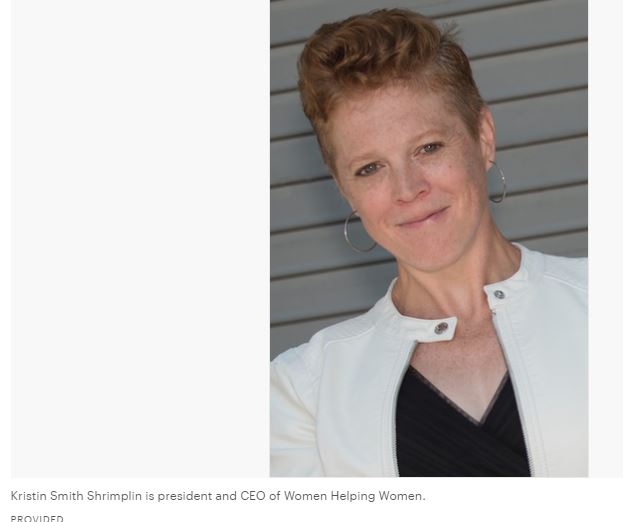
Kristin Smith Shrimplin is the president and CEO of Women Helping Women, an agency that serves all survivors of sexual assault, stalking and domestic violence in Hamilton and Butler counties.
The story about a Stanford University student who committed sexual assault caught national and local attention. But this is not a new narrative. This is a story that is very worn out. As the leader of Women Helping Women, I am unapologetically angry at the repetitive nature of this story. It’s 2016, and our nation, our communities and our campuses remain besieged by rape culture. This is an epidemic, and it is time for radical change.
Let’s start by changing the narrative. Media: Please tell us the stories of all of the actions and the words of the male friends of Brock Turner who went to the party with him. Tell us about how they stepped in at every point that he and any other individual targeted a woman for domination and control. Tell us about what Stanford University taught Brock Turner and all of its students about consent culture during first-year orientation. Tell us what Brock Turner’s father told him as a young man going off to college about how to respect women’s autonomy. Tell us what the teachers taught Brock Turner in middle and high school on prevention of sexual violence. Tell us what Brock Turner’s swim coach taught him when he was 8 years old about character, integrity and being a true champion.
Brock Turner (right) makes his way into the Santa Clara Superior Courthouse in Palo Alto, California, on June 2. He received a six-month jail sentence for raping a young woman.
Tell us. We will listen. But no one can tell us those stories because no one can find those headlines. The headlines can’t be reported because that’s not what happened that night or at all the points in time before that night. This is what is happening:
98 percent of rapists never see a day in jail or prison.
1 out of 3 women are sexually assaulted or physically abused in their lifetime.
1 out of 4 girls experience sexual assault before the age of 18.
A rapist’s father complains about his son’s sentence of 6 months of prison for “20 minutes of action,” and the woman raped must live with the impact of the trauma for the rest of her life.
In 2015, WHW responded over 15,000 times to the hospitals, to the courts, to the hotline, to support groups, and to one-on-one crisis intervention to serve survivors in Hamilton and Butler counties alone.
In the first quarter of 2016, WHW hit a record of responding over 4,000 times to survivors.
Let’s change the narrative by changing what we tell women and girls. Men: Be brave and talk to your sons, grandsons, nephews and friends about sexual assault, rape and consent culture. Promote prevention. Listen to the women and girls in your life. When women and girls tell you their stories, stand beside them with full support and model the Stanford survivor’s powerful words:
“… to girls everywhere, I am with you. On nights when you feel alone, I am with you. When people doubt you or dismiss you, I am with you… you are important, unquestionably, you are untouchable, you are beautiful, you are to be valued, respected, undeniably, every minute of every day, you are powerful, and nobody can take that away from you. To girls everywhere, I am with you…”
Let’s change the narrative and unite as a community to combat this violence. This public health epidemic demands attention as if it were toxic, lead-laden water in our public pipelines. Policymakers, institutions, universities, and community members: Let’s work together to dismantle immaterial language that describes a rapist. Individuals who commit sexual violence make a decision to commit a crime to victimize and violate another individual. It is immaterial that a rapist is an athlete with a promising swimming career who can no longer enjoy a steak because of the crime he committed. These irrelevant words serve as a manufactured smokescreen that takes us away from the real story.
The real story is that the rape culture violates our community’s ability to thrive. WHW trustees, advocates, prevention educators, volunteers and survivors call for a “forever cure” to this public health crisis. All leaders, supporters and major institutions must intensely use their influence and resources to shine a light on a crime that hides in the dark behind dumpsters. Humans are not trash.
We can no longer dismiss this issue as merely a “women’s issue.” This is a human rights issue in which humans are stripped of their autonomy and self-agency of their very own bodies. Sexual assault is a crime – a debilitating, soul-stripping crime. And now is the time to change it all: Change the media’s framing of the narrative. Change the judicial institutions’ response. Change patriarchy. Change oppression. Change apathy. Change the system.
WHW believes in the radical notion that all of our community members deserve to thrive in a culture of accountability, prevention and consent. Let’s all be “upstanders” and build that community together to support survivors and promote prevention.
This mode enables people with epilepsy to use the website safely by eliminating the risk of seizures that result from flashing or blinking animations and risky color combinations.
Visually Impaired Mode
Improves website's visuals
This mode adjusts the website for the convenience of users with visual impairments such as Degrading Eyesight, Tunnel Vision, Cataract, Glaucoma, and others.
Cognitive Disability Mode
Helps to focus on specific content
This mode provides different assistive options to help users with cognitive impairments such as Dyslexia, Autism, CVA, and others, to focus on the essential elements of the website more easily.
ADHD Friendly Mode
Reduces distractions and improve focus
This mode helps users with ADHD and Neurodevelopmental disorders to read, browse, and focus on the main website elements more easily while significantly reducing distractions.
Blindness Mode
Allows using the site with your screen-reader
This mode configures the website to be compatible with screen-readers such as JAWS, NVDA, VoiceOver, and TalkBack. A screen-reader is software for blind users that is installed on a computer and smartphone, and websites must be compatible with it.
Online Dictionary
Readable Experience
Content Scaling
Default
Text Magnifier
Readable Font
Dyslexia Friendly
Highlight Titles
Highlight Links
Font Sizing
Default
Line Height
Default
Letter Spacing
Default
Left Aligned
Center Aligned
Right Aligned
Visually Pleasing Experience
Dark Contrast
Light Contrast
Monochrome
High Contrast
High Saturation
Low Saturation
Adjust Text Colors
Adjust Title Colors
Adjust Background Colors
Easy Orientation
Mute Sounds
Hide Images
Hide Emoji
Reading Guide
Stop Animations
Reading Mask
Highlight Hover
Highlight Focus
Big Dark Cursor
Big Light Cursor
Cognitive Reading
Virtual Keyboard
Navigation Keys
Voice Navigation
Accessibility Statement
womenhelpingwomen.org
October 17, 2026
Compliance status
We firmly believe that the internet should be available and accessible to anyone, and are committed to providing a website that is accessible to the widest possible audience,
regardless of circumstance and ability.
To fulfill this, we aim to adhere as strictly as possible to the World Wide Web Consortium’s (W3C) Web Content Accessibility Guidelines 2.1 (WCAG 2.1) at the AA level.
These guidelines explain how to make web content accessible to people with a wide array of disabilities. Complying with those guidelines helps us ensure that the website is accessible
to all people: blind people, people with motor impairments, visual impairment, cognitive disabilities, and more.
This website utilizes various technologies that are meant to make it as accessible as possible at all times. We utilize an accessibility interface that allows persons with specific
disabilities to adjust the website’s UI (user interface) and design it to their personal needs.
Additionally, the website utilizes an AI-based application that runs in the background and optimizes its accessibility level constantly. This application remediates the website’s HTML,
adapts Its functionality and behavior for screen-readers used by the blind users, and for keyboard functions used by individuals with motor impairments.
If you’ve found a malfunction or have ideas for improvement, we’ll be happy to hear from you. You can reach out to the website’s operators by using the following email
Screen-reader and keyboard navigation
Our website implements the ARIA attributes (Accessible Rich Internet Applications) technique, alongside various different behavioral changes, to ensure blind users visiting with
screen-readers are able to read, comprehend, and enjoy the website’s functions. As soon as a user with a screen-reader enters your site, they immediately receive
a prompt to enter the Screen-Reader Profile so they can browse and operate your site effectively. Here’s how our website covers some of the most important screen-reader requirements,
alongside console screenshots of code examples:
Screen-reader optimization: we run a background process that learns the website’s components from top to bottom, to ensure ongoing compliance even when updating the website.
In this process, we provide screen-readers with meaningful data using the ARIA set of attributes. For example, we provide accurate form labels;
descriptions for actionable icons (social media icons, search icons, cart icons, etc.); validation guidance for form inputs; element roles such as buttons, menus, modal dialogues (popups),
and others. Additionally, the background process scans all the website’s images and provides an accurate and meaningful image-object-recognition-based description as an ALT (alternate text) tag
for images that are not described. It will also extract texts that are embedded within the image, using an OCR (optical character recognition) technology.
To turn on screen-reader adjustments at any time, users need only to press the Alt+1 keyboard combination. Screen-reader users also get automatic announcements to turn the Screen-reader mode on
as soon as they enter the website.
These adjustments are compatible with all popular screen readers, including JAWS and NVDA.
Keyboard navigation optimization: The background process also adjusts the website’s HTML, and adds various behaviors using JavaScript code to make the website operable by the keyboard. This includes the ability to navigate the website using the Tab and Shift+Tab keys, operate dropdowns with the arrow keys, close them with Esc, trigger buttons and links using the Enter key, navigate between radio and checkbox elements using the arrow keys, and fill them in with the Spacebar or Enter key.Additionally, keyboard users will find quick-navigation and content-skip menus, available at any time by clicking Alt+1, or as the first elements of the site while navigating with the keyboard. The background process also handles triggered popups by moving the keyboard focus towards them as soon as they appear, and not allow the focus drift outside it.
Users can also use shortcuts such as “M” (menus), “H” (headings), “F” (forms), “B” (buttons), and “G” (graphics) to jump to specific elements.
Disability profiles supported in our website
Epilepsy Safe Mode: this profile enables people with epilepsy to use the website safely by eliminating the risk of seizures that result from flashing or blinking animations and risky color combinations.
Visually Impaired Mode: this mode adjusts the website for the convenience of users with visual impairments such as Degrading Eyesight, Tunnel Vision, Cataract, Glaucoma, and others.
Cognitive Disability Mode: this mode provides different assistive options to help users with cognitive impairments such as Dyslexia, Autism, CVA, and others, to focus on the essential elements of the website more easily.
ADHD Friendly Mode: this mode helps users with ADHD and Neurodevelopmental disorders to read, browse, and focus on the main website elements more easily while significantly reducing distractions.
Blindness Mode: this mode configures the website to be compatible with screen-readers such as JAWS, NVDA, VoiceOver, and TalkBack. A screen-reader is software for blind users that is installed on a computer and smartphone, and websites must be compatible with it.
Keyboard Navigation Profile (Motor-Impaired): this profile enables motor-impaired persons to operate the website using the keyboard Tab, Shift+Tab, and the Enter keys. Users can also use shortcuts such as “M” (menus), “H” (headings), “F” (forms), “B” (buttons), and “G” (graphics) to jump to specific elements.
Additional UI, design, and readability adjustments
Font adjustments – users, can increase and decrease its size, change its family (type), adjust the spacing, alignment, line height, and more.
Color adjustments – users can select various color contrast profiles such as light, dark, inverted, and monochrome. Additionally, users can swap color schemes of titles, texts, and backgrounds, with over seven different coloring options.
Animations – person with epilepsy can stop all running animations with the click of a button. Animations controlled by the interface include videos, GIFs, and CSS flashing transitions.
Content highlighting – users can choose to emphasize important elements such as links and titles. They can also choose to highlight focused or hovered elements only.
Audio muting – users with hearing devices may experience headaches or other issues due to automatic audio playing. This option lets users mute the entire website instantly.
Cognitive disorders – we utilize a search engine that is linked to Wikipedia and Wiktionary, allowing people with cognitive disorders to decipher meanings of phrases, initials, slang, and others.
Additional functions – we provide users the option to change cursor color and size, use a printing mode, enable a virtual keyboard, and many other functions.
Browser and assistive technology compatibility
We aim to support the widest array of browsers and assistive technologies as possible, so our users can choose the best fitting tools for them, with as few limitations as possible. Therefore, we have worked very hard to be able to support all major systems that comprise over 95% of the user market share including Google Chrome, Mozilla Firefox, Apple Safari, Opera and Microsoft Edge, JAWS and NVDA (screen readers).
Notes, comments, and feedback
Despite our very best efforts to allow anybody to adjust the website to their needs. There may still be pages or sections that are not fully accessible, are in the process of becoming accessible, or are lacking an adequate technological solution to make them accessible. Still, we are continually improving our accessibility, adding, updating and improving its options and features, and developing and adopting new technologies. All this is meant to reach the optimal level of accessibility, following technological advancements. For any assistance, please reach out to


 By
By 
 By: Lucy May