
In 2022 Women Helping Women launched a transformational growth campaign, called Rise Beyond Violence, to raise $5.6 million. The campaign will help us serve 50,000 survivors, and expand prevention education programs involving 25,000 students and community members over the next 5 years.
Women Helping Women, Citing #MeToo Movement, Says “Enough Is Enough”
October 23, 2024, WHW
The video features a powerful personal testimony from a domestic violence survivor recounting their journey from abuse to safety with the help of Women Helping Women.
-
The Abuse & Isolation: The survivor details how the abuse escalated over time from subtle mean comments and emotional neglect to severe physical violence, including strangulation and the presence of a firearm. The abuser exercised total power and control by tracking her movements and dominating all bank accounts.
-
Reaching Out for Help: Believing she would face rejection, she searched online and contacted Women Helping Women. Instead of a standardized checklist, she was met with a compassionate advocate who listened to her needs and supported her desire to leave the state rather than shutting it down.
-
The Escape & Reconstruction: With the step-by-step guidance of a WHW advocate, she packed up her three children into three suitcases in four minutes. The organization coordinated critical logistical support—including law enforcement standby at her house, transportation, and navigating multiple airports—ensuring an advocate was available at every turn.
-
The Outcome: The survivor expresses profound gratitude, noting that she finally feels free, safe, and filled with hope for the future.
Representatives Named
No specific organizational representatives or staff members speak or are mentioned by name in this video. The narrative is told entirely from the perspective of an anonymous survivor sharing her personal experience with a Women Helping Women advocate
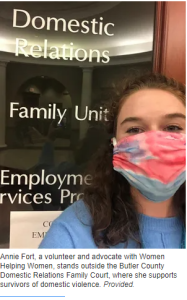
Terry DeMio, Anne Saker and Cameron Knight
An upswing of domestic violence was a feared consequence of the coronavirus pandemic. Now Hamilton County has evidence for it.
Women Helping Women, the southwest Ohio nonprofit that advocates and cares for victims of gender-based violence, reported Thursday it had registered a 23% increase in the number of clients from March 16 to June 30 compared to the same period a year ago.
The agency’s analysis also showed calls to its hotline jumped 53% this year over the same 14 weeks when compared to the 2019 time frame.
“COVID doesn’t cause gender-based violence. Economic stress doesn’t cause gender violence,” said Kristin Shrimplin, the agency’s president and chief executive officer. “It just adds fuel to the fire.”

In March, Shrimplin said, calls for help rose rapidly, about 20%. After the stay-at-home order was issued in mid-month, the calls dropped because, Shrimplin said, fewer domestic violence survivors could feel safe calling a hotline while at home full time with a perpetrator.
Lt. Col. Mike John of the Cincinnati Police Department works with Shrimplin on a dedicated unit that responds to domestic violence calls with police and WHW advocates. John said that even though police haven’t seen a jump in criminal reports, he is not surprised by the increase in hotline calls.
“It’s not like a simple assault at a bar,” he said. “We are very much dedicated to finding who that aggressor is and removing him from that situation. They (Women Helping Women advocates) are left to pick up the pieces.”
Women Helping Women provides that support, he said, no matter if the survivor decides to press charges.
Domestic incidents have been more violent
Shrimplin said she found another cause for alarm. More people calling the hotline had experienced brutal assaults that can be omens of fatal violence in intimate relationships.
“Strangulation, sexual assault, use of weapons, they were all up,” Shrimplin said.
Women Helping Women, like many such agencies in the United States, uses the Danger Assessment tool, a system of identifying particular domestic violence – non-fatal strangulation, for example – that can lead to femicide, the killing of a woman.
The dedicated group of WHW advocates and Cincinnati police working together is called Domestic Violence Enhanced Response Team, or DVERT. Advocates go on domestic violence calls with police to help survivors.
“What we were hearing on those calls, what we were seeing on scene with survivors, they were getting increased red flags to be killed compared to last year,” Shrimplin said.

New victims
The Women Helping Women report also found people who’d never before experienced physical violence at home now calling for help.
It’s an unsurprising development. The Substance Abuse and Mental Health Services Administration’s report on intimate-partner violence during the pandemic notes that loss of jobs, income in general, a disconnect of social services and help groups, a fear of getting COVID-19 and other issues now “may stimulate violence in families where it didn’t exist before and worsen situations in homes where mistreatment and violence has been a problem.”
The April shootings
In April, six female-identified victims were fatally shot in Hamilton County, compared to five for all of 2019. The Women Helping Women report said, “While COVID-19 was not cause of death, the impact on how society functioned greatly increased the harm and lethality of individuals who were already facing long standing system barriers to safety and resources.”
6 local women have been fatally shot during the stay-at-home order – more than all of 2019
Not all the homicides have been identified as domestic violence-related, police said.
But an Enquirer analysis of data from last year shows women killed in Cincinnati are more likely to be killed in partner violence or child abuse situations than any other reason.
Shrimplin said criminal reports will lag the number of calls to the agency’s hotline. “If people show up to hospitals and work with us, if we show up at different community points, if they call our hotline, that doesn’t mean that the survivors engage with the justice system.”
John of the Cincinnati police said of WHW, “That’s why their expertise is so important.”
How can victims get help
Women Helping Women has stepped up its services.
- In April, with no additional funding, the agency added text-ability to its hotline.
- Its volunteers bring masks, hand sanitizers and other personal protection products to the survivors it serves.
- When possible, the agency provides families gift cards for groceries or Lyft rides.
The state of Ohio is funneling new money to programs for domestic violence survivors.
- Attorney General Dave Yost announced $8.75 million from the federal CARES Act would go to support rape crisis centers and domestic violence shelters, in addition to $1 million to combat COVID-19 scams throughout the state.
- Gov. Mike DeWine also announced that 66 local victim service projects have been awarded a total of $3.2 million to support victims of crime. The projects will be funded by grants through the Family Violence Prevention & Services Act grants program.
If you are threatened or harmed or know someone who may be in danger, call or text the Women Helping Women hotline: 513-381-5610.
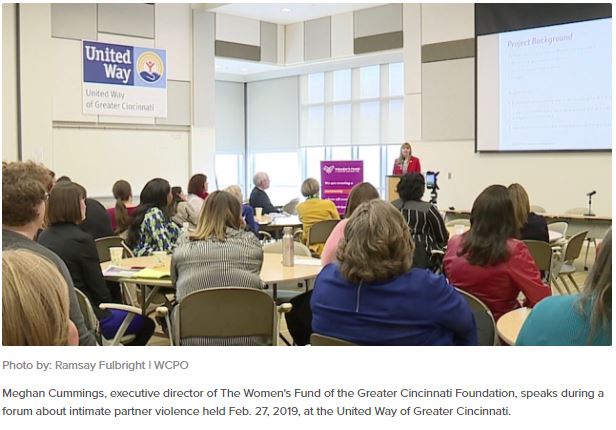
‘Biggest hidden problem we’ve ever encountered’
By: Lucy May
CINCINNATI — Although it’s been decades since Karen Bankston was married to him, her second husband’s cruelty is never far from the surface.
His abuse permeated her life, she said, at home, at church and even at work.
“On the job, when I got promoted, he accused me of sleeping with my supervisors,” said Bankston, an adjunct professor at the University of Cincinnati’s College of Nursing. “The emotional abuse is just as horrible as any physical abuse. It was never, ‘I’m proud of you.’ You really begin to question yourself.”
Bankston took the promotion and ended that marriage. She has been happily married to a different man for nearly three decades.
But her experience as a survivor of abuse is far from unique.
After a 2016 study found intimate partner violence interferes with the ability of local women to build better lives for themselves and their children, The Women’s Fund of the Greater Cincinnati Foundation wanted to help.
“We talk about all these challenges to women in the workplace, and this is like the biggest hidden problem we’ve ever encountered,” said Meghan Cummings, executive director of The Women’s Fund. “It’s the one that goes unnamed. It’s the one we just don’t talk about, and it’s so prevalent in a person’s ability to move up and into different careers.”
The Women’s Fund worked with a group of nonprofit organizations and businesses over the past 18 months to better understand how intimate partner violence interferes with working women’s ability to become self-sufficient.
Four survivors were at the center of the effort, helping the other participants understand their experiences and what could have helped them at work.
The goal was to increase understanding and empathy among employers when it comes to intimate partner violence. The group also developed recommendations for policies and procedures that businesses and nonprofit organizations can adopt to help employees who are struggling.
‘Calls we don’t want to get’
Nationally, one out of three women experience some form of physical violence at the hands of an intimate partner, according to the National Coalition Against Domestic Violence. Gender-based violence affects women across the region, said Kristin Shrimplin, CEO of Women Helping Women.
“What we know is survivors walk amongst us everywhere in this region,” she said. “So of course that means they’re in the workforce.”
Unfortunately, some companies react by ending a woman’s employment after they discover the problem, she said.
“It’s through the lens of liability or through the lens of other things that go on paper that are really through the lens of risk mitigation,” Shrimplin said. “They’re being held responsible for the violence.”
Having four survivors of intimate partner violence at the center of the latest effort was critically important, said Sarah Corlett, director of community development and strategy for Design Impact.
The Women’s Fund enlisted Design Impact to help guide the group’s work.
Corlett said everyone agreed it was important not to duplicate the efforts of other local organizations. Women Helping Women, for example, has a program called WorkStrong that helps corporations, governments and nonprofit organizations craft policies that help employees who are experiencing intimate partner violence.
Shrimplin said her agency developed that program after several employers contacted Women Helping Women because they had employees die as the result of domestic violence homicides.
“Those are the calls we don’t want to get anymore,” she said.
The recommendations that came out of the Design Impact work are more general, Cummings said.
One suggestion is to give all employees an explanation of the company’s policies related to intimate partner violence when they start, she said.
That way people who are struggling with the issue don’t get singled out.
Design Impact created what Cummings calls a “visual map” that companies could use to explain polices and what employees should expect if they make supervisors aware of the problem.

“Survivors share with us that employers often have the best intentions, but some of their interventions are not helpful at all,” Cumming said.
Hot spots
A male manager walking into a company parking lot to confront a violent husband, for example, could make things even worse for the employee the manager is trying to protect once that employee gets home, Shrimplin said.
The employers involved in the effort were open to what the survivors, especially, had to say, Corlett said.
“I was pleasantly surprised by the vulnerability and the willingness of employers in the room to stop and listen, admit where they were failing and where they could do better,” Corlett said.
One employer involved in the effort, for example, asked her home health care staff how many of them had experienced intimate partner violence. She was shocked to find that roughly 75 percent of her employees said they had, Cummings said.
“When we have low-wage jobs that are female-dominated at the lower socio-economic level, we think these are just real hot spots for this type of behavior,” she said.
That behavior ranges from intimidation or undermining efforts to get ahead all the way to physical violence.
Some survivors said their partners would turn off alarm clocks so they would be late for work or for job training, for example, while others said the physical abuse got worse as they got raises or promotions.
“I would hope that what the community is going to get now is action,” Shrimplin said.
That’s not to say employers can end intimate partner violence through office policies, she said, but employers must understand that there’s a business case for getting better at dealing with the problem.
“For corporate decision-makers, this is about bottom line,” she said, “and this is about productivity, and this is about retention and recruitment.”
Above all, Shrimplin said, employers must trust their employees to be the experts in what they need.
Those needs can be complicated when it comes to surviving an abusive relationship, Bankston added.
“Even when I got a divorce, and I intellectually felt it was the right thing to do, emotionally I felt like I had failed again,” Bankston said. “It’s just emotionally a horrible feeling on top of any smacks in the face or getting pushed down that you may also experience.”
More information about The Women’s Fund of the Greater Cincinnati Foundation is available online. Information about the Women Helping Women WorkStrong program is available online, too.
Lucy May writes about the people, places and issues that define our region – to celebrate what makes the Tri-State great and shine a spotlight on issues we need to address. To reach Lucy, email [email protected]. Follow her on Twitter @LucyMayCincy.
Copyright 2019 Scripps Media, Inc. All rights reserved. This material may not be published, broadcast, rewritten, or redistributed.
By Ann Thompson
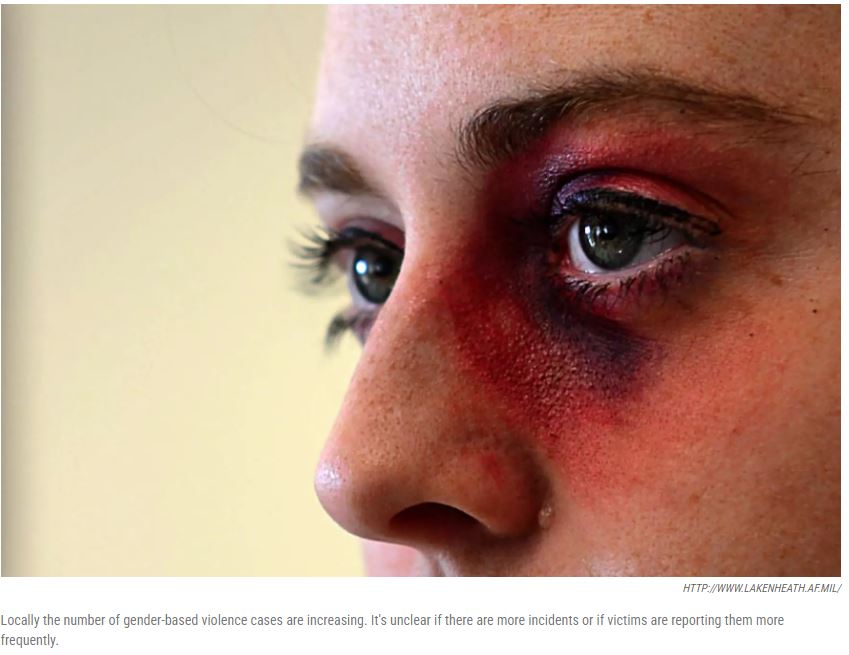
Citing a growing number of reported gender-based violence cases in Greater Cincinnati, Women Helping Women President and CEO Kristin Smith Shrimplin says there is a disturbing pattern with the way victims are treated.
Smith Shrimplin spoke Thursday at the organization’s annual Community Leader breakfast at The Westin Cincinnati. She says Women Helping Women is not a political agency, only commenting on policy and actions that negatively affect survivors.
Referencing the #MeToo movement she said, “The national narrative has changed in its belief of survivors and its treatment of survivors. Supporting survivors is not open for political debate.”
“We have had enough of the fundamental disrespect and disregard, the violation and victimization in our region and in the U.S. of survivors,” Smith Shrimplin told a crowd that broke into applause.
The Numbers Continue To Go Up
So far in 2018, Women Helping Women says it served 5,939 survivors compared to a total of 5,792 in 2017. Smith Shrimplin says this is the new normal. This year a new team of volunteers, DVERT, is helping as they respond to calls with police and take survivors and their children to safe places.
Assistant Cincinnati Police Chief Michael John also spoke Thursday, citing numbers for the last three years. He says in 2015 there were 1,700 reports of gender-based violence; 1,800 in 2016; and 1,943 in 2017. Nine people died in 2017.
Gender-based violence on college campuses also continues to be a problem. Women Helping Women increased its services there by 60 percent.
At the Thursday breakfast, the organization also called for businesses to take on a greater role in identifying possible victims by participating in the program WorkStrong.