
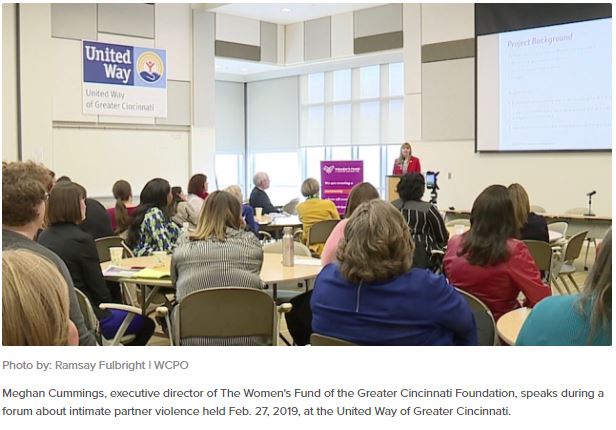
Meghan Cummings, executive director of The Women's Fund of the Greater Cincinnati Foundation, speaks during a forum about intimate partner violence
‘Biggest hidden problem we’ve ever encountered’
By: Lucy May
CINCINNATI — Although it’s been decades since Karen Bankston was married to him, her second husband’s cruelty is never far from the surface.
His abuse permeated her life, she said, at home, at church and even at work.
“On the job, when I got promoted, he accused me of sleeping with my supervisors,” said Bankston, an adjunct professor at the University of Cincinnati’s College of Nursing. “The emotional abuse is just as horrible as any physical abuse. It was never, ‘I’m proud of you.’ You really begin to question yourself.”
Bankston took the promotion and ended that marriage. She has been happily married to a different man for nearly three decades.
But her experience as a survivor of abuse is far from unique.
After a 2016 study found intimate partner violence interferes with the ability of local women to build better lives for themselves and their children, The Women’s Fund of the Greater Cincinnati Foundation wanted to help.
“We talk about all these challenges to women in the workplace, and this is like the biggest hidden problem we’ve ever encountered,” said Meghan Cummings, executive director of The Women’s Fund. “It’s the one that goes unnamed. It’s the one we just don’t talk about, and it’s so prevalent in a person’s ability to move up and into different careers.”
The Women’s Fund worked with a group of nonprofit organizations and businesses over the past 18 months to better understand how intimate partner violence interferes with working women’s ability to become self-sufficient.
Four survivors were at the center of the effort, helping the other participants understand their experiences and what could have helped them at work.
The goal was to increase understanding and empathy among employers when it comes to intimate partner violence. The group also developed recommendations for policies and procedures that businesses and nonprofit organizations can adopt to help employees who are struggling.
‘Calls we don’t want to get’
Nationally, one out of three women experience some form of physical violence at the hands of an intimate partner, according to the National Coalition Against Domestic Violence. Gender-based violence affects women across the region, said Kristin Shrimplin, CEO of Women Helping Women.
“What we know is survivors walk amongst us everywhere in this region,” she said. “So of course that means they’re in the workforce.”
Unfortunately, some companies react by ending a woman’s employment after they discover the problem, she said.
“It’s through the lens of liability or through the lens of other things that go on paper that are really through the lens of risk mitigation,” Shrimplin said. “They’re being held responsible for the violence.”
Having four survivors of intimate partner violence at the center of the latest effort was critically important, said Sarah Corlett, director of community development and strategy for Design Impact.
The Women’s Fund enlisted Design Impact to help guide the group’s work.
Corlett said everyone agreed it was important not to duplicate the efforts of other local organizations. Women Helping Women, for example, has a program called WorkStrong that helps corporations, governments and nonprofit organizations craft policies that help employees who are experiencing intimate partner violence.
Shrimplin said her agency developed that program after several employers contacted Women Helping Women because they had employees die as the result of domestic violence homicides.
“Those are the calls we don’t want to get anymore,” she said.
The recommendations that came out of the Design Impact work are more general, Cummings said.
One suggestion is to give all employees an explanation of the company’s policies related to intimate partner violence when they start, she said.
That way people who are struggling with the issue don’t get singled out.
Design Impact created what Cummings calls a “visual map” that companies could use to explain polices and what employees should expect if they make supervisors aware of the problem.
Meghan Cummings, at podium, speaks at a Feb. 27 forum on intimate partner violence.
“Survivors share with us that employers often have the best intentions, but some of their interventions are not helpful at all,” Cumming said.
Hot spots
A male manager walking into a company parking lot to confront a violent husband, for example, could make things even worse for the employee the manager is trying to protect once that employee gets home, Shrimplin said.
The employers involved in the effort were open to what the survivors, especially, had to say, Corlett said.
“I was pleasantly surprised by the vulnerability and the willingness of employers in the room to stop and listen, admit where they were failing and where they could do better,” Corlett said.
One employer involved in the effort, for example, asked her home health care staff how many of them had experienced intimate partner violence. She was shocked to find that roughly 75 percent of her employees said they had, Cummings said.
“When we have low-wage jobs that are female-dominated at the lower socio-economic level, we think these are just real hot spots for this type of behavior,” she said.
That behavior ranges from intimidation or undermining efforts to get ahead all the way to physical violence.
Some survivors said their partners would turn off alarm clocks so they would be late for work or for job training, for example, while others said the physical abuse got worse as they got raises or promotions.
“I would hope that what the community is going to get now is action,” Shrimplin said.
That’s not to say employers can end intimate partner violence through office policies, she said, but employers must understand that there’s a business case for getting better at dealing with the problem.
“For corporate decision-makers, this is about bottom line,” she said, “and this is about productivity, and this is about retention and recruitment.”
Above all, Shrimplin said, employers must trust their employees to be the experts in what they need.
Those needs can be complicated when it comes to surviving an abusive relationship, Bankston added.
“Even when I got a divorce, and I intellectually felt it was the right thing to do, emotionally I felt like I had failed again,” Bankston said. “It’s just emotionally a horrible feeling on top of any smacks in the face or getting pushed down that you may also experience.”
More information about The Women’s Fund of the Greater Cincinnati Foundation  is available online. Information about the Women Helping Women WorkStrong program  is available online, too.
Lucy May writes about the people, places and issues that define our region – to celebrate what makes the Tri-State great and shine a spotlight on issues we need to address. To reach Lucy, email [email protected]. Follow her on Twitter @LucyMayCincy.
Copyright 2019 Scripps Media, Inc. All rights reserved. This material may not be published, broadcast, rewritten, or redistributed.
Women Helping Women's school and community educator, created this placemant with the help of Hali Nacdimen, an industrial designer with downtown-based Kaleidoscope

‘We have to really give men a voice’

Em Joy, Women Helping Women’s school and community educator, created this placement with the help of Hali Nacdimen, an industrial designer with downtown-based Kaleidoscope, as part of the Studio C program.

Lucy MayBy: Lucy May

CINCINNATI — A local nonprofit organization is hoping a carefully designed placemat in the right Greater Cincinnati restaurants could help put a stop to violence against women and girls.

The placemat is covered in “conversation starters” to encourage mealtime conversations between dads and sons, uncles and nephews or other pairs of men and boys. The goal is to get them talking about their own emotional needs and how to respect women.

The idea was born out of Women Helping Women‘s participation in Studio C, a 12-week initiative funded by United Way of Greater Cincinnati that helps nonprofit organizations find new, creative solutions to especially difficult problems.

Before you dismiss the placemat strategy, consider this: Kristin Smith Shrimplin, the CEO of Women Helping Women, has seen it work.

She took her two nephews — ages 12 and 9 — to dinner at LaRosa’s earlier this summer. As they were drawing pictures on a piece of butcher paper that the restaurant provided, she started using some of the conversation starters she knew were on the placemat prototype.

“My nephews are obstinate. They think ‘auntie’ is too emotional,” she said. “But I’m not kidding. We talked about — in appropriate language — what consent means. What inappropriate touching means and if that ever happens, what they’re to do. We talked about how the 12-year-old hasn’t had his first kiss yet, what that’s like and how you have to ask. We talked about gun violence and if there’s a gun in a friend’s home, what they’re to do. We talked about cigarettes, drugs and alcohol.”

Shrimplin talked with her nephews about important things in a non-threatening way, all while sharing a meal and drawing on paper.

“They talked about it, they handled it, they were really leaning into the conversation,” she said. “That just told me, if we could really roll out this concept, there could be some really neat organic things that happen in those moments.”

Hali Nacdimen, an industrial designer with downtown-based Kaleidoscope, sent initial designs for the placemat for Women Helping Women after spending more than an hour with Shrimplin and her staff to understand their mission and what they had learned about empowering men to help end gender-based violence. Em Joy, the nonprofit’s school and community educator, created the prototype.

Women Helping Women’s goal is to partner with an iconic Cincinnati restaurant chain — such as Skyline, LaRosa’s or Frisch’s — to get the placemats on tables across the region, Shrimplin said.

Giving Men A Voice

The placemat idea was one of several that came out of the Eureka moment that Shrimplin and her staff had during their Studio C experience.

During the 12-week program, facilitators from Design Impact  helped Women Helping Women and the other participating nonprofit organizations determine what “wicked problem” each was trying to solve and then helped them boil it down to its most simple form.

“Our wicked problem was we wanted to end gender-based violence by men being the leaders in the movement to address it,” Shrimplin said. “It’s not about men just being engaged. It’s really about men being empowered.”

For years, Women Helping Women knew that involving men was an important part of ending domestic violence, sexual assault and stalking. But the Studio C process helped the organization expand its thinking about how to approach men and help them get involved.

“Studio C helped us realize we have to really give men a voice,” said Caitlin Burke, Women Helping Women’s prevention coordinator. “We were assuming they had a voice and weren’t using it for this issue.”

The program’s design thinking approach encouraged the organization to question its assumptions about men and to interview men to find out what they really thought about Women Helping Women’s work and mission.

“What I started to realize is men haven’t been really given the opportunity — starting back in boyhood — to talk about their vulnerability in a safe way,” Shrimplin said. “How, by the time they’re 18 or 20 years old, can we expect them to speak out against violence against women and girls when they couldn’t even speak out about their own emotional needs?”

That realization pushed Shrimplin and her staff to find more ways to invest in men, she said.

“We thought maybe what we need to do is invest in men and invest in their vulnerability and investing in creating a space where it is safe for them to be vulnerable,” she said.

The goal is to help men see strength in their vulnerability, not weakness.

“When they feel strong in doing that, they can then speak out,” she said.

It might sound counterintuitive for Women Helping Women to start focusing on men, but that kind of solution isn’t unusual for Studio C.

Challenging Assumptions

The program uses design thinking, a strategy that is common in the business world but less common among nonprofits, said Tamaya Dennard, a social and civic innovation specialist with Design Impact.

“A lot of times it’s really similar to the concepts of creative problem-solving,” said Ramsay Ford, a co-founder of Studio C. “You start with really focusing on who is going to be using a product or service, who is the community that’s involved in this solution or this program and getting a deep understanding of who they are, what their motivations are and how they’re involved.”

This is the third year that United Way has been funding Studio C, and it’s not uncommon for the process to challenge the assumptions of the nonprofit organizations that participate, said Mike Baker, director of community impact for United Way of Greater Cincinnati.

The first year of the Studio C program, for example, the Housing Authority of Covington and Northern Kentucky Head Start partnered to try to find a way to get more kids from the City Heights housing complex enrolled in preschool.

Leaders of both organizations believed that parents weren’t enrolling their kids because they didn’t have good transportation from City Heights to the locations where Head Start classes were held.

Studio C challenged them to talk with parents to find out if the problem really was transportation, Baker said.

“They talked to 10 to 15 families. And all of them said transportation was an issue, but it wasn’t the top issue,” he said. “Most often the top issue was ‘my kid is too little to go to school’ or ‘they’re going to learn everything they need to know in kindergarten.'”

The Housing Authority of Covington and Northern Kentucky Head Start realized they needed to educate parents about what good preschool was — that it wouldn’t require their squirmy toddlers to sit still at a desk all day.

After they helped parents understand that the two organizations tripled enrollment in Head Start in just a month’s time.

“That’s the success for us,” Baker said. “If we can drive more of that planning — moving past what we all think we know about the people we’re trying to help and more diving in and really developing solutions that are much more tangible to the real issue.”

For Women Helping Women, the 12-week program made a huge difference, Shrimplin said. Now it’s just a matter of getting those placemats in local restaurants.

For more information about Women Helping Women, click here.

For more information about Studio C, click here. Studio C is accepting applications through Aug. 11 for its next session. Meetings for that session will start Sept. 1. To apply, click here.

Lucy May writes about the people, places and issues that define our region – to celebrate what makes the Tri-State great and also shine a spotlight on issues we need to address. Childhood poverty is an important focus for her and for WCPO. To read more stories about childhood poverty, to go www.wcpo.com/poverty.

To read more stories by Lucy, go to www.wcpo.com/may. To reach her, email [email protected]. Follow her on Twitter @LucyMayCincy.